It is given that  and that
  when
when  . Find
  in terms of
  .
.
Roughwork.

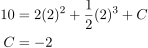
In conclusion,
 .
.

物理子衿
It is given that and that when . Find in terms of .
Roughwork.
In conclusion,
.
In the figure below, the complex numbers  ,
,  ,
,  ,
,  , and
, and  are represented in the Argand diagram by the vertices of a regular pentagon with centre at the origin
  . If
. If  , write in polar form and calculate the value of
  .
.

Recall.
A complex number  in Cartesian form
  can also be expressed in the polar form

where  is called the modulus
  , and
, and  the argument
  , of .
Roughwork.
Observe that
 .
.
and
 .
.
Hence
 .
.
The remaining are left the reader as an exercise.
Prove, by mathematical induction, that  is divisible by
  .
.
Roughwork.
Let proposition  be that
 .
.
First, note
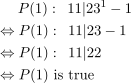
that is true for  .
.
Next, assumed be to true.

Thus, is true implies  true.
true.
From  follows the proposition is true for all positive integers
  . By the principle of mathematical induction proven is that divides .
Differentiate  with respect to .
Roughwork.
![\begin{aligned} & \quad\, \frac{\mathrm{d}}{\mathrm{d}x}\Big( 2(3-4x)^{\frac{5}{6}}\Big) \\ & = 2\bigg( \frac{5}{6}\bigg) (3-4x)^{\frac{5}{6}-1}(-4) \\ & = -\frac{20}{3}(3-4x)^{-\frac{1}{6}} \\ & = -\frac{20}{3\sqrt[6]{3-4x}} \\ \end{aligned}](https://physicspupil.com/wp-content/ql-cache/quicklatex.com-9959d52c8c9ee233e4e8e0a2da6a607b_l3.svg "Rendered by QuickLaTeX.com")
Find the -coordinate of the point on the curve  where the tangent is horizontal.
Roughwork.
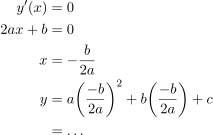
The gradient  of the curve
  is
is
 .
.
When the tangent is horizontal,
Calculate the gradient of the curve  at the point
  .
.
Roughwork.
Let the function  of variables and be

Then,
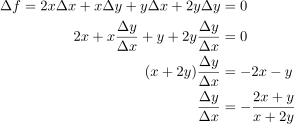
The gradient  at point
  is
is
 .
.
Calculate the gradient of the curve  at the point
  .
.
Roughwork.
Differentiating  wrt to and taking reciprocal,

the gradient  at point
  is
is
 .
.
Find the area bounded by the curve  and the straight line
  .
.
Roughwork.
Rewriting,

Solving,


Now that the points of intersection are  and
and  , plot a graph below.

By either definite integral,

The upper integral is easier solvable than the lower one. Exercise.
Prove that
 .
.
Hence solve the equation

for  .
.
Roughwork.

The missing steps are left the reader.
Show that the straight line  touches the curve
  .
.
Roughwork.
If there exists some point  of intersection of the straight line and the curve, we have

Substituting  for
for  in the second equation, we have


Such point as  exists.
 The intersection of
  is non-empty.
 The straight line touches the curve.