A rocket fully loaded with fuel has total mass  including mass
  of fuel. The rocket is fired vertically upwards at
  . During its journey, the fuel is allowed to burn at a constant rate
  such that the relative backward velocity of the exhaust gases is
  .
.
(a) If  is the mass of the rocket plus fuel and
  its velocity at time
  , show that, if air resistance is neglected, the equation of motion is
 .
.
(b) Show that, the speed of the rocket at time  is given by
 .
.
(c) The height  which is reached by the rocket at the instant when the fuel is all burnt depends on the rate of burning . Determine the rate of burning
  such that the height reached will be maximal. (Hint: For the stationary value to be maximal, first show that

at  )
)
Roughwork.
(a) Jot  . Take
  . By Newton’s 2nd law,

(b)

and the result follows.
(c) From
![\begin{aligned} v(t) & = -gt-u\ln \bigg( 1-\frac{b}{M}t\bigg) \\ H(t) & =\int_0^t v(t')\,\mathrm{d}t' \\ & = \int_0^t \bigg[ -gt'-u\ln \bigg( 1-\frac{b}{M}t'\bigg) \bigg]\,\mathrm{d}t' \\ & = -\frac{g}{2}t'^2\bigg|_0^t +\frac{uM}{b}\int_{t'=0}^{t'=t} \ln T\,\mathrm{d}T \\ \dots\enspace & \textrm{as }\int \ln x\,\mathrm{d}x=x\ln x-x+C\enspace \dots \\ \end{aligned}](https://physicspupil.com/wp-content/ql-cache/quicklatex.com-e45aa5ccd805e16aca30c5f9fea6435c_l3.svg "Rendered by QuickLaTeX.com")
This problem is not to be attempted.

 to the parabola
  .
.
 and
and  be two points at which the two tangents touches the parabola. Then,


 .
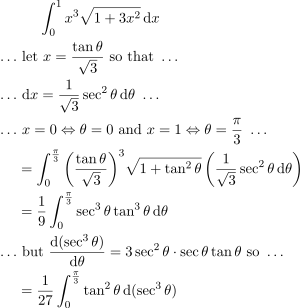
.
![\begin{aligned} & \quad\enspace \int_{0}^{1}x^3\sqrt{1+3x^2}\,\mathrm{d}x \\ \dots &\textrm{ let }u=1+3x^2\textrm{ then }\mathrm{d}x=\frac{\mathrm{d}u}{6x}\textrm{ }\dots \\ \dots &\textrm{ then }x=0\Leftrightarrow u=1\textrm{ and }x=1\Leftrightarrow u=4\textrm{ }\dots \\ & = \int_{1}^{4}x^3\sqrt{u}\,\bigg(\frac{\mathrm{d}u}{6x}\bigg) \\ & = \frac{1}{6}\int_{1}^{4}\bigg(\frac{u-1}{3}\bigg)\sqrt{u}\,\mathrm{d}u \\ & = \frac{1}{18}\int_{1}^{4}\big( u^{\frac{3}{2}}-u^{\frac{1}{2}}\big)\,\mathrm{d}u \\ & = \frac{1}{18}\bigg[ \frac{2u^{\frac{5}{2}}}{5}-\frac{2u^{\frac{3}{2}}}{3}\bigg]\bigg|_{1}^{4} \\ & = \cdots \\ \end{aligned}](https://physicspupil.com/wp-content/ql-cache/quicklatex.com-2de73630bc9aa34328c9f2a302349c59_l3.svg "Rendered by QuickLaTeX.com")
 is in the form of the parabola given by the equation

 is
is  . Find the coordinate of
 .
. on the curve
 .
.


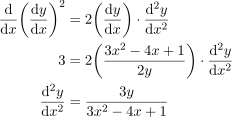

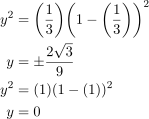


 for the author.
 if
if .
.
 . By what approximate amount does the volume increases, if the diameter is increased by a very small amount
  ?
?

 is the number of sick people;
  and
and  are constants.
 and
and  .
. ,
,  , and
, and  in terms of the given constants
  ?
?


 million in
  and it increases by
  each year, what will be the estimated population in
  ? Give your answer correct to
 and
and  of radii
  ) and weights
  and
and  respectively rest in equilibrium inside the cylinder as shown in the diagram. Suppose that the internal and external radii of the cylinder are
  respectively, where
  .
.
 , identical to