The complex number  satisfies the condition
 .
.
If  , where
  and
and  are real, find and simplify the relation between and . Find also the values of and for which
  is a minimum.
Roughwork.

Substituting  for ,
for ,

Ans. 

物理子衿
The complex number satisfies the condition
.
If , where and are real, find and simplify the relation between and . Find also the values of and for which is a minimum.
Roughwork.
Substituting for ,
Ans.
Find 
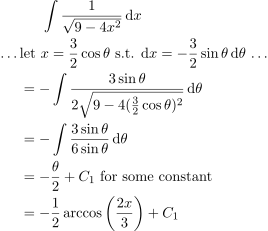
i. by using the substitution  ;
;
ii. by using the substitution  .
.
Explain why you appear to get two different answers.
Roughwork.
i.
ii.
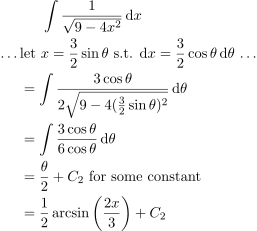
Let’s see if

or, to be rephrased, whether
![\displaystyle{\frac{\mathrm{d}}{\mathrm{d}x}\bigg[\arcsin \bigg(\frac{2x}{3}\bigg) + \arccos\bigg(\frac{2x}{3}\bigg) \bigg]\stackrel{\textrm{?}}{\equiv} 0}](https://physicspupil.com/wp-content/ql-cache/quicklatex.com-5a1120df7fabec43a4f4fd938f43801d_l3.svg "Rendered by QuickLaTeX.com")
This is left an exercise for the reader.
 is a curve with equation
  .
.
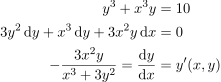
(a) Find  .
.
(b) Find the equation of the tangent to the curve at the point  .
.
Roughwork.


This problem is not to be attempted.
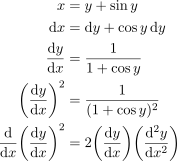
Let  . Find and
  in terms of .
Roughwork.


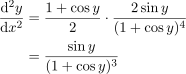
Stretching the focus, compromise the better for it.
 where
where  ,
,  , and are constants. Find the values of , , and , given that
  is a factor of
  and that the remainders when is divided by
  and
and  are
are  and
and  respectively.
Roughwork.
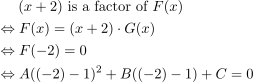


This problem is not to be attempted.
Two lines  and
and  intersect at a point . Find the equations of the two lines passing through whose distances from the origin are equal to
  .
.
Roughwork.
Solving for  point of intersection:

we have it  .
.
Let the equations of the two lines be

Despite the formula

Wikipedia on Distance from a point to a line
let’s rely on first principles. So draw a picture.

And the rest is left an exercise for the reader.
Find the equation of the two lines which are both parallel to the line

and tangent to the ellipse
 .
.
Roughwork.
The slope of the line is

and the gradient of the ellipse

Plugging

into

so are the points of contact

From

follow the equations

as requested.
This problem is not to be attempted.
A family of straight lines is given by the equation
 ,
,
where  is real.
(a) Find the equation of a line  in the family whose -intercept is
  .
.
(b) Find the equation of a line  in the family which is parallel to the -axis.
(c) Find the acute angle between and .
Roughwork.
(a)
Substituting  for the -intercept:

(b)
Differentiating on both hand sides,

(c)  .
.
This problem is not to be attempted.
 and
and  are real numbers such that
 .
.
Find the values of and . Hence write down the two square roots of  .
.
Roughwork.
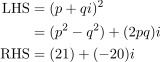


 .
.
A rod  of length
  units slides with
  on the -axis and
  on the -axis.
  is the point on such that
  . Find the equation of the locus of .
Roughwork.
Let  and
and  where
where ![a,b\in [0,4]](https://physicspupil.com/wp-content/ql-cache/quicklatex.com-7cc3b41554991833802f5ebd52f2912e_l3.svg "Rendered by QuickLaTeX.com") and
and  . The locus of
  is
is
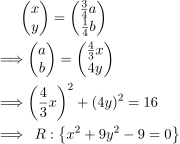
This problem is not to be attempted.