202207051339 Solution to 1974-CE-AMATH-I-XX

(a) In the figure below, ABCDEF is a regular hexagon. Which one of the 6 vectors \overrightarrow{AD}, \overrightarrow{DA}, \overrightarrow{FC}, \overrightarrow{CF}, \overrightarrow{EB}, \overrightarrow{BE} is equal to \overrightarrow{AB}+\overrightarrow{BC}+\overrightarrow{DC}?

(b) \mathbf{u} and \mathbf{v} are unit vectors making an angle 60^\circ with each other as shown in the figure below. AB is a vector making an angle 30^\circ with \mathbf{u} and |\overrightarrow{AB}|=2. Express \overrightarrow{AB} in terms of \mathbf{u} and \mathbf{v}.

(c) In the figure below, \angle B=90^\circ and m(\overrightarrow{AB})=10. Calculate \overrightarrow{AB}\cdot\overrightarrow{AC}.


(a)

\begin{aligned} \mathbf{AD} & = -\mathbf{DA} \\ |\mathbf{AD}| & = |\mathbf{DA}| \\ \mathbf{FC} & = -\mathbf{CF} \\ |\mathbf{FC}| & = |\mathbf{CF}| \\ \mathbf{EB} & = -\mathbf{BE} \\ |\mathbf{EB}| & = |\mathbf{BE}| \\ \end{aligned}

Ans. \mathbf{FC} \textrm{\scriptsize{OR}} \overrightarrow{FC} by inspection.

Working.

\begin{aligned} &\quad \mathbf{AB} + \mathbf{BC} + \mathbf{DC} \\ & = (\mathbf{AB} + \mathbf{BC}) + \mathbf{DC} \\ & = \mathbf{AC} + \mathbf{DC} \\ \dots & \textrm{ as }\mathbf{AC}=\mathbf{FD} \enspace\dots \\ & = \mathbf{FD} + \mathbf{DC} \\ & = \mathbf{FC} \\ \end{aligned}


(b)

Write, in Cartesian components of unit vectors \hat{\mathbf{i}} and \hat{\mathbf{j}}, the following:

\begin{aligned} \mathbf{AB} & = |\mathbf{AB}|\cos 30^\circ\,\hat{\mathbf{i}} + |\mathbf{AB}|\sin 30^\circ\,\hat{\mathbf{j}} \\ & = 2\cos 30^\circ\,\hat{\mathbf{i}} + 2\sin 30^\circ\,\hat{\mathbf{j}} \\ & = \sqrt{3}\,\hat{\mathbf{i}} + 1\,\hat{\mathbf{j}} \\ \end{aligned}

and similarly,

\begin{aligned} \mathbf{u} & = |\mathbf{u}|\,\hat{\mathbf{i}} \\ \mathbf{v} & = |\mathbf{v}|\cos 60^\circ\,\hat{\mathbf{i}} + |\mathbf{v}|\sin 60^\circ\,\hat{\mathbf{j}}\\ & \\ \because\enspace & \mathbf{u}, \mathbf{v}\textrm{ are unit vectors} \\ \therefore\enspace & |\mathbf{u}|=|\mathbf{v}|=1 \\ & \\ \mathbf{u} & = \hat{\mathbf{i}} \\ \mathbf{v} & = \frac{1}{2}\,\hat{\mathbf{i}} + \frac{\sqrt{3}}{2} \hat{\mathbf{j}} \\ \end{aligned}

\begin{aligned} \begin{bmatrix} \mathbf{u} \\ \mathbf{v} \end{bmatrix} & = \begin{bmatrix} 1 & 0 \\ \frac{1}{2} & \frac{\sqrt{3}}{2} \end{bmatrix} \begin{bmatrix} \hat{\mathbf{i}} \\ \hat{\mathbf{j}} \end{bmatrix} \\ \begin{bmatrix} \hat{\mathbf{i}} \\ \hat{\mathbf{j}} \end{bmatrix} & = \begin{bmatrix} 1 & 0 \\ \frac{1}{2} & \frac{\sqrt{3}}{2} \end{bmatrix}^{-1}\begin{bmatrix} \mathbf{u} \\ \mathbf{v} \end{bmatrix} \\ \end{aligned}

Lemma. (Inversion of 2-by-2 matrices)

For 2\times 2 matrices, inversion can be done as follows:

\begin{aligned} \mathbf{A}^{-1} & = \begin{bmatrix} a & b \\ c & d \end{bmatrix}^{-1} \\ & = \frac{1}{\mathrm{det}\mathbf{A}}\begin{bmatrix} d & -b \\ -c & a \end{bmatrix} \\ & = \frac{1}{ad-bc}\begin{bmatrix} d & -b \\ -c & a \end{bmatrix} \\ \end{aligned}

Wikipedia on Invertible matrix

Then,

\begin{bmatrix} 1 & 0 \\ \frac{1}{2} & \frac{\sqrt{3}}{2}\end{bmatrix}^{-1} = \begin{bmatrix} 1 & 0 \\ -\frac{1}{\sqrt{3}} & \frac{2}{\sqrt{3}} \end{bmatrix}

so that

\begin{bmatrix} \hat{\mathbf{i}} \\ \hat{\mathbf{j}} \end{bmatrix} = \begin{bmatrix} 1 & 0 \\ -\frac{1}{\sqrt{3}} & \frac{2}{\sqrt{3}} \end{bmatrix}\begin{bmatrix}\mathbf{u} \\ \mathbf{v}\end{bmatrix}

Thus

\begin{aligned} \mathbf{AB} & =\begin{pmatrix} \sqrt{3} & 1\end{pmatrix}\begin{bmatrix}\hat{\mathbf{i}} \\ \hat{\mathbf{j}} \end{bmatrix} \\ & = \begin{pmatrix} \sqrt{3} & 1\end{pmatrix} \begin{bmatrix} 1 & 0 \\ -\frac{1}{\sqrt{3}} & \frac{2}{\sqrt{3}} \end{bmatrix} \begin{bmatrix}\mathbf{u} \\ \mathbf{v}\end{bmatrix} \\ & = \begin{bmatrix} \frac{2}{\sqrt{3}} & \frac{2}{\sqrt{3}} \end{bmatrix}\begin{bmatrix}\mathbf{u} \\ \mathbf{v}\end{bmatrix} \\ &=\frac{2}{\sqrt{3}}\,\mathbf{u}+\frac{2}{\sqrt{3}}\,\mathbf{v} \\ \end{aligned}

There might be some mistake if conceptually.


(c)

I don’t know how. Skip it.

202203061208 Solution to 1973-CE-AMATH-I-XX

A circle passes through the points (-1,-1), (3,3), and (7,-1). Find the equation of this circle.


Solution.

Let the centre of this circle be located at point (a,b) and its radius be R long. The equation of this circle is thus in the form

(x-a)^2+(y-b)^2=R^2,

where a, b, and R are three unknowns to be obtained in the following three equations:

\begin{aligned} (-1-a)^2+(-1-b)^2 & = R^2 \\ (3-a)^2+(3-b)^2 & = R^2 \\ (7-a)^2+(-1-b)^2 & = R^2 \\ \end{aligned}

\begin{aligned} (a^2+2a+1) + (b^2+2b+1) & = R^2 \\ (a^2-6a+9) + (b^2-6b+9) & = R^2 \\ (a^2-14a+49) + (b^2+2b+1) & = R^2 \\ \end{aligned}

\begin{aligned} a & = 3 \\ b & = -1 \\ R & = 4 \\ \end{aligned}

\therefore The equation of this circle is

(x-3)^2+(y+1)^2=16.

202112021444 Solution to 1979-CE-AMATH-I-1

Let \displaystyle{y=x+\frac{1}{x^2}}. Find \displaystyle{\frac{\mathrm{d}y}{\mathrm{d}x}} from first principles.


Solution.

From first principles,

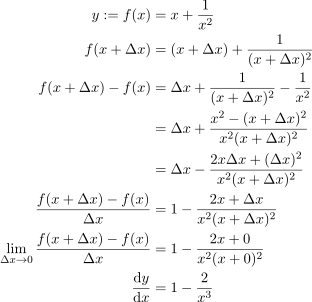
\begin{aligned} y:=f(x) & =x+\frac{1}{x^2} \\ f(x+\Delta x) & =(x+\Delta x) + \frac{1}{(x+\Delta x)^2} \\ f(x+\Delta x)-f(x) & = \Delta x + \frac{1}{(x+\Delta x)^2} - \frac{1}{x^2} \\ & = \Delta x + \frac{x^2-(x+\Delta x)^2}{x^2(x+\Delta x)^2} \\ & = \Delta x - \frac{2x\Delta x+(\Delta x)^2}{x^2(x+\Delta x)^2} \\ \frac{f(x+\Delta x)-f(x)}{\Delta x} & = 1 - \frac{2x + \Delta x}{x^2(x+\Delta x)^2} \\ \lim_{\Delta x\to 0}\frac{f(x+\Delta x)-f(x)}{\Delta x} & = 1 - \frac{2x + 0}{x^2(x+0)^2} \\ \frac{\mathrm{d}y}{\mathrm{d}x} & = 1 - \frac{2}{x^3} \\ \end{aligned}


Playground.

To make fun of calculus, do let

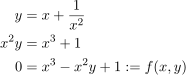
\begin{aligned} y & =x+\frac{1}{x^2} \\ x^2y & =x^3+1 \\ 0 & = x^3-x^2y+1 := f(x,y) \\ \end{aligned}

where f(x,y) is a degree 3 polynomial in two variables x and y.

The set of solutions to f(x,y)=0 is

\begin{cases} \enspace x \neq 0 \\ \enspace  y = \frac{x^3+1}{x^2} \end{cases}

Computing \partial_xf and \partial_yf as follow:

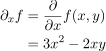
\begin{aligned} \partial_xf & = \frac{\partial}{\partial x}f(x,y) \\ & = 3x^2-2xy \\ \end{aligned}

and

\begin{aligned} \partial_yf & = \frac{\partial}{\partial y}f(x,y) \\ & = -x^2 \\ \end{aligned},

we oversee the relation

\mathrm{d}f = (\partial_xf)(\Delta x)+(\partial_yf)(\Delta y).


Definition. (Singularity and Smoothness)

A point p=(a,b) on a curve \mathcal{C}=\{ (x,y)\in\mathbb{C}^2:f(x,y)=0\} is said to be singular if

\begin{aligned} \frac{\partial f}{\partial x}(a,b) & = 0 \\ \frac{\partial f}{\partial y}(a,b) & = 0 \\ \end{aligned}.

A point that is not singular is called smooth. If there is at least one singular point on \mathcal{C}, then curve \mathcal{C} is called a singular curve. If there are no singular points on \mathcal{C}, the curve \mathcal{C} is called a smooth curve.

C.f. Definition 1.9.1, T. Carrity, et al., Algebraic Geometry: A Problem Solving Approach


That said, in our scenario

f(x,y)=x^3-x^2y+1,

the set of candidates for singularity

\{ (a,b)\in\mathbb{C}^2\enspace \mathrm{s.t.}\enspace f(a,b)=0\textrm{ and }\partial_xf(a,b)=\partial_yf(a,b)=0\}.

is empty.

\therefore The curve \mathcal{C}=\{ (x,y)\in\mathbb{C}^2:x^3-x^2y+1=0\} is smooth, thus everywhere differentiable.


Wait, the function in question should be the curve

F(x)=\displaystyle{x+\frac{1}{x^2}};

still, for better or worse, F(x) is \textrm{\scriptsize{NOT}} a differentiable function because the derivative does \textrm{\scriptsize{NOT}} exist at x=0, for that point is a discontinuity.

202111241152 Solution to 1971-CE-AMATH-3

Prove by mathematical induction that n(n^2+2) is divisible by 3 for all positive integral values of n.


Solution.

Let P(n) be the statement that

P(n):\enspace n(n^2+2)\textrm{ is divisible by }3\textrm{ for }n\in\mathbb{Z}^{+}

First, we wish to show P(1) holds true.

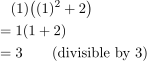
\begin{aligned} &\quad (1)\big( (1)^2 + 2\big) \\ & = 1(1+2) \\ & = 3\qquad (\textrm{divisible by }3)\\ \end{aligned}

\therefore P(1) is true.

Once we assume that P(n) is true for some positive integral values, we wish to show P(n+1) is true.

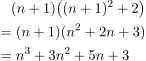
\begin{aligned} &\quad (n+1)\big( (n+1)^2 + 2\big) \\ & = (n+1)(n^2+2n+3) \\ & = n^3 + 3n^2 + 5n +3 \\ \end{aligned}

Let f(x)=x^3+3x^2+5x+3.

Suppose we can divide f(x) by 3, i.e.,

f(x)=3\cdot g(x)

for some g(x)=Ax^3+Bx^2+Cx+D where A,B,C,D\in\mathbb{R}.

Then, let’s see

\begin{aligned} \frac{f(x)}{g(x)} & = 3 \\ \frac{\mathrm{d}}{\mathrm{d}x}\bigg( \frac{f(x)}{g(x)}\bigg) & = \frac{\mathrm{d}}{\mathrm{d}x}(3) \\ \frac{g(x)f'(x)-f(x)g'(x)}{[g(x)]^2} & = 0 \\ g(x)f'(x)-f(x)g'(x) & = 0 \\ \end{aligned}

Plugging in f(x), f'(x), g(x), and g'(x), we have

\begin{aligned} &\quad (Ax^3+Bx^2+Cx+D)(3x^2+6x+5) \\ & = (x^3+3x^2+5x+3)(3Ax^2+2Bx+C) \\ \end{aligned}

\begin{aligned} &\quad \enspace \textrm{LHS} \\ & = (3A)x^5 + (6A+3B)x^4 + (5A+6B+3C)x^3 \\ &\qquad\quad + (5B+6C+3D)x^2 + (5C+6D)x + (5D) \\ \end{aligned}

\begin{aligned} &\quad \enspace \textrm{RHS} \\ & = (3A)x^5 + (9A+2B)x^4 + (15A+6B+C)x^3 \\ &\qquad\quad + (9A+10B+3C)x^2 + (6B+5C)x + (3C) \\ \end{aligned}

We have a set of five equations below:

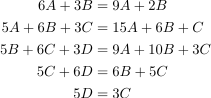
\begin{aligned} 6A + 3B & = 9A + 2B \\ 5A+6B+3C & = 15A+6B+C \\ 5B+6C+3D & = 9A+10B+3C \\ 5C +6D & = 6B+5C \\ 5D & = 3C \\ \end{aligned}

which can be summarized to

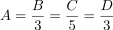
\displaystyle{A=\frac{B}{3}=\frac{C}{5}=\frac{D}{3}},

that is equivalent to saying

g(x)=\displaystyle{\frac{f(x)}{3}=\frac{x^3}{3}+x^2+\frac{5x}{3}+1},

viz. I have been wasting time over a circular reasoning of no use.

I should have tried to attest otherwise that g(x) is of some positive integral values, even though this is \textrm{\scriptsize{NOT}} proving the statement P(n) by mathematical induction firsthand.


Reformulation.

To show that the following statement Q(x) holds true:

Q(x):\quad \displaystyle{\frac{x^3}{3}+x^2+\frac{5x}{3}+1}\textrm{ is an integer for any }x\in\mathbb{Z}^{+}.

Q(1) is true because

\displaystyle{\frac{(1)^3}{3}+(1)^2+\frac{5(1)}{3}+1}=4

is an integer.

Assume Q(x) is true for some x\in\mathbb{Z}^{+}.

Then,

\begin{aligned} &\qquad \frac{(x+1)^3}{3}+(x+1)^2+\frac{5(x+1)}{3}+1 \\ & = \frac{(x^3+3x^2+3x+1)}{3} + (x^2+2x+1)+\frac{(5x+5)}{3} + 1 \\ & = \bigg( \frac{x^3}{3}+x^2+\frac{5x}{3}+1\bigg) + \bigg( \frac{3x^2+3x+1}{3}+2x+1+\frac{5}{3}+1 \bigg) \\ \end{aligned}

The first term is an integer for Q(x) is assumed to be true. We then need to check whether the second term is of integral value(s).

The second term, after simplification, is

x^2+3x+4,

obviously an integer.

\therefore Q(x+1) thus holds.

Because Q(1) is true, by mathematical induction, Q(x) is true for all positive integers x.


Escape to the original statement.

3|n^3+3n^2+5n+3\Longleftrightarrow P(n+1)\textrm{ holds true.}

Because P(1) is true, by mathematical induction, P(n) is true for any positive integers n.

202111241104 Solution to 1969-CE-AMATH-3

Prove by mathematical induction that if n is a positive integer, f(n)\equiv 3^{2n}-1 is divisible by 8.


Solution.

We wish to show that the statement is true for n=1, and also true for n+1.

When n=1, f(1)=3^{2(1)}-1=8 is divisible by 8.

Assume f(n) is true for some positive integer n, i.e.,

\{f(n):3^{2n}-1=8m\, |\, \exists \, m, n\in\mathbb{Z}^{+}\}.

For f(n+1)=3^{2(n+1)}-1, we have

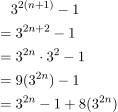
\begin{aligned} & \quad 3^{2(n+1)}-1 \\ & = 3^{2n+2} - 1 \\ & = 3^{2n}\cdot 3^2 - 1 \\ & = 9(3^{2n})-1 \\ & = 3^{2n} -1 + 8(3^{2n}) \\ \end{aligned}

As is assumed 3^{2n}-1 divisible by 8, the statement is thus also true for n+1.

We have proven by mathematical induction that for any positive integer n\enspace (\in\mathbb{Z}^+), f(n) is divisible by 8.


Afterword.

Try to prove \textrm{\scriptsize{NOT}} by mathematical induction \textrm{\scriptsize{BUT}} by direct proof.

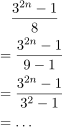
\begin{aligned} &\quad \frac{3^{2n}-1}{8} \\ & = \frac{3^{2n}-1}{9-1} \\ & = \frac{3^{2n}-1}{3^2-1} \\ & = \dots \end{aligned}

Let x=3^2, then

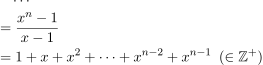
\begin{aligned} &\quad \dots \\ & = \frac{x^n-1}{x-1} \\ & = 1+x+x^2+\cdots + x^{n-2} + x^{n-1} \enspace (\in\mathbb{Z}^{+}) \\ \end{aligned}

\therefore f(n)\equiv 3^{2n}-1 is divisible by 8.