202408201533 Example 13.8

Let \displaystyle{x=\frac{y-2}{y+2}}.

(a) Find \displaystyle{\frac{\mathrm{d}y}{\mathrm{d}x}} in terms of y.
(b) Make y the subject of the given function. Hence, find \displaystyle{\frac{\mathrm{d}y}{\mathrm{d}x}} in terms of x.
(c) Are the answers obtained in (a) and (b) different? Explain your assertion.

Extracted from S. W. Li et al. (2002). New Progress in Additional Mathematics Book 3


Roughwork.

\begin{aligned} x & = \frac{y-2}{y+2} \\ x & = \frac{y+2-4}{y+2} \\ \textrm{Eq. (1):}\quad x=f(y) & = 1-\frac{4}{y+2} \\ \frac{4}{y+2} & = 1-x \\ \frac{4}{1-x} & = y+2 \\ \textrm{Eq. (2):}\quad y=g(x) & = \frac{4}{1-x} - 2 \\ \end{aligned}


domain: what can go into a function
codomain: what may possibly come out of a function
range: what actually comes out of a function

Kevin Sookocheff on Range, Domain, and Codomain (2018)


Write, for function f,

\begin{aligned} \textrm{domain: }& \mathbb{R}\backslash\{ -2\} \\ \textrm{codomain: }& \mathbb{R} \\ \textrm{range: }& \mathbb{R} \\ \end{aligned}

and for function g,

\begin{aligned} \textrm{domain: }& \mathbb{R}\backslash\{ 1\} \\ \textrm{codomain: }& \mathbb{R} \\ \textrm{range: }& \mathbb{R} \\ \end{aligned}

We see f discontinuous at -2; and g, at 1; whereas non-differentiable.


(to be continued)

202402161017 Solution to 2017-DSE-MATH-I-6

The coordinates of the points A and B are (-3,4) and (9,-9) respectively.

\begin{aligned} \mathbf{OA} & = (-3,4) \\ \mathbf{OB} & = (9,-9) \\ \end{aligned}

A is rotated anticlockwise about the origin through 90^\circ to A'.

f(r,\theta )=(r,\theta +\frac{\pi}{2})

B' is the reflection image of B with respect to the x-axis.

g(x,y)=(x,-y)

(a) Write down the coordinates of A' and B'.

Hint. Conversion between Cartesian and polar coordinates:

\begin{aligned} r(x,y) & = \sqrt{x^2+y^2} \\ \theta (x,y) & = \tan^{-1}\bigg(\frac{y}{x}\bigg) \\ x(r,\theta ) & = r\cos\theta \\ y(r,\theta ) & = r\sin\theta \\ \end{aligned}

(b) Prove that AB is perpendicular to A'B'.

Hint. Show that \mathbf{AB}\cdot\mathbf{A'B'}=0.

\begin{aligned} \mathbf{AB} & = \mathbf{AO} + \mathbf{OB} \\ & = \mathbf{OB} - \mathbf{OA} \\ \mathbf{A'B'} & = \mathbf{A'O} + \mathbf{OB'} \\ & = \mathbf{OB'} - \mathbf{OA'} \\ \end{aligned}

\begin{aligned} & \quad \mathbf{AB}\cdot\mathbf{A'B'} \\ & = (\mathbf{OB}-\mathbf{OA})\cdot (\mathbf{OB'}-\mathbf{OA'}) \\ & = \mathbf{OB}\cdot\mathbf{OB'} - \mathbf{OB}\cdot\mathbf{OA'} - \mathbf{OA}\cdot\mathbf{OB'} + \mathbf{OA}\cdot\mathbf{OA'} \\ \end{aligned}

Scalar (/dot) product of two vectors:

\begin{aligned} \mathbf{X}\cdot\mathbf{Y} & =|\mathbf{X}||\mathbf{Y}|\cos\measuredangle{(\mathbf{X},\mathbf{Y})} \\ \textrm{\scriptsize{OR}}\quad\mathbf{X}\cdot\mathbf{Y} & =\sum_{i=1}^{n}x_iy_i \\ \end{aligned}

(modified with hints added)


Roughwork.

We give segment AB the equation L:

\begin{aligned} \frac{y-4}{x-(-3)}& = \frac{4-(-9)}{-3-9} = -\frac{13}{12} \\ L:\quad 0 & = 13x+12y-9 \\ \textrm{where } & (x,y)\in [-3,9]\times [-9,4] \\ \end{aligned}

and segment A'B' the equation L':

\begin{aligned} \frac{y-(-3)}{x-(-4)}& = \frac{9-(-3)}{9-(-4)} = \frac{12}{13} \\ L':\quad 0 & = 12x-13y+9 \\ \textrm{where } & (x,y)\in [-4,9]\times [-3,9] \\ \end{aligned}

The intersection point C(a,b) of lines L and L' can be obtained by solving their simultaneous equations:

\begin{aligned} \quad\enspace & \left\{ \begin{aligned} 13a+12b-9 & = 0 \\ 12a-13b+9 & = 0 \\ \end{aligned}\right\} \\ &\Rightarrow \left\{ \begin{aligned} a & = \frac{9}{313} \\ b & = \frac{225}{313} \\ \end{aligned}\right\} \\ \end{aligned}

Should L\perp L', the line L rotated by \pi /2 about point C(a,b) on the xy-plane would equal line L', the rotation matrix being

\begin{pmatrix} \cos\theta & -\sin\theta & -a\cos\theta + b\sin\theta + a\\ \sin\theta & \cos\theta & -a\sin\theta - b\cos\theta + b \\ 0 & 0 & 1 \\ \end{pmatrix}\Bigg|_{\theta =\frac{\pi}{2}}

to be applied to

\begin{pmatrix} x \\ y \\ 1 \\ \end{pmatrix}\quad\textrm{ for } x,y\in L(x,y)

such that

\begin{aligned} & \quad \begin{pmatrix} 0 & -1 & a+b \\ 1 & 0 & -a+b \\ 0 & 0 & 1 \\\end{pmatrix}\begin{pmatrix} x \\ y \\ 1 \\ \end{pmatrix} \\ & = \begin{pmatrix} a+b-y \\ x-a+b \\ 1 \\\end{pmatrix} \\ & \stackrel{\textrm{def}}{=} \begin{pmatrix} x' \\ y' \\ 1 \\\end{pmatrix}\quad \textrm{ for }x',y'\in L'(x',y') \\ \end{aligned}

the centre of rotation being invariant, i.e.,

(x,y)|_{(a,b)}=(x',y')|_{(a,b)}.


The rest is left the reader as an exercise.

202402151329 Solution to 1985-CE-AMATH-II-5

If the equation

x^2+y^2+kx-(2+k)y=0

represents a circle with radius \sqrt{5},

(a) find the value(s) of k;
(b) find the equation(s) of the circle(s).


As if sitting an exam in additional mathematics, it certainly not being showing off, we should perhaps involve ourselves with some sort of calculus.

Roughwork.

As always, have in mind some pictures. Hence, we draw:

and also

after the stage got set, we write

\begin{aligned} 0 & = x^2+y^2+kx-(2+k)y \\ 0 & = 2x\,\mathrm{d}x+2y\,\mathrm{d}y + k\,\mathrm{d}x - (2+k)\,\mathrm{d}y \\ y' & = \frac{\mathrm{d}y}{\mathrm{d}x} = \frac{2x+k}{k-2y+2} \\ \end{aligned}

and furthermore,

\begin{aligned} \frac{\mathrm{d}y}{\mathrm{d}x} & = 0 \\ & \Rightarrow 2x+k=0 \\ & \Rightarrow x = -\frac{k}{2} \\ \frac{\mathrm{d}y}{\mathrm{d}x} & = \infty \\ & \Rightarrow k-2y+2 = 0 \\ & \Rightarrow y = \frac{k}{2}+1 \\ \end{aligned}

In the case of x=-\frac{k}{2}:

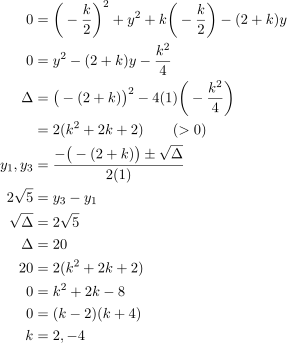
\begin{aligned} 0 & = \bigg( -\frac{k}{2}\bigg)^2+y^2+k\bigg( -\frac{k}{2}\bigg) -(2+k)y \\ 0 & = y^2 - (2+k)y - \frac{k^2}{4} \\ \Delta & = \big( -(2+k)\big)^2 - 4(1)\bigg( -\frac{k^2}{4}\bigg) \\ & = 2(k^2+2k+2)\qquad (> 0) \\ y_1,y_3 & = \frac{-\big( -(2+k)\big) \pm \sqrt{\Delta}}{2(1)} \\ 2\sqrt{5} & = y_3-y_1 \\ \sqrt{\Delta} & = 2\sqrt{5} \\ \Delta & = 20 \\ 20 & = 2(k^2+2k+2) \\ 0 & = k^2+2k-8 \\ 0 & = (k-2)(k+4) \\ k & = 2,-4 \\ \end{aligned}

and the case of y=\frac{k}{2}+1:

\begin{aligned} 0 & = x^2 + \bigg( \frac{k}{2}+1\bigg)^2 + kx - (2+k)\bigg( \frac{k}{2}+1\bigg) \\ 0 & = x^2+kx - \bigg(\frac{k}{2}+1\bigg)^2\\ \Delta & = (k)^2 - 4(1)\bigg( -\bigg(\frac{k}{2}+1\bigg)^2\bigg) \\ & = 2(k^2+2k+2) \qquad (> 0) \\ x_1,x_3 & = \frac{-(k)\pm\sqrt{\Delta}}{2(1)} \\ 2\sqrt{5} & = x_3 - x_1 \\ \sqrt{\Delta} & = 2\sqrt{5} \\ \Delta & = 20 \\ 20 & = 2(k^2+2k+2) \\ 0 & = k^2+2k-8 \\ 0 & = (k-2)(k+4) \\ k & = 2,-4 \\ \end{aligned}

Targeting the centre C(a,b):

\begin{aligned} a_{i=1,2} & = \frac{x_3 - x_1}{2} = -\frac{k}{2}\bigg|_{k=2,-4} = -1,2 \\ b_{i=1,2} & = \frac{y_3-y_1}{2} = \frac{-\big( -(2+k)\big)}{2}\bigg|_{k=2,-4} = 2,-1 \\ (a,b) & = (-1,2)\cup (2,-1) \\ \end{aligned}

Of the equation of circle, the standard form is

\left\{ \begin{aligned} (x+1)^2 + (y-2)^2 & = (\sqrt{5})^2 \\ (x-2)^2 + (y+1)^2 & = (\sqrt{5})^2 \\ \end{aligned}\right\}

and the general form

\left\{ \begin{aligned} x^2+y^2+2x-4y & = 0 \\ x^2+y^2-4x+2y & = 0 \\ \end{aligned}\right\}


This problem is not to be attempted.

202212301726 Solution to 1987-CE-AMATH-I-3

For any complex number z, let \overline{z}, |z|, and \mathrm{Re}(z) be its conjugate, modulus, and real part respectively. Show that

z+\overline{z}=2\mathrm{Re}(z) and |z|\geqslant \mathrm{Re}(z).

Hence, or otherwise, show that for any complex numbers z_1 and z_2,

z_1z_2+\overline{z_1z_2}\leqslant 2|z_1||z_2|.


Roughwork.

In the field \mathbb{C}=\{ x+iy:x,y\in\mathbb{R}\} of complex numbers, x is called the real part of z and y the imaginary part, i.e.,

z=x+iy=\mathrm{Re}(z)+i\,\mathrm{Im}(z),

its trigonometric form being z=r(\cos\theta +i\sin\theta ) with r the modulus and \theta the argument, and its exponential form, z=re^{i\theta}.

This problem is not to be attempted.

202212231206 Solution to 2002-CE-AMATH-I-18

(a) Let z=\cos\theta +i\sin\theta, where -\pi<\theta \leqslant \pi. Show that

|z^2+1|^2=2(1+\cos 2\theta ).

Hence, or otherwise, find the greatest value of |z^2+1|.
(b) w is a complex number such that |w|=3.
i. Show that the greatest value of |w^2+9| is 18.
ii. Explain why the equation

w^4-81=100i(w^2-9)

has only two roots.


Roughwork.

(a)

\begin{aligned} \textrm{LHS} & = |z^2+1|^2 \\ & = |(\cos\theta +i\sin\theta )^2+1|^2 \\ & = |(\cos^2\theta -\sin^2\theta +2i\sin\theta\cos\theta )+1|^2 \\ & = |(2\cos^2\theta )+i(2\sin\theta\cos\theta )|^2 \\ & = \big(\sqrt{(2\cos^2\theta )^2+(2\sin\theta\cos\theta )^2}\big)^2 \\ & = 4\cos^4\theta +4\sin^2\theta\cos^2\theta \\ & = 4\cos^2\theta (\cos^2\theta +\sin^2\theta ) \\ & = 4\cos^2\theta \\ \end{aligned}

From the double-angle formula

\cos 2\theta = 2\cos^2\theta -1

Wikipedia on List of trigonometric identities

the equality follows, i.e., \textrm{LHS}=\textrm{RHS}. As \max (\cos 2\theta )=1, the greatest value of |z^2+1| is

\sqrt{2(1+(1))} = 2.

(b) Not to be attempted.