For  (
( or
or  ), define
 .
.
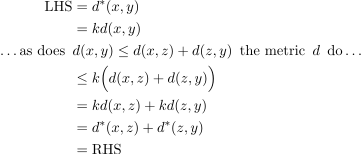
Prove that  is a metric on
  .
.
Motivation.
A ruler is marked by rules for the sake of measuring things. Not so much common to a ruler, but well worth the rule for the general, that a metric must measure its metric space, with the metric defined below:
Definition. (metric) Let  be a non-empty set. A function
  is said to be a metric on if it satisfies the following conditions:
i.  ;
;
ii.  ;
;
iii.  ;
;
iv.  .
.
Remark.
i. As is known, distance should be either positive or zero (i.e., non-negative); ii. We are in one only by discrimination; iii. Fair and just from a symmetric point of view; and iv. The straighter the path, the shorter the distance (also known as the Triangle Inequality).
Proof.
Assume  for convenience. (Provided
  , the assumption is ready for reduction or extension.)
i.
If the minimum  , condition (i)
  is seen. If the minimum
  , be it called the absolute value, the magnitude, the norm, the modulus, or whatsoever, a complex number is non-negative in norm.
Recall. (Norm of complex conjugate)
A complex number  contains two parts, the real part
  and the imaginary part
  . The norm
  (and the norm
  of its complex conjugate
  )
)
is defined by the formula:
![|z|=|x+\textrm{i}\, y|=\sqrt{\big[\textrm{Re}(z)\big]^2+\big[\textrm{Im}(z)\big]^2}=\sqrt{x^2+y^2}](https://physicspupil.com/wp-content/ql-cache/quicklatex.com-a6e8a140612268cc253e48f411856690_l3.svg "Rendered by QuickLaTeX.com") .
.
 It turns out that
  (where
  ) is positive iff
  , and zero iff
  , but never negative.
 The sum, the difference, the product, and the quotient of two complex numbers is one another complex number for the complex number field is algebraically closed.
ii.
(only-if) Giving a try straightforth:
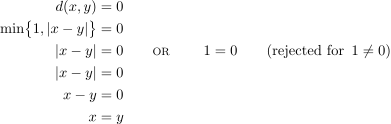
(if) In reverse from backward:
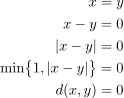
If provided with appropriate explanation, the proof can be shortened by use of the two-way if-and-only-if.
iii.
Suffice it to check whether  is true or not.
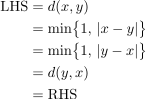
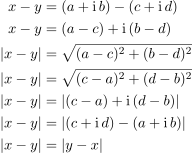
Roughwork.
 , let
, let  and
and  where
where  ,
,  ,
,  , and are real numbers. Then,
iv.
Given here are some equations, I write out all them lest I might forget any:
 ,
,
 ,
,
 .
.
RTP (i.e. required to prove):


If  , so what have I done with?
WTS (i.e. wish to show):

The following inequalities hold evidently:

But  has not yet been ascertained.

The Argand diagram above replaces the usual – and -axes of the Cartesian plane with the real and the imaginary axes of Argand plane.
Owing to my giving too raw and rude maybe a proof, the problem should have otherwise been treated case-by-case. I.e., they are in either case:

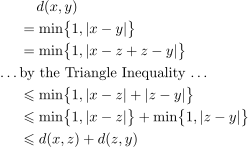
Just do it by rote:

QED

 and
and  be metric spaces and
  be a function. Then,
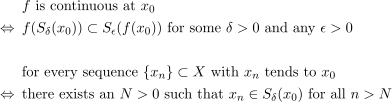
  is continuous at a point
  if and only if
  , for every sequence
  with
with  .
.

 ,
, .
.

 and
and  ‘s in several symbols )
 , the interior of set
  , the derived set of set
  , the closure of set
  (also denoted by
  or
or  ), the boundary of set
  and
and  .
.
 is said to be an open set if it is a neighborhood of each of its points. (Equivalently, a set
  , there exists an
  such that
  .)
.)  . A set
  is said to be a neighborhood (nbd) of
  ,
, for some
  , denoted by
  , the subset of
  N.b. An open sphere is always non-empty since it contains its centre at least.
![C[0,1]](https://physicspupil.com/wp-content/ql-cache/quicklatex.com-168f4e72cde1f8f08203a891457ae1f4_l3.svg "Rendered by QuickLaTeX.com") , determine the values of
, determine the values of  and
and  , when
 and
and  ;
; and
and  ;
; ;
; and
and  .
.![C[a,b]](https://physicspupil.com/wp-content/ql-cache/quicklatex.com-45e2c6fceb00a46edebad4ec842d0375_l3.svg "Rendered by QuickLaTeX.com") be the set of all real-valued continuous functions defined on
be the set of all real-valued continuous functions defined on ![[a,b]](https://physicspupil.com/wp-content/ql-cache/quicklatex.com-b4670559c4f8d351511ca9a22b8506b9_l3.svg "Rendered by QuickLaTeX.com") . For any
. For any ![x,y\in C[a,b]](https://physicspupil.com/wp-content/ql-cache/quicklatex.com-3fa277c68ea439a8b445e9d14c7fc414_l3.svg "Rendered by QuickLaTeX.com") , define the uniform metric
, define the uniform metric  :
:![d_{\infty}(x,y)=\displaystyle{\max_{t\in [a,b]}}|x(t)-y(t)|](https://physicspupil.com/wp-content/ql-cache/quicklatex.com-e9b9e118441bd0878f1fca2048bbab45_l3.svg "Rendered by QuickLaTeX.com") .
.![B[a,b]](https://physicspupil.com/wp-content/ql-cache/quicklatex.com-924c8bb3d5a2292df494dcaf35c819e8_l3.svg "Rendered by QuickLaTeX.com") be the set of all real-valued functions defined and bounded on
be the set of all real-valued functions defined and bounded on ![d_{\infty}(x,y)=\displaystyle{\sup_{t\in [a,b]}}|x(t)-y(t)|](https://physicspupil.com/wp-content/ql-cache/quicklatex.com-73c69d39b280335ac882f9314b300cb2_l3.svg "Rendered by QuickLaTeX.com") .
.![x, y\in C[a,b]](https://physicspupil.com/wp-content/ql-cache/quicklatex.com-da79fddd85003b44fd129fdd443d8a11_l3.svg "Rendered by QuickLaTeX.com") , define
, define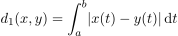
 represents the absolute area between the functions
 ![\begin{aligned} & \quad\, d_{\infty} (x,y) \\ &= \max_{t\in [0,1]} |x(t)-y(t)| \\ \end{aligned}](https://physicspupil.com/wp-content/ql-cache/quicklatex.com-7614358d3f9d3fc954eac66617920836_l3.svg "Rendered by QuickLaTeX.com")
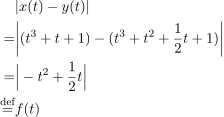
 , apply differentiation to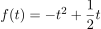
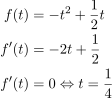
 is plotted in a graph, a parabola admits of no inflexion points, needless to check on
  . So,
. So,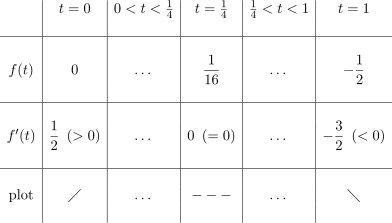

![[0,1]](https://physicspupil.com/wp-content/ql-cache/quicklatex.com-4ddc1168784a8b723604919df78ae658_l3.svg "Rendered by QuickLaTeX.com") attains its maximum value
attains its maximum value  when
when  .
.![\begin{aligned} & d_{\infty} (x,y) \\ = & \max_{t\in [0,1]} |x(t)-y(t)| \\ = & \max_{t\in [0,1]} |f(t)| \\ = & \frac{1}{16} \qquad\qquad\qquad \checkmark\\ \end{aligned}](https://physicspupil.com/wp-content/ql-cache/quicklatex.com-714c59802498b971a1c80bd7d1b16359_l3.svg "Rendered by QuickLaTeX.com")
![\begin{aligned} d_1(x,y) & = \int_0^1 |x(t)-y(t)| \,\mathrm{d}t \\ & = \int_0^1 f(t)\,\mathrm{d}t \\ & = \int_0^1 \bigg| -t^2 + \frac{1}{2}t \bigg| \, \mathrm{d}t \\ & = \bigg[ -\frac{t^3}{3} + \frac{t^2}{4} \bigg] \bigg|_0^1 \\ & = -\frac{1}{12}\qquad\qquad\qquad \times \\ \end{aligned}](https://physicspupil.com/wp-content/ql-cache/quicklatex.com-34b82c1b7b8d2e82275cfbe16a96b3a1_l3.svg "Rendered by QuickLaTeX.com")
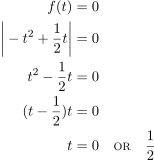
 , zero when
  , and negative when
 ![t\in (0.5,1]](https://physicspupil.com/wp-content/ql-cache/quicklatex.com-00b80af89bee5955a7ee0bccdc690427_l3.svg "Rendered by QuickLaTeX.com") .
.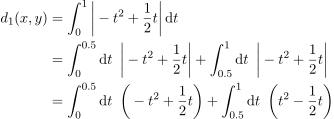
![\begin{aligned} & \int_{0}^{0.5} \bigg( -t^2 + \frac{1}{2}t \bigg) \,\mathrm{d}t \\ = & \bigg[ -\frac{t^3}{3} + \frac{t^2}{4} \bigg] \bigg|_{0}^{0.5} \\ = & \bigg[ -\frac{(0.5)^3}{3} + \frac{(0.5)^2}{4} \bigg] - \bigg[ -\frac{(0)^3}{3} + \frac{(0)^2}{4} \bigg] \\ \dots & \enspace \textrm{by arithmetic}\enspace \dots \\ = & \frac{1}{48} \\ \end{aligned}](https://physicspupil.com/wp-content/ql-cache/quicklatex.com-6402545b4f99818401a434df6e892a79_l3.svg "Rendered by QuickLaTeX.com")
![\begin{aligned} & \int_{0.5}^{1}\bigg( t^2-\frac{1}{2}t\bigg) \,\mathrm{d}t \\ = & \bigg[ \frac{t^3}{3} - \frac{t^2}{4} \bigg]\bigg|_{0.5}^{1} \\ = & \bigg[ \frac{(1)^3}{3} - \frac{(1)^2}{4} \bigg] - \bigg[ \frac{(0.5)^3}{3} - \frac{(0.5)^2}{4} \bigg] \\ \dots & \enspace \textrm{by arithmetic}\enspace \dots \\ = & \bigg( \frac{1}{12} \bigg) - \bigg( -\frac{1}{48} \bigg) \\ = & \frac{5}{48} \\ \end{aligned}](https://physicspupil.com/wp-content/ql-cache/quicklatex.com-038ab7e282e9aa1a9f62b92c92fe7081_l3.svg "Rendered by QuickLaTeX.com")
 .
. be a fixed positive real number. For
  , define
 .
. is a metric on
  satisfying the following conditions
  ;
; ;
; for any
  .
. ,
,  is sometimes called the distance between
 and in that the metric
  ) and
) and  ),
),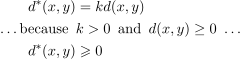
 Condition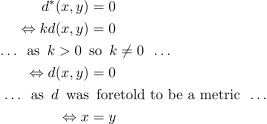

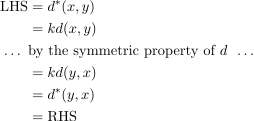

 is a metric space metered by a well-defined metric