202009272336 Homework 1 (Q3)

Verify the following statements by definition of limit.

[Hint: Use the (\epsilon ,\,\delta )-language.]

i. \displaystyle{\lim_{n\to \infty}\frac{2n^2-1}{4n^2+2}=\frac{1}{2}};

ii. \displaystyle{\lim_{n\to \infty}\frac{\sqrt{n^2+n}}{n}=1};

iii. \displaystyle{\lim_{n\to \infty}\sqrt[n]{n+2}=1}.


Verification.

i. Given

\displaystyle{\lim_{n\to \infty}\frac{2n^2-1}{4n^2+2}=\frac{1}{2}},

or,

\displaystyle{\lim_{n\to \infty}f(n)=\frac{1}{2}},

in which

\displaystyle{f(n)=\frac{2n^2-1}{4n^2+2}}.

Informally speaking of it, the function f(n) shall go to the limit 1/2 if its variable n goes to the (+\textrm{ve}) infinity.

Remark.

In other words, if a function f tends to its limit L, by that it is to say, there exists some output value(s) f(x) sufficiently close to the number L.

Make-up arguments.

\begin{aligned} & \quad\enspace \bigg| \frac{2n^2-1}{4n^2+2} - \frac{1}{2} \bigg| \\ & = \bigg| \frac{(2n^2-1)-(2n^2+1)}{4n^2+2} \bigg| \\ & = \bigg| \frac{-2}{4n^2+2}\bigg| \\ & = \frac{1}{2n^2+1} \qquad\qquad \big( < \frac{1}{2n^2} \big) \\ \end{aligned}

As needs

\big| f(n)-L\big| = \displaystyle{\frac{1}{2n^2+1}} < \epsilon,

so let

\begin{aligned} \epsilon & = \frac{1}{2n^2} \\ n & = \frac{\sqrt{2}}{2\sqrt{\epsilon}} \\ \end{aligned}

Roughwork. (Instructive)

\forall\, \epsilon >0,

\exists\, n>N(\epsilon )=\displaystyle{\frac{\sqrt{2}}{2\sqrt{\epsilon}}} s.t.

\begin{aligned} & \quad\enspace \bigg| \frac{2n^2-1}{4n^2+2} - \frac{1}{2} \bigg| \\ & = \frac{1}{2n^2+1} \\ & < \frac{1}{2n^2} \\ & < \frac{1}{2(\frac{\sqrt{2}}{2\sqrt{\epsilon}})^2} \\ & = \epsilon \\ \end{aligned}

(to be continued)


Definition. (Limit) Let f be a real-valued function defined on a subset D of the real numbers \mathbb{R}. Let c be a limit point of D and let L be a real number. Symbolically:

\begin{aligned} & \qquad\enspace \lim_{x\to c} f(x) = L \\ & \Longleftrightarrow \bigg( \forall\, \epsilon >0,\, \exists\, \delta >0,\, \forall\, x\in D, 0<|x-c|<\delta \Rightarrow \big| f(x)-L \big| < \epsilon \bigg) \\ \end{aligned}

Wikipedia on (\epsilon ,\,\delta )-definition of limit


(continue)

The presentation below is based on the Suggested Solution:

First,

\bigg| \displaystyle{\frac{2n^2-1}{4n^2+2}-\frac{1}{2}}\bigg| = \bigg| \frac{1}{2n^2+1}\bigg| <\bigg| \frac{1}{n^2} \bigg|.

Then, just do let

N=N(\epsilon )=\bigg[ \displaystyle{\frac{1}{\sqrt{\epsilon}}} \bigg] +1.

Lastly, \forall\, \epsilon >0, it stands that

\bigg| \displaystyle{\frac{2n^2-1}{4n^2+2}-\frac{1}{2}}\bigg| <\epsilon

whenever n\ge N.

QED


Part ii. and part iii. are noteworthy exercises that have yet to be done.

202009270104 Homework 1 (Q1)

i. Prove that \sqrt{6} is irrational; and

ii. Determine whether \sqrt{2}+\sqrt{3} is rational or not.


Solution.

i. Assume on the contrary that \sqrt{6} be rational, may I rewrite it in terms of a quotient (or a fraction) where the numerator and the nonzero denominator are a pair of coprime integers.

I.e., \sqrt{6}=\displaystyle{\frac{p}{q}} where p,q \in\mathbb{Z} and (p,q)=1.


Roughwork.

\begin{aligned} \sqrt{6} & = \frac{p}{q} \\ 6 & = \frac{p^2}{q^2} \\ p^2 & = 6q^2 \\ & = 2(3q^2) \\ \therefore \qquad 2\big| p^2 & \Rightarrow 2\big| p \textrm{\qquad(why?)} \\ \end{aligned}


From p^2=6q^2 we have 2\big| p.

So let p=2r for some integer r.


Roughwork.

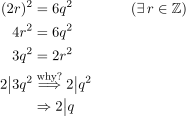
\begin{aligned} (2r)^2 & = 6q^2 \qquad\qquad (\exists\, r\in\mathbb{Z}) \\ 4r^2 & = 6q ^2 \\ 3q^2 & = 2r^2 \\ 2\big| 3q^2 & \stackrel{\textrm{why?}}{\Longrightarrow} 2\big| q^2 \\ & \Rightarrow 2\big| q \\ \end{aligned}


We have also seen 2\big| q.

If and when both statements 2\big| p and 2\big| q meet, it implies p and q are no more coprime, and thus a contradiction.

Definition. (Coprime) Two integers a and b are said to be coprime if the only positive integer that divides them both is one. Equivalently speaking, the greatest common divisor (gcd) of a and b is 1,i.e., \textrm{gcd}(a,b)=1, or written simply, (a,b)=1. Synonymous with coprime' are relatively prime’, `mutually prime’, and the like.

ii.

To prove or disprove from scratch, assume that \sqrt{2}+\sqrt{3} be rational, and see what happens. Let

\sqrt{2}+\sqrt{3}=\displaystyle{\frac{p}{q}}

for some coprimes p,\, q\in\mathbb{Z} s.t. (p,q)=1.

\begin{aligned} \sqrt{3} & = \frac{p}{q} - \sqrt{2} \\ 3 & = \frac{p^2}{q^2} - 2\bigg(\frac{p}{q}\bigg)(\sqrt{2}) +2 \\ 2(\sqrt{2})\bigg(\frac{p}{q}\bigg) & = \frac{p^2}{q^2} - 1 = \frac{p^2-q^2}{q^2} \\ \sqrt{2} & = \frac{p^2-q^2}{2pq} \\ \sqrt{2} & = \frac{p}{2q} - \frac{q}{2p} \in \mathbb{Q} \\ \textrm{As is proven,\enspace} & \sqrt{2}\in \mathbb{R}\backslash\mathbb{Q} \\ \end{aligned}

Contradiction arises ( \Rightarrow \Leftarrow ).

\therefore \sqrt{2}+\sqrt{3} is irrational.

(to be continued)


(doing another way around)

To make use of part i., one might find the Lemma below useful:


Lemma. The product of any two rational numbers is again one rational number.

Proof. Let \displaystyle{\frac{a}{b}} and \displaystyle{\frac{c}{d}}
be rational numbers in their simplest forms reducible.
\begin{aligned} \bigg( \frac{a}{b}\bigg) \bigg( \frac{c}{d}\bigg) & = \bigg( \frac{ac}{bd}\bigg) \\ \because \quad a,b,c,d\in\mathbb{Z} & \Rightarrow ac,\, bd\in\mathbb{Z}\\ \therefore \bigg( \frac{a}{b}\bigg) , \bigg( \frac{c}{d}\bigg) \in \mathbb{Q} & \Rightarrow \bigg( \frac{ac}{bd}\bigg) \in \mathbb{Q} \\ \end{aligned}


If \sqrt{2}+\sqrt{3} were rational, again were its square rational in view of the aforementioned Lemma. Just make an experiment in so doing:

\begin{aligned} (\sqrt{2}+\sqrt{3})^2 & = (\sqrt{2})^2 + 2(\sqrt{2})(\sqrt{3}) + (\sqrt{3})^2 \\ & = 5 + 2\sqrt{6} \\ \end{aligned}

On logic,

\begin{aligned} & \quad (\sqrt{2}+\sqrt{3})^2 \textrm{\quad is rational} \\ & \Rightarrow 5+2\sqrt{6} \textrm{\quad is rational} \\ & \stackrel{\textrm{why?}}{\Longrightarrow} \sqrt{6} \textrm{\quad is rational} \\ \end{aligned}

However, as shown in part i., \sqrt{6} is irrational. The assumption that \sqrt{2}+\sqrt{3} be rational has been contradicted.

The contrary is true that \sqrt{2}+\sqrt{3} is \textrm{\scriptsize{NOT}} rational.

202008190019 Exercise 1.28

In each case, determine all real x and y which satisfy the given relation.

(a) x+\mathrm{i}y=|x-\mathrm{i}y|,

(b) x+\mathrm{i}y=(x-\mathrm{i}y)^2,

(c) \displaystyle{\sum_{k=0}^{100}}\mathrm{i}^k=x+\mathrm{i}y.


Solution.

(a)

\begin{aligned} x + \mathrm{i}y & = |x-\mathrm{i}y|  \\ x + \mathrm{i}y &  = \sqrt{(x)^2+(-y)^2} \\ x + \mathrm{i}y & = \big(  \sqrt{(x)^2+(-y)^2}  \big) + \mathrm{i}(0) \end{aligned}

\therefore y=0 and x\enspace (\geqslant 0)\, \in\mathbb{R} is any non-negative real number.

(b)

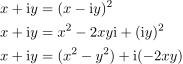
\begin{aligned} x + \mathrm{i}y & = (x-\mathrm{i}y)^2 \\ x + \mathrm{i}y & = x^2 - 2xy\mathrm{i} + (\mathrm{i}y)^2 \\ x + \mathrm{i}y & = (x^2-y^2) + \mathrm{i}(-2xy) \end{aligned}

Comparing the imaginary parts:

\begin{aligned} y=-2xy & \Rightarrow (2x+1)y = 0 \\ & \Rightarrow x = -\frac{1}{2}\qquad \textrm{or}\qquad y=0 \end{aligned}

Comparing the real parts:

\begin{aligned} x & = x^2-y^2 \\ x^2 - x - y^2 & = 0 \\ x & = \frac{-(-1)\pm \sqrt{(-1)^2-4(1)(-y^2)}}{2(1)} \\ & = \frac{1\pm \sqrt{1+4y^2}}{2} \end{aligned}

When y=0, x=\displaystyle{\frac{1\pm \sqrt{1+4(0)^2}}{2}}=0,\, 1.

When x=-\frac{1}{2},

\begin{aligned} -\frac{1}{2} & =\frac{1\pm\sqrt{1+4y^2}}{2} \\ \Rightarrow 2 & = \sqrt{1+4y^2} \\ \Rightarrow y & = \pm \displaystyle{\frac{\sqrt{3}}{2}} \end{aligned}

\therefore \begin{pmatrix} x \\ y \end{pmatrix}\in \Bigg\{ \begin{pmatrix} 0 \\ 0 \end{pmatrix},\,\begin{pmatrix} 1 \\ 0 \end{pmatrix},\, \begin{pmatrix} -\frac{1}{2} \\ \frac{\sqrt{3}}{2} \end{pmatrix},\, \begin{pmatrix} -\frac{1}{2} \\ -\frac{\sqrt{3}}{2} \end{pmatrix}   \Bigg\}.

(c)

\begin{aligned} \sum_{k=0}^{k=100}\mathrm{i}^k & = x+\mathrm{i}y \\ \mathrm{i}^{0} + \mathrm{i}^{1} + \mathrm{i}^{2} + \dots + \mathrm{i}^{100} & = x+\mathrm{i}y \\ \sum_{n=0}^{50} \mathrm{i}^{(2n)} + \sum_{n=0}^{49} \mathrm{i}^{(2n+1)} & = x+\mathrm{i}y \\ \sum_{n=0}^{50} (-1)^n + \mathrm{i}\sum_{n=0}^{49} (-1)^{n} & = x+\mathrm{i}y \\ \end{aligned}

\begin{aligned} \therefore \qquad x & = \sum_{n=0}^{50}(-1)^n \\ & = (-1)^{0} + (-1)^{1} + (-1)^{2} +\dots + (-1)^{50} \\ & = 1-1+1+\dots +1 \\ & = 1 \end{aligned}

\begin{aligned} \therefore \qquad y & = \sum_{n=0}^{49}(-1)^n \\ & = (-1)^{0} + (-1)^{1} + (-1)^{2} +\dots + (-1)^{49} \\ & = 1-1+1+\dots -1 \\ & = 0 \end{aligned}

Sol. \bigg\{\begin{aligned} & x = 1 \\ & y = 0 \end{aligned}\bigg\}.

202004241649 Problem 2, Ch. 1 Sec. 1

Prove the following equalities:

(a) |ab|=|a|\cdot |b|;

(b) |a|^2=a^2;

(c) \displaystyle{\bigg|\frac{a}{b}\bigg|=\frac{|a|}{|b|}} (where b\neq 0);

(d) \sqrt{a^2}=|a|.


Proof.

(a) (proof by cases)

i. When a,b\geqslant 0:

|ab|=ab=|a||b|.

ii. When a,b< 0:

|ab|=ab=(-a)(-b)=|a||b|.

iii. When a\geqslant 0 and b<0:

|ab|=-ab=a(-b)=|a||b|.

iv. When a<0 and b\geqslant 0:

|ab|=-ab=(-a)b=|a||b|.

QED


(b) (proof by induction)

By making a stronger claim

P(n): For any positive integer n, |a^n|=|a|^n.

Proof.

The trivial cases n=0 and n=1 are evident.

Consider the case n=2,

\begin{aligned} |a^2| & = |a||a| \qquad \textrm{(by equality (a))} \\ & = |a|^2 \end{aligned}

P(2) is true.

Assume now that P(n) is true,

\begin{aligned} P(n+1): \qquad |a^{n+1}|& = |a^n\cdot a| \\ & = |a^n||a| \qquad \textrm{(by equality (a))}\\ & = |a|^n|a| \qquad \textrm{(by the assumption }P(n)\textrm{ is true)} \\ & = |a|^{n+1} \end{aligned}

it can be seen that P(n+1) is also true.

From the fact that P(2) is true and by the principle of mathematical induction, P(n) is true for all positive integers n.

It follows that |a|^2=|a^2|=a^2 holds.

QED


(c) (direct proof)

\because |a|=\displaystyle{\bigg|  \frac{a}{b}\cdot b\bigg|} =\bigg|\displaystyle{\frac{a}{b}}\bigg| |b|,

where the second equality sign is due to equality (a),

\therefore \displaystyle{\bigg| \frac{a}{b} \bigg| = \frac{|a|}{|b|}}.

QED


(d) (proof by definition)

The absolute value of a real number a, denoted by |a|, is defined by

|a|= \begin{cases} x & \textrm{if } x\geqslant 0, \\  -x & \textrm{if }x<0  \end{cases}

For any non-negative real number a, the symbol \sqrt{a} denotes the non-negative square root of a.

QED

202004241533 Problem 1, Ch. 1 Sec. 1

Prove that if a and b are real numbers then

||a|-|b||\leqslant |a-b|\leqslant |a|+|b|.


Proof.

As |a| is non-negative and -|a| non-positive, one has

Eq. (1):

-|a|\leqslant a\leqslant |a|

Eq. (2):

-|b|\leqslant b\leqslant |b|

Combining Eq. (1) and Eq. (2),

-(|a|+|b|)\leqslant a+b\leqslant |a|+|b|,

or, Eq. (3): (the triangle inequality)

|a+b|\leqslant |a|+|b|.

Applying the triangle inequality to |a-b|, one gets

Eq. (4):

|a-b|=|a+(-b)|\leqslant |a|+|-b|=|a|+|b|,

or, Eq. (4)’:

|a-b|\leqslant |a|+|b|.

Applying the triangle inequality to |a|=|(a-b)+b|, one gets

Eq. (5):

|a|=|(a-b)+b|\leqslant |a-b|+|b|,

or, Eq. (5)’:

|a|-|b|\leqslant |a-b|.

Applying the triangle inequality to |b|=|(b-a)+a|, one gets

Eq. (6):

|b|=|(b-a)+a|\leqslant |b-a|+|a|,


Roughwork.

\begin{aligned} |b|-|a| & \leqslant |b-a| \\|b|-|a| & \leqslant |a-b| \\-|a-b| & \leqslant |a|-|b|\end{aligned}


or, Eq. (6)’:

-|a-b| \leqslant |a|-|b|

Combining Eq. (5)’ and Eq. (6)’:

-|a-b| \leqslant |a|-|b| \leqslant |a-b|,

or, Eq. (7):

||a|-|b||\leqslant |a-b|.

Combining Eq. (4)’ and Eq. (7), one obtains readily

||a|-|b||\leqslant |a-b|\leqslant |a|+|b|.

QED