202402151329 Solution to 1985-CE-AMATH-II-5

If the equation

x^2+y^2+kx-(2+k)y=0

represents a circle with radius \sqrt{5},

(a) find the value(s) of k;
(b) find the equation(s) of the circle(s).


As if sitting an exam in additional mathematics, it certainly not being showing off, we should perhaps involve ourselves with some sort of calculus.

Roughwork.

As always, have in mind some pictures. Hence, we draw:

and also

after the stage got set, we write

\begin{aligned} 0 & = x^2+y^2+kx-(2+k)y \\ 0 & = 2x\,\mathrm{d}x+2y\,\mathrm{d}y + k\,\mathrm{d}x - (2+k)\,\mathrm{d}y \\ y' & = \frac{\mathrm{d}y}{\mathrm{d}x} = \frac{2x+k}{k-2y+2} \\ \end{aligned}

and furthermore,

\begin{aligned} \frac{\mathrm{d}y}{\mathrm{d}x} & = 0 \\ & \Rightarrow 2x+k=0 \\ & \Rightarrow x = -\frac{k}{2} \\ \frac{\mathrm{d}y}{\mathrm{d}x} & = \infty \\ & \Rightarrow k-2y+2 = 0 \\ & \Rightarrow y = \frac{k}{2}+1 \\ \end{aligned}

In the case of x=-\frac{k}{2}:

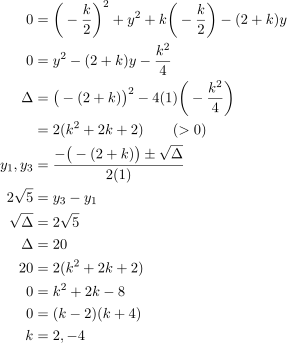
\begin{aligned} 0 & = \bigg( -\frac{k}{2}\bigg)^2+y^2+k\bigg( -\frac{k}{2}\bigg) -(2+k)y \\ 0 & = y^2 - (2+k)y - \frac{k^2}{4} \\ \Delta & = \big( -(2+k)\big)^2 - 4(1)\bigg( -\frac{k^2}{4}\bigg) \\ & = 2(k^2+2k+2)\qquad (> 0) \\ y_1,y_3 & = \frac{-\big( -(2+k)\big) \pm \sqrt{\Delta}}{2(1)} \\ 2\sqrt{5} & = y_3-y_1 \\ \sqrt{\Delta} & = 2\sqrt{5} \\ \Delta & = 20 \\ 20 & = 2(k^2+2k+2) \\ 0 & = k^2+2k-8 \\ 0 & = (k-2)(k+4) \\ k & = 2,-4 \\ \end{aligned}

and the case of y=\frac{k}{2}+1:

\begin{aligned} 0 & = x^2 + \bigg( \frac{k}{2}+1\bigg)^2 + kx - (2+k)\bigg( \frac{k}{2}+1\bigg) \\ 0 & = x^2+kx - \bigg(\frac{k}{2}+1\bigg)^2\\ \Delta & = (k)^2 - 4(1)\bigg( -\bigg(\frac{k}{2}+1\bigg)^2\bigg) \\ & = 2(k^2+2k+2) \qquad (> 0) \\ x_1,x_3 & = \frac{-(k)\pm\sqrt{\Delta}}{2(1)} \\ 2\sqrt{5} & = x_3 - x_1 \\ \sqrt{\Delta} & = 2\sqrt{5} \\ \Delta & = 20 \\ 20 & = 2(k^2+2k+2) \\ 0 & = k^2+2k-8 \\ 0 & = (k-2)(k+4) \\ k & = 2,-4 \\ \end{aligned}

Targeting the centre C(a,b):

\begin{aligned} a_{i=1,2} & = \frac{x_3 - x_1}{2} = -\frac{k}{2}\bigg|_{k=2,-4} = -1,2 \\ b_{i=1,2} & = \frac{y_3-y_1}{2} = \frac{-\big( -(2+k)\big)}{2}\bigg|_{k=2,-4} = 2,-1 \\ (a,b) & = (-1,2)\cup (2,-1) \\ \end{aligned}

Of the equation of circle, the standard form is

\left\{ \begin{aligned} (x+1)^2 + (y-2)^2 & = (\sqrt{5})^2 \\ (x-2)^2 + (y+1)^2 & = (\sqrt{5})^2 \\ \end{aligned}\right\}

and the general form

\left\{ \begin{aligned} x^2+y^2+2x-4y & = 0 \\ x^2+y^2-4x+2y & = 0 \\ \end{aligned}\right\}


This problem is not to be attempted.

202402051319 Pastime Exercise 009

The blogger claims no originality of his problem below.


On a rollover road,

a vehicle performs circular motion:

Discuss how the driver could prevent a traffic accident.


Roughwork.

Take positive both, the angle \theta in an anti-clockwise direction, and the displacement \mathbf{s} in a rightward and an upward direction.

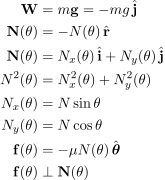
\begin{aligned} \mathbf{W} & = m\mathbf{g} = -mg\,\hat{\mathbf{j}} \\ \mathbf{N}(\theta ) & = -N(\theta )\,\hat{\mathbf{r}} \\ \mathbf{N}(\theta ) & = N_x(\theta )\,\hat{\mathbf{i}} + N_y(\theta )\,\hat{\mathbf{j}} \\ N^2(\theta ) & = N_x^2(\theta )+N_y^2(\theta ) \\ N_x(\theta ) & = N\sin\theta \\ N_y(\theta ) & = N\cos\theta \\ \mathbf{f}(\theta ) & = -\mu N(\theta )\,\hat{\boldsymbol{\theta}} \\ \mathbf{f}(\theta ) & \perp \mathbf{N}(\theta ) \\ \end{aligned}

In order for the vehicle not to leave the track, the radius of curvature r \textrm{\scriptsize{MUST}} be kept constant, i.e., r=R(=\textrm{Const.}).

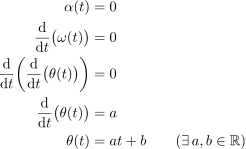
Recall, in uniform circular motion there isn’t any (angular) acceleration in angular velocity, i.e.,

\begin{aligned} \alpha (t) & = 0 \\ \frac{\mathrm{d}}{\mathrm{d}t}\big(\omega (t)\big) & = 0 \\ \frac{\mathrm{d}}{\mathrm{d}t}\bigg( \frac{\mathrm{d}}{\mathrm{d}t}\big(\theta (t)\big)\bigg) & = 0 \\ \frac{\mathrm{d}}{\mathrm{d}t}\big(\theta (t)\big) & = a \\ \theta (t) & = at+b\qquad (\exists\, a,b\in\mathbb{R}) \\ \end{aligned}

If uniform circular motion is \textrm{\scriptsize{NOT}} assumed,

i.e., \alpha \neq 0\textrm{ \scriptsize{OR} }r\neq\textrm{Const.},

then angular displacement \theta (t) wrt time t will be a polynomial in an indeterminate t of degree 2 or higher,

i.e., O(t)=O(t^c)\qquad\exists\, c\, (\in\mathbb{Z}^+)\geqslant 2.

Angular acceleration \boldsymbol{\alpha} is less often mentioned than is its parallel tangential acceleration \mathbf{a}_{\parallel}\, (=r\boldsymbol{\alpha}) as the pair to centripetal (/centrifugal) acceleration \mathbf{a}_{\perp}.

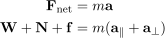
By Newton 2nd Law, write

\begin{aligned} \mathbf{F}_{\textrm{net}} & = m\mathbf{a} \\ \mathbf{W}+\mathbf{N}+\mathbf{f} & = m(\mathbf{a}_{\parallel}+\mathbf{a}_{\perp}) \\ \end{aligned}

The presence of a centripetal acceleration, i.e., \exists\,\mathbf{a}_{\perp}\neq\mathbf{0}, is necessary for any circular motion, be it uniform or not; but not sufficient for the absence of a tangential acceleration \forall\,\mathbf{a}_{\parallel}= 0 (why?). One knows instinctively, that the vehicle should possess a minimum angular speed \min (\omega ) to do this dangerous stunt. And so much the better if beyond this bound \min (\omega )\leqslant \omega \leqslant \max (\omega ) \ll c one has all degrees of freedom.

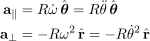
By definition,

\begin{aligned} \mathbf{a}_{\parallel} & = R\dot{\omega}\,\hat{\boldsymbol{\theta}} = R\ddot{\theta}\,\hat{\boldsymbol{\theta}} \\ \mathbf{a}_{\perp} & = -R\omega^2\,\hat{\mathbf{r}} = -R\dot{\theta}^2\,\hat{\mathbf{r}} \\ \end{aligned}

Stepping on and off the accelerator (/gas pedal), however delicately, is \textrm{\scriptsize{NOT}} designed to keep a constant acceleration for the gear.


This problem is not to be attempted.

202401311548 Pastime Exercise 008

Let there be a cone R\,\mathrm{(unit)} in radius of its base and h\,\mathrm{(unit)} in height.

Find the volume V\,\mathrm{(cubic\, unit)} of the cone, using what are so-called i. the disc (/washer) method and ii. the (cylindrical) shell method, if the names my memory serves me right.

Answer. \displaystyle{V=\frac{1}{3}\pi R^2h}.


Roughwork.

Visualize the cone.

i. By disc method,

\begin{aligned} \frac{R}{h} & = \frac{r}{h-z} = \tan\theta \\ r & = R\bigg( 1-\frac{z}{h}\bigg) \\ V & = \pi R^2\int_{0}^{h}\bigg( 1-\frac{z}{h}\bigg)^2\,\mathrm{d}z \\ \cdots & \cdots\cdots\cdots\cdots\cdots\cdots\cdots \\ \textrm{let }& z'=1-\frac{z}{h} \\ \frac{\mathrm{d}z'}{\mathrm{d}z} & = -\frac{1}{h} \\ \mathrm{d}z & = -h\,\mathrm{d}z' \\ z=0 & \Leftrightarrow z'=1 \\ z=h & \Leftrightarrow z'= 0 \\ \cdots & \cdots\cdots\cdots\cdots\cdots\cdots\cdots \\ V& = \pi R^2\int_{1}^{0} z'^2(-h\,\mathrm{d}z') \\ & = -\pi R^2h \bigg[ \frac{z'^3}{3}\bigg]\bigg|_{1}^{0} \\ & = -\pi R^2h \bigg(\frac{(0)^3}{3} - \frac{(1)^3}{3}\bigg) \\ & = \frac{\pi R^2h}{3}\\ \end{aligned}

ii. By shell method,

we are obtaining the volume of a solid of revolution about the z-axis by integrating the slices (/cross sections) ranging between \theta\in [0,2\pi ].

It is left the reader as an exercise.


This problem is not to be attempted.

202401041119 Exercise 8.2.541

Evaluate the integral

\displaystyle{\underset{\varGamma}{\int}(x\,\mathrm{d}y+y\,\mathrm{d}x)},

where (a) \varGamma is an arc of the parabola y=\sqrt{x}, (b) \varGamma is a segment of a straight line, (c) \varGamma is the arc of the parabola y=x^2 connecting the points (0,0) and (1,1) in the direction indicated by the arrows (see Figure below).

Extracted from Yakov Stepanovič Bugrov. (1984). A collection of problems.

Answer. (a) 1; (b) 1; (c) 1.


Roughwork.

(a)

When a point moves along the curve \varGamma :y=\sqrt{x} in the indicated direction,

\begin{aligned} &\quad \underset{\varGamma}{\int}(x\,\mathrm{d}y+y\,\mathrm{d}x) \\ & = \int_{(0,0)}^{(1,1)}(y^2\,\mathrm{d}y+\sqrt{x}\,\mathrm{d}x) \\ & = \bigg[\frac{y^3}{3} + \frac{2x^{3/2}}{3}\bigg]\bigg|_{(0,0)}^{(1,1)}\\ & = \bigg(\frac{(1)^3}{3} + \frac{2(1)^{3/2}}{3}\bigg) - \bigg(\frac{(0)^3}{3} + \frac{2(0)^{3/2}}{3}\bigg) \\ & = \bigg(\frac{1}{3}+\frac{2}{3}\bigg) - (0+0) \\ & = 1 \\ \end{aligned}

(b)

When a point moves along the curve \varGamma :y=x in the indicated direction,

\begin{aligned} &\quad \underset{\varGamma}{\int}(x\,\mathrm{d}y+y\,\mathrm{d}x) \\ & = \int_{(0,0)}^{(1,1)}(y\,\mathrm{d}y+x\,\mathrm{d}x) \\ & = \bigg[\frac{y^2}{2} + \frac{x^2}{2}\bigg]\bigg|_{(0,0)}^{(1,1)} \\ & = \bigg(\frac{(1)^2}{2} + \frac{(1)^2}{2}\bigg) - \bigg(\frac{(0)^2}{2} + \frac{(0)^2}{2}\bigg)\\ & = \bigg( \frac{1}{2} + \frac{1}{2}\bigg) - (0+0) \\ & = 1 \\ \end{aligned}

(c)

When a point moves along the curve \varGamma :y=x^2 in the indicated direction,

\begin{aligned} &\quad \underset{\varGamma}{\int}(x\,\mathrm{d}y+y\,\mathrm{d}x) \\ & = \int_{(0,0)}^{(1,1)}(\sqrt{y}\,\mathrm{d}y+x^2\,\mathrm{d}x) \\ & = \bigg[\frac{2y^{3/2}}{3} + \frac{x^3}{3}\bigg]\bigg|_{(0,0)}^{(1,1)} \\ & = \bigg(\frac{2(1)^{3/2}}{3} + \frac{(1)^3}{3}\bigg) - \bigg(\frac{2(0)^{3/2}}{3} + \frac{(0)^3}{3}\bigg) \\ & = \bigg(\frac{2}{3}+\frac{1}{3}\bigg) - (0+0) \\ & = 1 \\ \end{aligned}


Afterword.

What am I doing?

\displaystyle{\int (x\,\mathrm{d}y+y\,\mathrm{d}x) = \int x\,\mathrm{d}y + \int y\,\mathrm{d}x}

Note the first term on RHS:

and the second term on RHS:


Many simple formulae in physics, such as the definition of work as W=\mathbf{F}\cdot\mathbf{s}, have natural continuous analogues in terms of line integrals, in this case \displaystyle{W=\underset{L}{\int}\mathbf{F}(\mathbf{s})\,\mathrm{d}\mathbf{s}}, which computes the work done on an object moving through an electric or gravitational field \mathbf{F} along a path L.

Cited from Wikipedia on Line integral


\begin{aligned} &\quad \int (x\,\mathrm{d}y+y\,\mathrm{d}x) \\ & = \int \begin{bmatrix} y & x \end{bmatrix} \begin{bmatrix} \mathrm{d}x \\ \mathrm{d}y \end{bmatrix} \\ & = \int \mathbf{F}(x,y)\,\mathrm{d}\mathbf{s} \\ \cdots & \cdots \cdots \cdots \cdots \cdots \cdots \cdots \cdots \cdots \cdots \\ & \mathbf{F}(x,y) = y\,\hat{\mathbf{i}} + x\,\hat{\mathbf{j}} \\ \cdots & \cdots \cdots \cdots \cdots \cdots \cdots \cdots \cdots \cdots \cdots \\ \end{aligned}

As an aside, work done W is the scalar (/dot) product of force \mathbf{F} and displacement \mathbf{s}. A conservative vector field in physics is analogous to a path-independent vector field in mathematics. That is, over any paths, the line integral depends only upon the starting point and the end point.


This problem is not to be attempted.

202401031807 Pastime Exercise 007

The blogger claims no originality of his problem below.

A ball of mass m is being passed through a smooth extensible light string, the two ends of which being attached to walls a distance d apart.

When time t=t_0:

when t=t_1:

when t=t_2:

when t=t_3:

when t=t_4:

when t=t_5:

when t=t_6:

such that stroboscopically for t\in [t_0,t_6], we see the ball’s trajectory fits into a parabola as can be described by some quadratic equation:

The tension T(t) of the string and the speed v(t) of the ball are time-varying variables dependent on mass m and distance d as well. By considering the free-body diagrams of the ball and of the string in discrete time frames t_i‘s (where i\in\{ 0,1,2,3,4,5,6\}), find the equation of motion at continuous time intervals of \Delta t=t_6-t_0.


This problem is not to be attempted.

202311270959 Exercise 1.4.33

Simplify:

(AB)^{-1}(AC^{-1})(D^{-1}C^{-1})^{-1}D^{-1}.

Extracted from H. Anton & C. Rorres. (2010). Elementary Linear Algebra Application Version (10e)

Answer. B^{-1}


Roughwork.

Let

\begin{aligned} A_{m\times n}&:m\textrm{-by-}n \\ B_{n\times o}&:n\textrm{-by-}o \\ (C^{\mathrm{T}})_{n\times p}}&:n\textrm{-by-}p \\ (D^{\mathrm{T}})_{q\times n}&:q\textrm{-by-}n \\ C_{p\times n}&:p\textrm{-by-}n \\ D_{n\times q}&:n\textrm{-by-}q \\ (AB)_{m\times o}&:m\textrm{-by-}o \\ ((AB)^{\mathrm{T}})_{o\times m}&:o\textrm{-by-}m \\ ((AC)^{\mathrm{T}})_{m\times p}&:m\textrm{-by-}p \\ (D^{\mathrm{T}}C^{\mathrm{T}})_{q\times p}&:q\textrm{-by-}p \\ ((D^{\mathrm{T}}C^{\mathrm{T}})^{\mathrm{T}})_{p\times q}&:p\textrm{-by-}q \\ \end{aligned}

such that after simplification the original array of matrices (here transpose in place of inverse) should give an o-by-n matrix. For merely satisfying this requirement one candidate can be B_{n\times o}‘s transpose, i.e., (B^{\mathrm{T}})_{o\times n}, but not much evidence than coincidence here.

Observe, that the simplified expression, in general, should \textrm{\scriptsize{NOT}} necessarily be a span (/linear combination) of matrices in the list above, for none any pair of matrices have necessarily the same dimension for which matrix addition is possible, apart from square matrices.

Hence, assume AB, C, and D to be three square matrices which are invertible.

Note, that the simplified expression should be an arrangement of matrix multiplication amongst some of 8 matrices A and A^{-1}, B and B^{-1}, C and C^{-1}, and D and D^{-1}.

Consider, by simplification the matrix product should have strictly less than r=7 factors, i.e., at most 6; and in adding an extra identity matrix I to the preceding (*such as to avoid terms AA^{\mathrm{-1}}=A^{\mathrm{-1}}A=I to go nearby) we have n=9 matrices at hand; the possible outcomes is a permutation

\text{}^9P_{6}=9^6=531441

with replacement, minus

8\times 6=48.

The chance of getting by is

\displaystyle{\frac{1}{531441-48}=\frac{1}{531393} \approx 0.000188\%.


This problem is not to be attempted.

202311081445 Pastime Exercise 006

The figure below is a representation of the \mathbf{E}-field by electric field lines in a family R of infinitely many quadratic functions

y_t(x_{t'})=a_tx_{t'}^2+b_tx_{t'}+c_t


Roughwork.

A tangent to any quadratic curve at some point in the locus gives the \mathrm{\pm ve} direction of the electric force experienced by a (positive) test charge placed there. I.e.,

\displaystyle{T(x_{t'},y_{t})=\frac{\mathrm{d}}{\mathrm{d}x}\big( y_t(x_{t'})\big) = 2a_tx_{t'}+b_{t}},

the slope of tangent.

WLOG we work with the first quadrant. First, begin with the repulsive force \mathrm{}_Q\mathbf{F}_{q} acting on the test charge +q due to point charge +Q.

\begin{aligned} \mathrm{}_QF_{q,x}^2+\mathrm{}_QF_{q,y}^2 & = \mathrm{}_QF_{q}^2 \\ \mathrm{}_QF_{q,y} & = \bigg(\frac{y_t}{x_{t'}+d/2}\bigg)\mathrm{}_QF_{q,x} \\ \cdots\cdots & \cdots\cdots\\ \mathrm{}_QF_{q,x} & = \frac{\mathrm{}_QF_{q}}{\sqrt{1+\Big(\frac{y_t}{x_{t'}+d/2}\Big)^2}} \\ \mathrm{}_QF_{q,y} & = \bigg(\frac{y_t}{x_{t'}+d/2}\bigg) \Bigg(\frac{\mathrm{}_QF_{q}}{\sqrt{1+\Big(\frac{y_t}{x_{t'}+d/2}\Big)^2}}\Bigg) \\ \cdots\cdots & \cdots\cdots\\ \mathrm{}_Q\mathbf{F}_{q} & = \mathrm{}_QF_{q,x}\,\hat{\mathbf{i}}+ \mathrm{}_QF_{q,y}\,\hat{\mathbf{j}} \\ \end{aligned}

Next, continue with the attractive force \mathrm{}_{-Q}\mathbf{F}_{q} acting on the test charge +q due to point charge -Q.

\begin{aligned} \mathrm{}_{-Q}F_{q,x}^2+\mathrm{}_{-Q}F_{q,y}^2 & = \mathrm{}_{-Q}F_{q}^2 \\ \mathrm{}_{-Q}F_{q,y} & = \bigg(\frac{y_t}{d/2-x_{t'}}\bigg)\mathrm{}_{-Q}F_{q,x} \\ \cdots\cdots & \cdots\cdots\\ \mathrm{}_{-Q}F_{q,x} & = \frac{\mathrm{}_{-Q}F_{q}}{\sqrt{1+\Big(\frac{y_t}{d/2-x_{t'}}\Big)^2}} \\ \mathrm{}_{-Q}F_{q,y} & = \bigg(\frac{y_t}{d/2-x_{t'}}\bigg) \Bigg(\frac{\mathrm{}_{-Q}F_{q}}{\sqrt{1+\Big(\frac{y_t}{d/2-x_{t'}}\Big)^2}}\Bigg) \\ \cdots\cdots & \cdots\cdots\\ \mathrm{}_{-Q}\mathbf{F}_{q} & = \mathrm{}_{-Q}F_{q,x}\,\hat{\mathbf{i}}+ \mathrm{}_{-Q}F_{q,y}\,\hat{\mathbf{j}} \\ \end{aligned}

Adding \mathrm{}_{Q}\mathbf{F}_{q} and \mathrm{}_{-Q}\mathbf{F}_{q} will give the resultant electric force \mathbf{F}_{E}(x_{t'},y_t).

Note that

\begin{aligned} \mathrm{}_QF_q & = k\frac{Q}{\mathrm{}_Qr_{q}^2} \\ \mathrm{}_{-Q}F_q & = k\frac{-Q}{\mathrm{}_{-Q}r_{q}^2} \\ \end{aligned}

where

\begin{aligned} \mathrm{}_Qr_q & = \sqrt{(d/2+x_{t'})^2+y_t^2} \\ \mathrm{}_{-Q}r_q & = \sqrt{(d/2-x_{t'})^2+y_t^2} \\ & \\ & \\ \end{aligned}

are the distances of a test charge at q(x_{t'},y_t) from point charges +Q at A(-d/2,0) and -Q at B(d/2,0).

The smallest angle between \mathbf{F}_{E}(x_{t'},y_{t}) and the level should be equal to the slope of tangent 2a_tx_{t'}+b_{t} at point q(x_{t'},y_t).

As of the vertex of each parabola, the x-coordinate is

\displaystyle{0=x_{t'}=-\frac{b_{t}}{2a_{t}}}

s.t. b_{t}=0, and the y-coordinate c_{t}=y_t(0).

I guess, under correction, the separation distance d is none any parameter of the loci.


Visualisation is \textrm{\scriptsize{NOT}} mathematical \textrm{\scriptsize{BUT}} conceptual.

202311070929 Exercise 21.1.2

Find (by drawing or calculation) the resultant of the following forces, in magnitude and direction.

(a)

(b)

(c)

Extracted from A. Godman & J. F. Talbert. (1973). Additonal Mathematics Pure and Applied in SI units.


(a)

So that the two forces are labelled as vectors \mathbf{OA} and \mathbf{OB}, let their initial points for both be O and the terminal points of each A and B.

In Cartesian coordinates,

\begin{aligned} \mathbf{OA} & = |\mathbf{OA}|\,\hat{\mathbf{i}} \\ & = OA\,\hat{\mathbf{i}} \\ & = 12\,\mathrm{N}\,\hat{\mathbf{i}} \\ \mathbf{OB} & = |\mathbf{OB}|\,\hat{\mathbf{j}} \\ & = OB\,\hat{\mathbf{j}} \\ & = 10\,\mathrm{N}\,\hat{\mathbf{j}} \\ \end{aligned}

With, on purpose, no diagrams being provided, let also the resultant force \mathbf{OC} be directed from the same initial point O to some terminal point we let be C. Then,

\begin{aligned} \mathbf{OC} & = \mathbf{OA} + \mathbf{OB} \\ & = 12\,\mathrm{N}\,\hat{\mathbf{i}} + 10\,\mathrm{N}\,\hat{\mathbf{j}} \\ OC & = |\mathbf{OC}| \\ & = \sqrt{12^2+10^2} \\ & = 15.6\,\mathrm{N}\qquad\textrm{(3 s.f.)} \\ \end{aligned}

Trying in polar coordinates,

\begin{aligned} \mathbf{OA} & = |\mathbf{OA}|\,\hat{\mathbf{r}} \\ & = 12\,\mathrm{N}\,\hat{\mathbf{r}} \\ \mathbf{OB} & = |\mathbf{OB}|\,\hat{\mathbf{r}} +\frac{\pi}{2}\,\hat{\boldsymbol{\theta}}\\ & = \bigg( 10\,\hat{\mathbf{r}} + \frac{\pi}{2}\,\hat{\boldsymbol{\theta}}\bigg) \,\mathrm{N} \\ \end{aligned}

Recall the formulae for addition of vectors

\begin{aligned} r_3 & = \sqrt{r_1^2+2r_1r_2\cos(\theta_2-\theta_1)+r_2^2} \\ \theta_3 & = \theta_1+\arctan \bigg(\frac{r_2\sin (\theta_2-\theta_1)}{r_1+r_2\cos (\theta_2-\theta_1)}\bigg) \\ \end{aligned}

beside the rectangular form I am stupid enough to do the polar. Quit.


(b)

By tail-to-tip method, draw

\begin{aligned} OC & = \sqrt{OB^2+BC^2} \\ & = \sqrt{OB^2+OA^2} \\ & = \sqrt{40^2+30^2} \\ & = 50\,\mathrm{N} \\ \tan\theta & = \frac{30}{40} \\ \theta & = \tan^{-1} \bigg(\frac{30}{40}\bigg) \\ & = 36.9^\circ\qquad\textrm{(3 s.f.)} \\ \end{aligned}

Or, by parallelogram method, draw

which makes no matter how you visualise, only are the calculations the matters.


(c)

Draw a labelled diagram below:

\begin{aligned} \mathbf{OA} & = 4\cos 30^\circ \,\hat{\mathbf{i}} + 4\sin 30^\circ \,\hat{\mathbf{j}} \\ & = 4\bigg(\frac{\sqrt{3}}{2}\bigg)\,\hat{\mathbf{i}} + 4\bigg(\frac{1}{2}\bigg) \,\hat{\mathbf{j}} \\ & = \big(2\sqrt{3}\,\hat{\mathbf{i}} +2\,\hat{\mathbf{j}}\big)\,\mathrm{N} \\ \mathbf{OB} & = \big( 6\,\hat{\mathbf{i}}\big)\,\mathrm{N} \\ \end{aligned}

Let \mathbf{OC} be the resultant vector,

\begin{aligned} \mathbf{OC} & = \mathbf{OA} + \mathbf{OB} \\ & = \big( 2\sqrt{3}+6\big) \,\hat{\mathbf{i}} + 2\,\hat{\mathbf{j}} \\ \end{aligned}

Write OA, OB, and OC the magnitudes of respective vectors \mathbf{OA}, \mathbf{OB}, and \mathbf{OC},

\begin{aligned} OA & = 4 \\ OB & = 6 \\ OC & = |\mathbf{OC}| \\ & = \sqrt{(2\sqrt{3}+6)^2+2^2} \\ & = \sqrt{52+24\sqrt{3}} \\ & = 2\sqrt{13+6\sqrt{3}} \\ \end{aligned}

With a diagram in mind,

apply cosine law,

\begin{aligned} \cos \angle COB & = \frac{OC^2+OB^2-OA^2}{2(OC)(OB)} \\ & = \frac{(52+24\sqrt{3})+(36)-(16)}{2(52+24\sqrt{3})(6)} \\ \angle COB & = \cdots \\ \end{aligned}


This problem is not to be attempted.

202310191146 Exercise 7.9.26

Evaluate the integral

\displaystyle{\int x\sin x\cos x\,\mathrm{d}x}.

Extracted from James Stewart. (2012). Calculus (8e)


Roughwork.

(abortive attempt)

\begin{aligned} & \quad\enspace \int x\sin x\cos x\,\mathrm{d}x \\ & = \int x\sin x\cos x \bigg(\frac{\mathrm{d}(\sin x)}{\cos x}\bigg) \\ & = \int x\sin x\,\mathrm{d}(\sin x) \\ & = (x\sin x)(\sin x) - \int (\sin x)\bigg(\frac{\mathrm{d}(x\sin x)}{\mathrm{d}x}\bigg)\,\mathrm{d}x + C\quad\textrm{for some constant} \\ & = x\sin^2x - \int \sin x\,\mathrm{d}(x\sin x) \\ & = x\sin^2x - \bigg\{ (\sin x)(x\sin x) - \int (x\sin x)\bigg(\frac{\mathrm{d}}{\mathrm{d}x}(\sin x)\bigg) \,\mathrm{d}x \bigg\} \\ & = x\sin^2x - \bigg\{ x\sin^2x - \int x\sin x\cos x\,\mathrm{d}x \bigg\} \\ & = \int x\sin x\cos x\,\mathrm{d}x \\ \end{aligned}


As a last resort, I need help from the following

Fundamental Theorem of Calculus. Let f be a continuous real-valued function defined on a closed interval [a,b], Let F be the function defined, for all x in [a,b], by

\displaystyle{F(x)=\int_{a}^{x}f(t)\,\mathrm{d}t}

Then F is uniformly continuous on [a,b] and differentiable on the open interval (a,b), and

F'(x)=f(x)

for all x in (a,b) so F is an antiderivative of f.

Cited from Wikipedia on Fundamental theorem of calculus


Let \displaystyle{\frac{\mathrm{d}F(x)}{\mathrm{d}x}=x\sin x\cos x}.

But for using foresight, one should not have written

\begin{aligned} F(x) & :=\frac{x}{2}\sin^2x+G(x) \\ \frac{\mathrm{d}F(x)}{\mathrm{d}x} & = x\sin x\cos x + \frac{\sin^2x}{2} + G'(x) \\ G'(x) & := -\frac{\sin^2x}{2} \\ G(x) & = \int G'(x)\,\mathrm{d}x \\ & = -\frac{1}{2}\int\sin^2x\,\mathrm{d}x \\ & = -\frac{1}{2}\int \bigg(  \frac{1-\cos 2x}{2}\bigg) \,\mathrm{d}x\\ & = -\frac{1}{4}\bigg\{ \int \mathrm{d}x - \int \cos 2x\,\mathrm{d}x \bigg\} \\ & = -\frac{1}{4}\bigg\{ x - \frac{\sin 2x}{2} \bigg\} \\ F(x) & = \frac{x}{2}\sin^2x - \frac{1}{4}\bigg( x - \frac{\sin 2x}{2} \bigg) \\ & = \frac{x\sin^2x}{2} + \frac{\sin 2x}{8} - \frac{x}{4} \\ \end{aligned}

with some constant C.


The case is closed.