If  , find the values of
  ,
,  ,
,  ,
,  ,
,  ,
,  .
.
Solution.

On reflection.
Suppose you are given an unknown quadratic function  such that

and you are asked to make polynomial interpolation.


And then is the interpolated polynomial  .
.

物理子衿
If , find the values of , , , , , .
Solution.
On reflection.
Suppose you are given an unknown quadratic function such that
and you are asked to make polynomial interpolation.
And then is the interpolated polynomial .
If  , find the values of , , ,
  ,
,  ,
,  .
.
Solution.
Given .

This exercise is done.
On reflection.
Suppose you are given the following conditions:

and you are asked to interpolate by Lagrange polynomials over the range ![[0,2]](https://physicspupil.com/wp-content/ql-cache/quicklatex.com-1571666a47302be9ed925a760be14ff0_l3.svg "Rendered by QuickLaTeX.com") .
.

The interpolating polynomial  checks with the original function
  .
.
Observe that both  and
and  are open and closed in , i.e., clopen.
Proof. Pastime.
Remark. ( ‘s in several symbols )
is a set of points.
 , the interior of set , contains all interior points.
 , the derived set of set , contains all accumulation/cluster/limit points.
 , the closure of set , contains all adherent points.
 (also denoted by
  or
or  ), the boundary of set , contains all boundary points.
Let  be a metric space,
  and
and  .
.
Prove that the set

is open in .
Setup.
Understand the definition given to each of the following:
First, what is meant by whether a set is open or not in some metric space?
Definition. (open set) Let be a metric space. A set  is said to be an open set if it is a neighborhood of each of its points. (Equivalently, a set is said to be an open set
if for each  , there exists an
  such that
  .)
.)
Please refer to pg. 20, Jain and Ahmad’s Metric Spaces.
Second, what is referred to as a neighborhood of some point(s)?
Definition. (neighborhood) Let be a metric space and  . A set
  is said to be a neighborhood (nbd) of
if there exists an open sphere centred at and contained in  ,
,
i.e., if  for some .
Please refer to pg. 19, Jain and Ahmad’s Metric Spaces.
Third, what is an open sphere?
Definition. (open sphere) Let be a metric space. Let and be a real number. The open sphere with centre and radius  , denoted by
  , the subset of given by
  N.b. An open sphere is always non-empty since it contains its centre at least.
Please refer to pg. 16, Jain and Ahmad’s Metric Spaces.
Suppose  ,
,  and
and  . Find
  and
and  .
.
Hint. (Verbal translation)
You are given that the number of elements in set is  ,the number of elements in set
  is
is  , and the number of elements in the intersection of set and set is
  .
.
You are asked:
What is the number of elements in the union of set and set ?What is the number of elements in the relative complement  of set with respect to set ?
Definition. The relative complement of with respect to is the set
 .
.
Can you try drawing a Venn diagram?

Attempts.
(constructive)
Let
 ,
,
and also
 ,
,
so that  .
.
The union  of set and set must as follows be:
 ,
,
such that  .
.
The relative complement of set w.r.t. set is

and the number of its elements is
 .
.
(analytic)
By observation of the Venn diagram,

you are writing out
 ,
,
keeping in mind that

shall answer another question of a different subject.
The radius of a right circular cylinder is decreasing at a rate of  , while its height
  is decreasing at a rate of
  . How is the volume changing when
  and
and  ? Is the volume increasing or decreasing?
Solution.

The volume of a right circular cylinder is calculated by the formula
 .
.
The volume  (a dependent variable) of a cylinder varies with its radius and height (both independent variables). The change of volume, simply put it, is a derivative of volume with respect to time
  :
:
 .
.
Differentiate  wrt. time :
![\begin{aligned} \frac{\mathrm{d}}{\mathrm{d}t} V(r,h,t) & = \frac{\mathrm{d}}{\mathrm{d}t} (\pi r^2 h) \\ & = \pi \frac{\mathrm{d}}{\mathrm{d}t} (r^2h) \\ & = \pi \bigg[ r^2 \frac{\mathrm{d}}{\mathrm{d}t}(h) + h \frac{\mathrm{d}}{\mathrm{d}t} (r^2) \bigg] \\ & = \pi \bigg[ \big( r(t) \big)^2 \frac{\mathrm{d}}{\mathrm{d}t}\big( h(t) \big) + \big( h(t)\big) \bigg( \frac{\mathrm{d}}{\mathrm{d}t}\big( r(t) \big)^2 \bigg) \bigg] \\ & = \pi (r^2h' +2hrr' ) \\ & = \pi r^2h' + 2\pi hrr' \\ \end{aligned}](https://physicspupil.com/wp-content/ql-cache/quicklatex.com-6799ee3438e9e88d3a6b70a1e4e814ca_l3.svg "Rendered by QuickLaTeX.com")
Given , ,  , and
, and  , you would have it.
In some formalism of partial derivatives,

you could have it also.
Afterthought.
It just so happens that there are two lines of attack, by taking total/ordinary derivatives and by taking partial derivatives. Is here anyhow the difference? Is there anything the matter?
Find the trajectory of a cannon ball fired by a cannoneer at  above his eye level with an initial speed
  .
.
Ans.
Imagine you are in his place, like the picture below:

Then, suppose you are opening fire at such positive  -axis direction as that follows along the meridian. In addition, assume that the earth is to be lying flat beneath the cannon ball during its flight, that every pole (
 -axis) upheld would be so much right-angled (/normal /perpendicular) to the ground as parallel (-transported) anywhere.
We neglect air friction.
1. Along the -direction, the speed is kept  .
.
2. Along the -direction, the speed is initially  . By the laws of gravity, the cannon ball will experience a net force
  due to gravitational pull by the Earth. If upward direction is taken the positive sign, an equation of motion due to the Galilean transformation (i.e.,
  ) will depict that
  .
.
3. One another equation  depicts how distance
  (i.e., the magnitude of displacement
  ) varies with time during linear motion in constant acceleration
  .
.
One might have already noticed I am setting the original question aside, as it were. Let’s pinpoint the answer now.
The trajectory should be obtained in the form:
 .
.
where
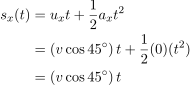
and
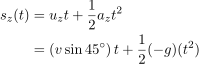
In ![C[0,1]](https://physicspupil.com/wp-content/ql-cache/quicklatex.com-168f4e72cde1f8f08203a891457ae1f4_l3.svg "Rendered by QuickLaTeX.com") , determine the values of
, determine the values of  and
and  , when
(a)  and
and  ;
;
(b)  and
and  ;
;
(c) and  ;
;
(d)  and
and  .
.
Recall.
Definition. (uniform metric) Let ![C[a,b]](https://physicspupil.com/wp-content/ql-cache/quicklatex.com-45e2c6fceb00a46edebad4ec842d0375_l3.svg "Rendered by QuickLaTeX.com") be the set of all real-valued continuous functions defined on
be the set of all real-valued continuous functions defined on ![[a,b]](https://physicspupil.com/wp-content/ql-cache/quicklatex.com-b4670559c4f8d351511ca9a22b8506b9_l3.svg "Rendered by QuickLaTeX.com") . For any
. For any ![x,y\in C[a,b]](https://physicspupil.com/wp-content/ql-cache/quicklatex.com-3fa277c68ea439a8b445e9d14c7fc414_l3.svg "Rendered by QuickLaTeX.com") , define the uniform metric
, define the uniform metric  :
:
![d_{\infty}(x,y)=\displaystyle{\max_{t\in [a,b]}}|x(t)-y(t)|](https://physicspupil.com/wp-content/ql-cache/quicklatex.com-e9b9e118441bd0878f1fca2048bbab45_l3.svg "Rendered by QuickLaTeX.com") .
.
N.b. If we let ![B[a,b]](https://physicspupil.com/wp-content/ql-cache/quicklatex.com-924c8bb3d5a2292df494dcaf35c819e8_l3.svg "Rendered by QuickLaTeX.com") be the set of all real-valued functions defined and bounded on , the uniform metric is then defined
be the set of all real-valued functions defined and bounded on , the uniform metric is then defined
![d_{\infty}(x,y)=\displaystyle{\sup_{t\in [a,b]}}|x(t)-y(t)|](https://physicspupil.com/wp-content/ql-cache/quicklatex.com-73c69d39b280335ac882f9314b300cb2_l3.svg "Rendered by QuickLaTeX.com") .
.
(cited from Examples 14 and 15, pg. 13, Pawan K. Jain and Khalil Ahmad’s Metric Spaces (2e) on Introductory Concepts)
Definition. For any ![x, y\in C[a,b]](https://physicspupil.com/wp-content/ql-cache/quicklatex.com-da79fddd85003b44fd129fdd443d8a11_l3.svg "Rendered by QuickLaTeX.com") , define
, define
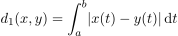
N.b.  represents the absolute area between the functions and
  as a measure of the distance between these two functions.
(cited from Example 16, pg. 14, Pawan K. Jain and Khalil Ahmad’s Metric Spaces (2e) on Introductory Concepts)
Solution.
(a)
![\begin{aligned} & \quad\, d_{\infty} (x,y) \\ &= \max_{t\in [0,1]} |x(t)-y(t)| \\ \end{aligned}](https://physicspupil.com/wp-content/ql-cache/quicklatex.com-7614358d3f9d3fc954eac66617920836_l3.svg "Rendered by QuickLaTeX.com")
Roughwork.
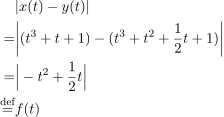
Approach.
To know the maximum value of  , apply differentiation to
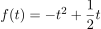
and attain
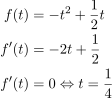
If the quadratic function  is plotted in a graph, a parabola admits of no inflexion points, needless to check on
  . So,
. So,
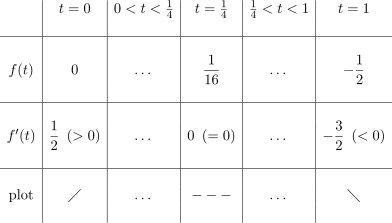

The continuous function in the closed interval ![[0,1]](https://physicspupil.com/wp-content/ql-cache/quicklatex.com-4ddc1168784a8b723604919df78ae658_l3.svg "Rendered by QuickLaTeX.com") attains its maximum value
attains its maximum value  when
when  .
.
![\begin{aligned} & d_{\infty} (x,y) \\ = & \max_{t\in [0,1]} |x(t)-y(t)| \\ = & \max_{t\in [0,1]} |f(t)| \\ = & \frac{1}{16} \qquad\qquad\qquad \checkmark\\ \end{aligned}](https://physicspupil.com/wp-content/ql-cache/quicklatex.com-714c59802498b971a1c80bd7d1b16359_l3.svg "Rendered by QuickLaTeX.com")
and should you think of what follows as quite right
![\begin{aligned} d_1(x,y) & = \int_0^1 |x(t)-y(t)| \,\mathrm{d}t \\ & = \int_0^1 f(t)\,\mathrm{d}t \\ & = \int_0^1 \bigg| -t^2 + \frac{1}{2}t \bigg| \, \mathrm{d}t \\ & = \bigg[ -\frac{t^3}{3} + \frac{t^2}{4} \bigg] \bigg|_0^1 \\ & = -\frac{1}{12}\qquad\qquad\qquad \times \\ \end{aligned}](https://physicspupil.com/wp-content/ql-cache/quicklatex.com-34b82c1b7b8d2e82275cfbe16a96b3a1_l3.svg "Rendered by QuickLaTeX.com")
you might have rather mistaken calculus.
Correction.
Get back to the basics,
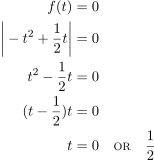
From the previous graph of , is found to be positive when  , zero when
  , and negative when
 ![t\in (0.5,1]](https://physicspupil.com/wp-content/ql-cache/quicklatex.com-00b80af89bee5955a7ee0bccdc690427_l3.svg "Rendered by QuickLaTeX.com") .
.
Doing it step-by-step,
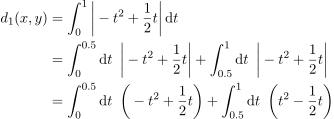
Evaluating term-by-term, the first term being
![\begin{aligned} & \int_{0}^{0.5} \bigg( -t^2 + \frac{1}{2}t \bigg) \,\mathrm{d}t \\ = & \bigg[ -\frac{t^3}{3} + \frac{t^2}{4} \bigg] \bigg|_{0}^{0.5} \\ = & \bigg[ -\frac{(0.5)^3}{3} + \frac{(0.5)^2}{4} \bigg] - \bigg[ -\frac{(0)^3}{3} + \frac{(0)^2}{4} \bigg] \\ \dots & \enspace \textrm{by arithmetic}\enspace \dots \\ = & \frac{1}{48} \\ \end{aligned}](https://physicspupil.com/wp-content/ql-cache/quicklatex.com-6402545b4f99818401a434df6e892a79_l3.svg "Rendered by QuickLaTeX.com")
and the second term being
![\begin{aligned} & \int_{0.5}^{1}\bigg( t^2-\frac{1}{2}t\bigg) \,\mathrm{d}t \\ = & \bigg[ \frac{t^3}{3} - \frac{t^2}{4} \bigg]\bigg|_{0.5}^{1} \\ = & \bigg[ \frac{(1)^3}{3} - \frac{(1)^2}{4} \bigg] - \bigg[ \frac{(0.5)^3}{3} - \frac{(0.5)^2}{4} \bigg] \\ \dots & \enspace \textrm{by arithmetic}\enspace \dots \\ = & \bigg( \frac{1}{12} \bigg) - \bigg( -\frac{1}{48} \bigg) \\ = & \frac{5}{48} \\ \end{aligned}](https://physicspupil.com/wp-content/ql-cache/quicklatex.com-038ab7e282e9aa1a9f62b92c92fe7081_l3.svg "Rendered by QuickLaTeX.com")
In sum,
 .
.
Part (b), (c), and (d) are not chosen.
Let be a metric space and let  be a fixed positive real number. For
  , define
 .
.
Prove that  is a metric on .
Recall.
Definition. (metric) Let be a non-empty set. A metric on is a real-valued function  satisfying the following conditions
 i– iv:
i.  ;
;
ii.  ;
;
iii. (Symmetry)  ;
;
iv. (Triangle Inequality)  for any
  .
.
N.b. Given  ,
,  is sometimes called the distance between and with respect to
  .
.
Proof.
i.
WTS (wish to show)

By definition  and in that the metric is let clear (
 ) and a fixed positive real number (
 ),
),
one can see
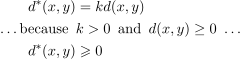
 Condition
 i. is made.
ii.
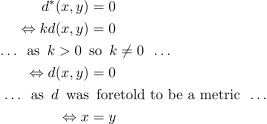
Condition ii. is made.
iii.
NTS (need to show)

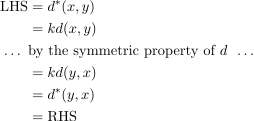
Condition iii. is made.
iv.
RTP (required to prove)

One starts with the left hand side,
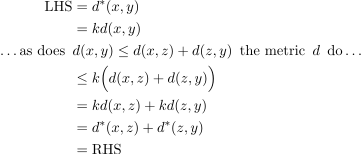
Condition iv. is made.
In conclusion,  is a metric space metered by a well-defined metric . This metric space shall simply be called hence.
Prove that  is divisible by
  for
for  .
.
Extracted from T. W. Judson. (2021). Abstract Algebra Theory and Applications.
Proof.
Let  be the statement:
 for any
Determine whether or not is true when  :
:

As  is divisible by ,
  is true.
Suppose is true for some  , try and prove the statement
  :
:


As is true and by the fact that three divides nine,  is therefore divisible by . That is,

That is true for , by the principle of mathematical induction, I have thus proven is divisible by for .