For Exercises 1-6, find the area of the region bounded by the given curves.
 and
and 

Roughwork.
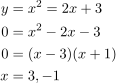

 are the points of intersection.
The area  of the shaded region is
![\begin{aligned} A & = \int_{-1}^{3}|(2x+3)-(x^2)|\,\mathrm{d}x \\ & = \bigg[ x^2+3x-\frac{x^3}{3}\bigg]\bigg|_{-1}^{3} \\ & = \bigg( (3)^2+3(3)-\frac{(3)^3}{3}\bigg) - \bigg( (-1)^2+3(-1)-\frac{(-1)^3}{3}\bigg) \\ & = (9) - \bigg(-\frac{5}{3}\bigg) \\ & = \frac{32}{3}\quad \textrm{(squared units)} \\ \end{aligned}](https://physicspupil.com/wp-content/ql-cache/quicklatex.com-5f993d3e91bd421fd15165ddee343693_l3.svg "Rendered by QuickLaTeX.com")
(alternatively)
![\begin{array}{cl} {A & = \displaystyle\int_{1}^{9}\bigg( \sqrt{y} - \frac{y-3}{2}\bigg)\,\mathrm{d}y + \int_{0}^{1}\Big( (\sqrt{y})-(-\sqrt{y})\Big)\,\mathrm{d}y }\\ & = \displaystyle\bigg( \frac{2y^{3/2}}{3}-\frac{y^2}{4}+\frac{3y}{2}\bigg)\bigg|_{1}^{9} + \bigg( \frac{4y^{3/2}}{3}\bigg)\bigg|_{0}^{1}} \\ & = \displaystyle\Bigg\{ \bigg[ \frac{2(9)^{3/2}}{3}-\frac{(9)^2}{4}+\frac{3(9)}{2}\bigg] -\bigg[\frac{2(1)^{3/2}}{3}-\frac{(1)}{4}+\frac{3(1)}{2}\bigg]\Bigg\} }\\ &\displaystyle\qquad \quad + \Bigg\{\bigg[\frac{4(1)^{3/2}}{3}\bigg] - \bigg[ \frac{4(0)^{3/2}}{3} \bigg]\Bigg\} }\\ & =\displaystyle \bigg( 18-\frac{81}{4}+\frac{27}{2}\bigg) - \bigg( \frac{2}{3}-\frac{1}{4}+\frac{3}{2} \bigg) + \bigg(\frac{4}{3}\bigg) - (0)} \\ & = \displaystyle\frac{32}{3}\quad \textrm{(squared units)}} \end{array}](https://physicspupil.com/wp-content/ql-cache/quicklatex.com-29c78f65521eca21cb00bbea7ceb330b_l3.svg "Rendered by QuickLaTeX.com")

物理子衿
For Exercises 1-6, find the area of the region bounded by the given curves.
and
Roughwork.
are the points of intersection.
The area of the shaded region is
(alternatively)
This exercise is related to Einstein’s famous law  . The relativistic momentum
  of a particle of mass
  moving at a speed
  along a straight line (say, the
  -axis) is
 ,
,
where  is the speed of light. The relativistic force on the particle along that line is
 ,
,
which is the same formula as Newton’s Second Law of motion in classical mechanics. Assume that the particle starts at rest at position  and ends at position
  along the -axis. The work done by the force
  on the particle is:

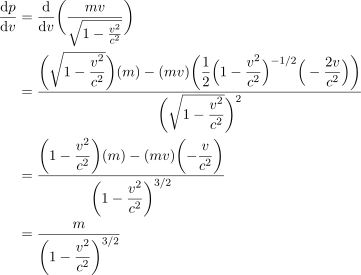
(a) Show that
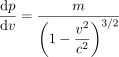 .
.
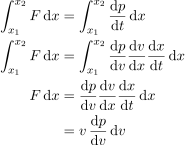
(b) Use the Chain Rule formula

to show that
 .
.
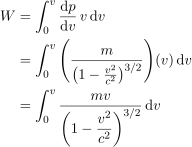
(c) Use parts (a) and (b) to show that
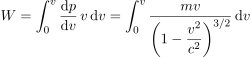 .
.
(d) Use part (c) to show that
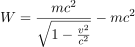 .
.
(e) Define the relativistic kinetic energy  of the particle to be
  , and define the total energy
  to be
to be
 .
.
So by part (d),  . Show that
 .
.
(Hint: Expand the right side of that equation.)
(f) What is when the particle is at rest?
Solution.
(a)
(b)
(c)
 .
.
(d)
![\begin{aligned} W & = \int_{0}^{v}\frac{mv}{\bigg(\displaystyle{1-\frac{v^2}{c^2}}\bigg)^{3/2}}\,\mathrm{d}v \\ \dots\enspace & \textrm{let }u=\frac{v}{c}\enspace\dots \\ \dots\enspace & \textrm{then }\mathrm{d}v=c\,\mathrm{d}u\enspace\dots \\ & = \int_{0}^{\frac{v}{c}}\frac{mc^2u}{(1-u^2)^{\frac{3}{2}}}\,\mathrm{d}u \\ \dots\enspace & \textrm{let }u=\sin\theta\enspace\dots \\ \dots\enspace & \textrm{then }\mathrm{d}u=\cos\theta\,\mathrm{d}\theta\enspace\dots \\ & = \int\frac{mc^2\sin\theta}{\cos^3\theta}\cdot\cos\theta\,\mathrm{d}\theta \\ & = \int\frac{mc^2\sin\theta}{\cos^2\theta}\,\mathrm{d}\theta \\ \dots\enspace & \textrm{let }w=\cos\theta\enspace\dots \\ \dots\enspace & \textrm{then }\mathrm{d}w=-\sin\theta\,\mathrm{d}\theta\enspace\dots \\ & \quad -\int \frac{mc^2}{w^2}\,\mathrm{d}w \\ & = \frac{mc^2}{w} \\ & = \frac{mc^2}{\cos\theta} \\ & = mc^2\sec\theta \\ & = \frac{mc^2}{\sqrt{1-u^2}} \\ & = \enspace\dots \\ & = \bigg[\frac{mc^2}{\sqrt{1-u^2}}\bigg]\bigg|^{\frac{v}{c}}_{0} \\ & = \frac{mc^2}{\sqrt{1-\displaystyle{\frac{v^2}{c^2}}}}-mc^2 \\ \end{aligned}](https://physicspupil.com/wp-content/ql-cache/quicklatex.com-2227d7c994b723ce7bc00a0cb45545d2_l3.svg "Rendered by QuickLaTeX.com")
Parts (e) and (f) are left to the readers.
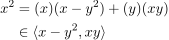
(a) Show that  in
in ![k[x,y]](https://physicspupil.com/wp-content/ql-cache/quicklatex.com-584acc935973e616ea2c851bc464e2d7_l3.svg "Rendered by QuickLaTeX.com") (
( any field).
(b) Show that  .
.
(c) Is  ? Why or why not?
Definition.
Let ![f_1,\dots ,f_s\in k[x_1,\dots ,x_n]](https://physicspupil.com/wp-content/ql-cache/quicklatex.com-5f08e62a15ff4e03854490db864f1aba_l3.svg "Rendered by QuickLaTeX.com") . We let
. We let  denote the collection
 ![\langle f_1,\dots ,f_s\rangle = \{ p_1f_1+\cdots +p_sf_s:p_i\in k[x_1,\dots ,x_n]\}](https://physicspupil.com/wp-content/ql-cache/quicklatex.com-f334ab4b3301b6106a075356020d5bc8_l3.svg "Rendered by QuickLaTeX.com") for
for  .
.
(a)
(b)
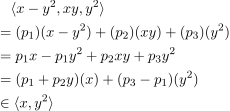
First, we want to show
 .
.
For any ![p_1,p_2,p_3\in k[x,y]](https://physicspupil.com/wp-content/ql-cache/quicklatex.com-12dccf91798ff1604735efc161b91edc_l3.svg "Rendered by QuickLaTeX.com") ,
,
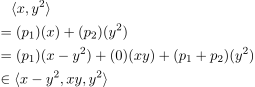
Next, we want to show
 .
.
For any ![p_1,p_2\in k[x,y]](https://physicspupil.com/wp-content/ql-cache/quicklatex.com-0f988f74e666d0747607e1462e98d6e8_l3.svg "Rendered by QuickLaTeX.com") ,
,
All in all,
.
(c) I guess  .
.
Graph each function by algebraically determining its key features. Then state the domain and range of the function.

Solution.
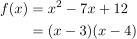
We see that  when
when  .
.
i. The -intercepts of  are thus
  and
and  .
.
Plugging in  will give the
  -intercept:
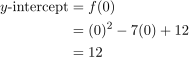
ii. The -intercept is thus  .
.
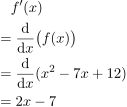
Differentiating  with respect to ,
When  and
and  , the slope of is zero, i.e.,
  .
.
iii.  is a turning point (/extreme point/vertex).
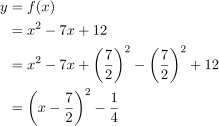
iv. The axis of symmetry of the graph is  .
.
Differentiating twice with respect to ,
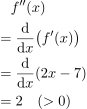
We see that the slope is increasing with .
v. The graph of is concave upward (/convex downward).
vi. The domain is  and the range
  .
.

|
1 2 3 4 5 6 7 8 9 10 11 12 13 |
CREATE TABLE SQL_Table_001 (ID int, Subject varchar(255), Object varchar(255), Category varchar(255) ); INSERT INTO SQL_Table_001 (Subject, Object, Category) VALUES ('algebraic geometry', 'regular (polynomial) functions', 'algebraic varieties') ('topology', 'continuous functions', 'topological spaces') ('differential topology', 'differentiable functions', 'differentiable manifolds') ('complex analysis', 'analytic (power series) functions', 'complex manifolds'); |
|
1 2 3 4 5 6 7 8 9 10 |
Output. +------+-------------------------+-------------------------------------+----------------------------+ | ID | Subject | Object | Category | +------+-------------------------+-------------------------------------+----------------------------+ | 1 | algebraic geometry | regular (polynomial) functions | algebraic varieties | | 2 | topology | continuous functions | topological spaces | | 3 | differential topology | differentiable functions | differentiable manifolds | | 4 | complex analysis | analytic (power series) functions | complex manifolds | +------+-------------------------+-------------------------------------+----------------------------+ (J.S. Milne on Algebraic Geometry (2017), pg. 7) |
Find the volume  inside the paraboloid
  for
for  .
.
Background. (Triple integral in cylindrical coordinates)
 where the mapping
  ,
,  ,
,  maps the solid
  in
in  -space onto the solid
  in
in  -space in a one-to-one manner.
pg.122, Chapter 3.5, Michael Corral. (2008). Vector Calculus
Setup.
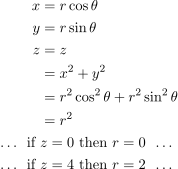
hence,

Solution.
Using vertical slices, we see that
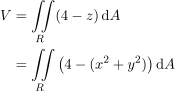
where  is the disc in
  . In polar coordinates
  we know that
  and that
  .
.
Thus,
![\begin{aligned} V & = \int_{0}^{2\pi}\int_{0}^{2} (4-r^2)\, r\,\mathrm{d}r\,\mathrm{d}\theta \\ & = \int_{0}^{2\pi}\int_{0}^{2} (4r-r^3)\,\mathrm{d}r\,\mathrm{d}\theta \\ & = \int_{0}^{2\pi} \bigg[ 2r^2-\frac{r^4}{4}\bigg]\bigg|_{0}^{2}\,\mathrm{d}\theta \\ & = 4\int_{0}^{2\pi} \mathrm{d}\theta \\ & = 4(2\pi )\\ & = 8\pi\quad \textrm{(cubic units)} \end{aligned}](https://physicspupil.com/wp-content/ql-cache/quicklatex.com-a70165187c9359906eb264d8ceb14cba_l3.svg "Rendered by QuickLaTeX.com")
Let  be a constant. Show that
 .
.
Solution.
![\begin{aligned} & \qquad \int_{z_1}^{z_2}\int_{y_1}^{y_2}\int_{x_1}^{x_2}M\,\mathrm{d}x\,\mathrm{d}y\,\mathrm{d}z \\ & = M\int_{z_1}^{z_2}\int_{y_1}^{y_2}\big[ x\big]\big|_{x_1}^{x_2} \,\mathrm{d}y\,\mathrm{d}z \\ & = M(x_2-x_1)\int_{z_1}^{z_2}\int_{y_1}^{y_2} \,\mathrm{d}y\,\mathrm{d}z \\ & = M(x_2-x_1)\int_{z_1}^{z_2}\big[ y\big] \big|_{y_1}^{y_2}\,\mathrm{d}z \\ & = M(y_2-y_1)(x_2-x_1)\int_{z_1}^{z_2}\,\mathrm{d}z \\ & = M(y_2-y_1)(x_2-x_1)\big[ z\big] \big|_{z_1}^{z_2} \\ & = M(z_2-z_1)(y_2-y_1)(x_2-x_1) \\ \end{aligned}](https://physicspupil.com/wp-content/ql-cache/quicklatex.com-15a31f4bcf7f39b3312471e1403c5a08_l3.svg "Rendered by QuickLaTeX.com")
For Exercises 1-8, evaluate the given triple integral.

Solution.
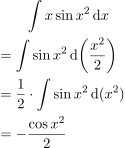
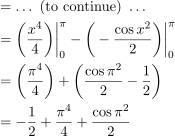
![\begin{aligned} &\qquad \int_{0}^{\pi}\int_{0}^{x}\int_{0}^{xy}x^2\sin z\,\mathrm{d}z\,\mathrm{d}y\,\mathrm{d}x \\ & = \int_{0}^{\pi}\int_{0}^{x}\big( -x^2\cos z\big)\big|_{z=0}^{z=xy}\,\mathrm{d}y\,\mathrm{d}x \\ & = \int_{0}^{\pi}\int_{0}^{x}(-x^2)(\cos xy-1)\,\mathrm{d}y\,\mathrm{d}x \\ & = \int_{0}^{\pi} (-x^2)\bigg(\frac{\sin xy}{x}-y\bigg)\bigg|_{y=0}^{y=x}\,\mathrm{d}x \\ & = \int_{0}^{\pi} (-x^2)\bigg( \frac{\sin x^2}{x}-x \bigg)\,\mathrm{d}x \\ & = \int_{0}^{\pi} (x^3 - x\sin x^2)\,\mathrm{d}x \\ & = \int_{0}^{\pi}x^3\,\mathrm{d}x - \int_{0}^{\pi} x\sin x^2\,\mathrm{d}x \\ & = \bigg( \frac{x^4}{4} \bigg)\bigg|_{0}^{\pi} - \bigg[ \cdots \bigg] \\ & = \enspace \dots \textrm{ (to be continued) }\dots \end{aligned}](https://physicspupil.com/wp-content/ql-cache/quicklatex.com-705c529a32c98933b62b3916d36478e2_l3.svg "Rendered by QuickLaTeX.com")
Roughwork. (Integration by parts)
For Exercises 1-8, evaluate the given triple integral.
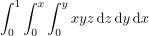
Solution.
![\begin{aligned} &\qquad \int_{0}^{1}\int_{0}^{x}\int_{0}^{y}xyz\,\mathrm{d}z\,\mathrm{d}y\,\mathrm{d}x \\ & = \int_{0}^{1}\int_{0}^{x} \bigg( \frac{xyz^2}{2}\bigg|_{z=0}^{z=y} \bigg)\,\mathrm{d}y\,\mathrm{d}x \\ & = \int_{0}^{1}\int_{0}^{x} \frac{xy^3}{2}\,\mathrm{d}y\,\mathrm{d}x \\ & = \int_{0}^{1} \bigg( \frac{xy^4}{8}\bigg|_{y=0}^{y=x} \bigg) \,\mathrm{d}x \\ & = \int_{0}^{1} \frac{x^5}{8}\,\mathrm{d}x \\ & = \bigg[ \frac{x^6}{48} \bigg]_{0}^{1} \\ & = \frac{1}{48} \\ \end{aligned}](https://physicspupil.com/wp-content/ql-cache/quicklatex.com-494694de5af1769156ad6675597d4f03_l3.svg "Rendered by QuickLaTeX.com")
For Exercises 1-8, evaluate the given triple integral.
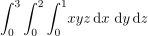
Solution.
![\begin{aligned} & \qquad \int_{0}^{3}\int_{0}^{2}\int_{0}^{1}xyz\,\mathrm{d}x\,\mathrm{d}y\,\mathrm{d}z \\ & = \int_{0}^{3}\int_{0}^{2} \bigg(\frac{x^2yz}{2}\bigg|_{x=0}^{x=1}\bigg)\,\mathrm{d}y\,\mathrm{d}z \\ & = \int_{0}^{3}\int_{0}^{2}\bigg(\frac{yz}{2}\bigg)\,\mathrm{d}y\,\mathrm{d}z \\ & = \int_{0}^{3}\bigg( \frac{y^2z}{4}\bigg|_{y=0}^{y=2} \bigg) \,\mathrm{d}z \\ & = \int_{0}^{3} z\,\mathrm{d}z \\ & = \bigg[\frac{z^2}{2}\bigg]_{0}^{3} \\ & = 4\frac{1}{2} \\ \end{aligned}](https://physicspupil.com/wp-content/ql-cache/quicklatex.com-73a9a99dffed3134dd8c75fb87dea5aa_l3.svg "Rendered by QuickLaTeX.com")