If  and
and  where
where  and
and  are both acute angles, find, without using tables or a calculator,
(a)  ,
,
(b)  ,
,
(c)  .
.
Extracted from J. F. Talbert & H. H. Heng. (1995). Additional Mathematics Pure and Applied (6e).
Roughwork.
(a)
Not yet to approach a solution, I wish to get a feel of the problem from three perspectives— i. algebraic, ii. geometric, and iii. differential:
(i. algebraic)

(ii. geometric)

(iii. differential)
Let  . Then, recall that

because of Taylor series/expansion of a function  at some point
  :
:

such that in our situation, you know, we have  (the Maclaurin series):

Now that we have enough, here begins the
Solution.
(i. algebraic)

(ii. geometric)


(iii. differential)
That angles and are acute angles, i.e.,

does not imply  is also an acute angle, but that
 .
.

© 2010 Geek3 / GNU-FDL, https://commons.wikimedia.org/wiki/File:Sine_cosine_one_period.svg
such that

Letting ,
![\begin{aligned} &\quad \textrm{Area under curve }f(x)\textrm{ in }x\in [0,A+B] \\ & = \int_{0}^{A+B}f(x)\,\mathrm{d}x \\ & = \int_{0}^{A+B}\sin (x)\,\mathrm{d}x \\ & = \big[-\cos x\big]_{0}^{A+B} \\ & = 1-\cos (A+B) \\ \end{aligned}](https://physicspupil.com/wp-content/ql-cache/quicklatex.com-7a1ffee415130e89327242e3b074b258_l3.svg "Rendered by QuickLaTeX.com")
![\begin{aligned} &\quad \textrm{Area under curve }f(x)\textrm{ in }x\in [0,A] \\ & = \int_{0}^{A}f(x)\,\mathrm{d}x \\ & = \int_{0}^{A}\sin (x)\,\mathrm{d}x \\ & = \big[-\cos x\big]_{0}^{A} \\ & = 1-\cos A \\ & = 1-\frac{4}{5} \\ & = \frac{1}{5} \\ \end{aligned}](https://physicspupil.com/wp-content/ql-cache/quicklatex.com-539b5472307c7cc30ca70e73257bde59_l3.svg "Rendered by QuickLaTeX.com")
![\begin{aligned} &\quad \textrm{Area under curve }f(x)\textrm{ in }x\in [0,B] \\ & = \int_{0}^{B}f(x)\,\mathrm{d}x \\ & = \int_{0}^{B}\sin (x)\,\mathrm{d}x \\ & = \big[-\cos x\big]_{0}^{B} \\ & = 1-\cos B \\ & = 1-\frac{12}{13} \\ & = \frac{1}{13} \\ \end{aligned}](https://physicspupil.com/wp-content/ql-cache/quicklatex.com-80e157f252926927bc32bfe2e5d71e7a_l3.svg "Rendered by QuickLaTeX.com")
![\begin{aligned} &\quad \textrm{Area under curve }f(x)\textrm{ in }x\in [B,A] \\ & = \frac{1}{5}-\frac{1}{13} \\ & = \frac{8}{65} \\ \end{aligned}](https://physicspupil.com/wp-content/ql-cache/quicklatex.com-4ff65c8583fe1e9bd19789a38205903b_l3.svg "Rendered by QuickLaTeX.com")
![\begin{aligned} &\quad \textrm{Area under curve }f(x)\textrm{ in }x\in [A,A+B] \\ & = 1-\cos (A+B) - \frac{1}{5} \\ & = \frac{4}{5}-\cos (A+B) \\ \end{aligned}](https://physicspupil.com/wp-content/ql-cache/quicklatex.com-22b5f5363bb4bbdb21f88deb72538268_l3.svg "Rendered by QuickLaTeX.com")
then letting  , and noting in a right-angled triangle the cosine of an angle admits of no negative values, so can it further be said

I lost my way…
Let  be the difference in degrees between time-varying angles
  and
and  where assumed is
  without loss of generality.

Taking partial derivatives wrt , ,  , and
, and  :
:


I lost my faith…
If

then
 .
.
By equality  it states that the output value
  of
of  is determined by input values of two arguments
  ;
;
by equality  that the output value of is determined by input values
  , i.e., by one significant argument
  , and another trivial argument
  ; and
; and
by equality  that the output value of is determined by input values
  , i.e., by one trivial argument
  , and another significant argument
  .
.
Hence, assuming a partial variation

we WTS the following

LHS:
![\begin{aligned} &\quad\enspace \frac{\mathrm{d}}{\mathrm{d}t}\sin (\texttt{var1}+\texttt{var2}) \\ & = \big[\cos (\texttt{var1}+\texttt{var2})\big] (\texttt{var1}'+\texttt{var2}') \\ \end{aligned}](https://physicspupil.com/wp-content/ql-cache/quicklatex.com-58fec73a7a10caf999d02267e803b8e9_l3.svg "Rendered by QuickLaTeX.com")
RHS:

and LHS=RHS implies:

(to be continued)


 ,
, ;
;


 :
:
 :
:
 :
:


 in radius of its base and
  in height.
 of the cone, using what are so-called
  .
.

![\begin{aligned} \frac{R}{h} & = \frac{r}{h-z} = \tan\theta \\ r & = R\bigg( 1-\frac{z}{h}\bigg) \\ V & = \pi R^2\int_{0}^{h}\bigg( 1-\frac{z}{h}\bigg)^2\,\mathrm{d}z \\ \cdots & \cdots\cdots\cdots\cdots\cdots\cdots\cdots \\ \textrm{let }& z'=1-\frac{z}{h} \\ \frac{\mathrm{d}z'}{\mathrm{d}z} & = -\frac{1}{h} \\ \mathrm{d}z & = -h\,\mathrm{d}z' \\ z=0 & \Leftrightarrow z'=1 \\ z=h & \Leftrightarrow z'= 0 \\ \cdots & \cdots\cdots\cdots\cdots\cdots\cdots\cdots \\ V& = \pi R^2\int_{1}^{0} z'^2(-h\,\mathrm{d}z') \\ & = -\pi R^2h \bigg[ \frac{z'^3}{3}\bigg]\bigg|_{1}^{0} \\ & = -\pi R^2h \bigg(\frac{(0)^3}{3} - \frac{(1)^3}{3}\bigg) \\ & = \frac{\pi R^2h}{3}\\ \end{aligned}](https://physicspupil.com/wp-content/ql-cache/quicklatex.com-c82832fa803b3f7f367a1777e5229fd8_l3.svg "Rendered by QuickLaTeX.com")

 -axis by integrating the slices (/cross sections) ranging between
 ![\theta\in [0,2\pi ]](https://physicspupil.com/wp-content/ql-cache/quicklatex.com-15eb5ad510855b5fc2c3bc9b1b9abfe4_l3.svg "Rendered by QuickLaTeX.com") .
. .
. .
. .
. .
.![\displaystyle{\frac{1}{4}(3y-2)-\bigg[ y-\frac{1}{y}(7-3y)\bigg] =-\frac{1}{4}y-7}](https://physicspupil.com/wp-content/ql-cache/quicklatex.com-fc95addad543512317800f8a23bd4507_l3.svg "Rendered by QuickLaTeX.com") .
.

 for
for  :
:

 for
for 

 for
for  :
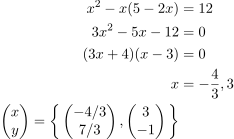
:

 for
for 
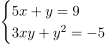
 for
for 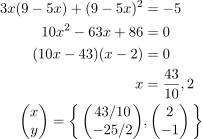

 for
for 

 for
for 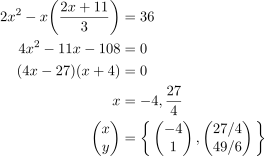
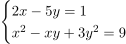
 for
for 

 for
for 

 for
for 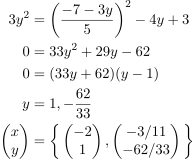
 in Fourier series.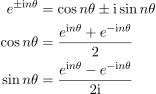
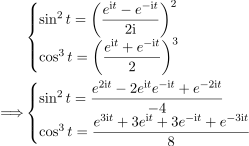
 .
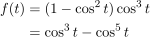
.
 is as expanded
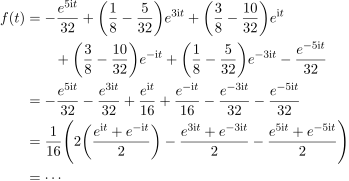
 .
. satisfying
  is called a periodic function, and the smallest
  its period. A periodic function

 . The coefficients of the Fourier series are found by using the orthogonality properties of sine and cosine functions over a period: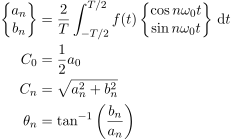
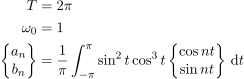
 :
:![\begin{aligned} a_0 & = \frac{1}{\pi}\int_{-\pi}^{\pi}\sin^2t\cos^3t\,\mathrm{d}t \\ \cdots\enspace\textrm{Let }& u=\sin t\textrm{ s.t. }\mathrm{d}t=\frac{\mathrm{d}u}{\cos t}\enspace\cdots \\ & = \frac{1}{\pi}\int_{t=-\pi}^{t=\pi}u^2\cos^2t\,\mathrm{d}u \\ & = \frac{1}{\pi}\int_{t=-\pi}^{t=\pi}u^2(1-u^2)\,\mathrm{d}u \\ & = \frac{1}{\pi}\int_{t=-\pi}^{t=\pi}(u^2-u^4)\,\mathrm{d}u \\ & = \frac{1}{\pi}\bigg[ \frac{u^3}{3}-\frac{u^5}{5} \bigg]\bigg|_{t=-\pi}^{t=\pi} \\ & = \frac{1}{\pi}\bigg[ \frac{\sin^3t}{3}-\frac{\sin^5t}{5} \bigg]\bigg|_{t=-\pi}^{t=\pi} \\ & = 0 \\ \end{aligned}](https://physicspupil.com/wp-content/ql-cache/quicklatex.com-d583ae6f5ca5004737bd61c8c302a97c_l3.svg "Rendered by QuickLaTeX.com")
 :
:![\begin{aligned} a_1 & = \frac{1}{\pi}\int_{-\pi}^{\pi}\sin^2t\cos^4t\,\mathrm{d}t \\ \dots\enspace &\textrm{By WolframAlpha}\enspace\dots \\ & = \frac{1}{\pi}\bigg[\frac{1}{192}(12t+3\sin (2t)-3\sin (4t)-\sin (6t))\bigg]\bigg|_{-\pi}^{\pi} \\ & = \frac{1}{\pi}\bigg(\frac{24\pi}{192}\bigg) \\ & = \frac{1}{8} \\ \end{aligned}](https://physicspupil.com/wp-content/ql-cache/quicklatex.com-1e3322729803545339064a82f75780e7_l3.svg "Rendered by QuickLaTeX.com")