202311270959 Exercise 1.4.33

Simplify:

(AB)^{-1}(AC^{-1})(D^{-1}C^{-1})^{-1}D^{-1}.

Extracted from H. Anton & C. Rorres. (2010). Elementary Linear Algebra Application Version (10e)

Answer. B^{-1}


Roughwork.

Let

\begin{aligned} A_{m\times n}&:m\textrm{-by-}n \\ B_{n\times o}&:n\textrm{-by-}o \\ (C^{\mathrm{T}})_{n\times p}}&:n\textrm{-by-}p \\ (D^{\mathrm{T}})_{q\times n}&:q\textrm{-by-}n \\ C_{p\times n}&:p\textrm{-by-}n \\ D_{n\times q}&:n\textrm{-by-}q \\ (AB)_{m\times o}&:m\textrm{-by-}o \\ ((AB)^{\mathrm{T}})_{o\times m}&:o\textrm{-by-}m \\ ((AC)^{\mathrm{T}})_{m\times p}&:m\textrm{-by-}p \\ (D^{\mathrm{T}}C^{\mathrm{T}})_{q\times p}&:q\textrm{-by-}p \\ ((D^{\mathrm{T}}C^{\mathrm{T}})^{\mathrm{T}})_{p\times q}&:p\textrm{-by-}q \\ \end{aligned}

such that after simplification the original array of matrices (here transpose in place of inverse) should give an o-by-n matrix. For merely satisfying this requirement one candidate can be B_{n\times o}‘s transpose, i.e., (B^{\mathrm{T}})_{o\times n}, but not much evidence than coincidence here.

Observe, that the simplified expression, in general, should \textrm{\scriptsize{NOT}} necessarily be a span (/linear combination) of matrices in the list above, for none any pair of matrices have necessarily the same dimension for which matrix addition is possible, apart from square matrices.

Hence, assume AB, C, and D to be three square matrices which are invertible.

Note, that the simplified expression should be an arrangement of matrix multiplication amongst some of 8 matrices A and A^{-1}, B and B^{-1}, C and C^{-1}, and D and D^{-1}.

Consider, by simplification the matrix product should have strictly less than r=7 factors, i.e., at most 6; and in adding an extra identity matrix I to the preceding (*such as to avoid terms AA^{\mathrm{-1}}=A^{\mathrm{-1}}A=I to go nearby) we have n=9 matrices at hand; the possible outcomes is a permutation

\text{}^9P_{6}=9^6=531441

with replacement, minus

8\times 6=48.

The chance of getting by is

\displaystyle{\frac{1}{531441-48}=\frac{1}{531393} \approx 0.000188\%.


This problem is not to be attempted.

202302200931 Review Problem 6.5.7

Let z\in\mathbb{C}. Recall that z=x+iy for some x,y\in\mathbb{R}, and we can form the complex conjugate of z by taking \overline{z}=x-iy. The function c:\mathbb{R}^2\to\mathbb{R}^2 which sends (x,y)\mapsto (x,-y) agrees with complex conjugation.

(a) Show that c is a linear map over \mathbb{R} (i.e., scalars in \mathbb{R}).
(b) Show that \overline{z} is not linear over \mathbb{C}.

Extracted from D. Cherney, et al. (2013). Linear Algebra.


Roughwork.

A function L:V\to W is linear if V and W are vector spaces and

L(ru+sv)=rL(u)+sL(v)

for all u,v\in V and r,s\in\mathbb{R}.

(a)

\begin{aligned} c(az_1+bz_2) & = c(a(x_1+iy_1)+b(x_2+iy_2)) \\ & = c((ax_1+bx_2)+i(ay_1+by_2)) \\ & = (ax_1+bx_2)+i(-(ay_1+by_2)) \\ & = (ax_1+bx_2)-i(ay_1+by_2) \\ & = a(x_1-iy_1) + b(x_2-iy_2) \\ & = a(x_1+i(-y_1)) + b(x_2+i(-y_2)) \\ & = a(c(x_1+iy_1)) + b(c(x_2+iy_2)) \\ & = ac(z_1) + bc(z_2) \\ \end{aligned}

(b)

Not to be attempted.

202009251201 Homework 1 (Q1)

Solve the system \mathbf{A}\mathbf{x} = \mathbf{0} for each matrix \mathbf{A} below.

(a)

\mathbf{A}= \begin{bmatrix}  1 & 3 & 5 & 7 \\ 3 & 5 & 7 & 9 \\ 5 & 7 & 9 & 1 \\  \end{bmatrix}

(b)

\mathbf{A}= \begin{bmatrix}  1 & 0 & 1 & 1 \\ 1 & 1 & 0 & 1 \\ 1 & 1 & -2 & 0 \\  \end{bmatrix}

(c)

\mathbf{A}= \begin{bmatrix}  4 & 6 & 0 & 1 & -9 \\ 1 & 2 & -4 & 5 & 7 \\ 2 & 3 & 6 & 4 & 2 \\ 1 & 0 & 3 & 2 & -5 \\  \end{bmatrix}

(d)

\mathbf{A}= \begin{bmatrix}  1 & 2 & 3 & 1 & 1 \\ 1 & 4 & 0 & 1 & 2 \\ 0 & 2 & -3 & 0 & 1 \\ 1 & 0 & 0 & 0 & 0 \\  \end{bmatrix}


Recall

Observe that \mathbf{A}‘s in (a) and (b) are 3-by-4 matrices, and in (c) and (d) are 4-by-5 matrices. Multiplication of two matrices \mathbf{A} and \mathbf{B} results in a matrix product \mathbf{A}\mathbf{B}. By convention, should an m-by-n matrix \mathbf{A} be written on the left, \mathbf{A} is meant the multiplicand, and should an n-by-p matrix \mathbf{B} be written on the right, \mathbf{B} is meant the multiplier. The matrix product \mathbf{AB} will become an m-by-p matrix.


Solution.

(a)

Let a 4-by-1 column vector \mathbf{x} be

\mathbf{x} = \begin{bmatrix} x_1 \\ x_2 \\ x_3 \\ x_4 \end{bmatrix}.

Then,

\begin{aligned} \mathbf{A}\mathbf{x} & = \mathbf{0} \\ \begin{bmatrix} 1 & 3 & 5 & 7 \\ 3 & 5 & 7 & 9 \\ 5 & 7 & 9 & 1 \\ \end{bmatrix} \begin{bmatrix} x_1 \\ x_2 \\ x_3 \\ x_4 \\ \end{bmatrix} & = \mathbf{0} \\ \begin{bmatrix} (1)(x_1)+(3)(x_2)+(5)(x_3)+(7)(x_4) \\ (3)(x_1)+(5)(x_2)+(7)(x_3)+(9)(x_4) \\ (5)(x_1)+(7)(x_2)+(9)(x_3)+(1)(x_4) \\ \end{bmatrix} & = \begin{bmatrix} 0 \\ 0 \\ 0 \\ \end{bmatrix} \end{aligned}

Here we have four unknowns but three equations.

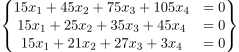
\begin{Bmatrix} 15x_1+ 45x_2+75x_3+105x_4 & = 0 \\ 15x_1+25x_2+35x_3+45x_4 & = 0 \\ 15x_1+21x_2+27x_3+3x_4 & = 0 \\ \end{Bmatrix}

It is feasible to carry through all the calculations, but do let us not work in so awkward a manner.

Performing row operations of matrices and using shorthand notations (e.g., R_1 stands for Row 1; 5R_2 stands for 5 times each entry in Row 2; R_1-R_3 means every entry in Row 3 is to be subtracted from the corresponding entry in Row 1.)

(1) R_3-5R_1

\begin{bmatrix}  1 & 3 & 5 & 7 \\ 3 & 5 & 7 & 9 \\ 0 & -8 & -16 & -34 \\  \end{bmatrix}

(2) R_2 - 3R_1

\begin{bmatrix}  1 & 3 & 5 & 7 \\ 0 & -4 & -8 & 12 \\ 0 & -8 & -16 & -34 \\  \end{bmatrix}

(3) R_3 - 2R_2

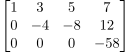
\begin{bmatrix}  1 & 3 & 5 & 7 \\ 0 & -4 & -8 & 12 \\ 0 & 0 & 0 & -58 \\  \end{bmatrix}

(4) R_3 \div (-58)

\begin{bmatrix}  1 & 3 & 5 & 7 \\ 0 & -4 & -8 & 12 \\ 0 & 0 & 0 & 1 \\  \end{bmatrix}

(5) R_2-12R_3

\begin{bmatrix}  1 & 3 & 5 & 7 \\ 0 & -4 & -8 & 0 \\ 0 & 0 & 0 & 1 \\  \end{bmatrix}

(6) R_1-7R_3

\begin{bmatrix}  1 & 3 & 5 & 0 \\ 0 & -4 & -8 & 0 \\ 0 & 0 & 0 & 1 \\  \end{bmatrix}

(7) R_2 \div (-4)

\begin{bmatrix}  1 & 3 & 5 & 0 \\ 0 & 1 & 2 & 0 \\ 0 & 0 & 0 & 1 \\  \end{bmatrix}

(8) R_1-3R_2

\begin{bmatrix}  1 & 0 & -1 & 0 \\ 0 & 1 & 2 & 0 \\ 0 & 0 & 0 & 1 \\  \end{bmatrix}

The matrix above is called the reduced row-echelon form of \mathbf{A}.

Now that the simplification has come handy:

\begin{aligned} x_1 -x_3 &=0 \\ x_2 +2x_3 & = 0 \\ x_4 & = 0 \\ \end{aligned}

and the answer is \mathbf{x}=\begin{bmatrix} x \\ -2x \\ x \\ 0 \end{bmatrix}.


Questions (b), (c), and (d) are left the readers.

202004231606 Exercise 1, Section 1.1

Determine whether the vectors emanating from the origin and terminating at the following pair of points are parallel.

(a) (3,1,2) and (6,4,2)

(b) (-3,1,7) and (9,-3,-21)

(c) (5,-6,7) and (-5,6,-7)

(d) (2,0,-5) and (5,0,-2)


Background.

Two nonzero vectors x and y are called parallel if y=tx for some nonzero real number t. (Thus nonzero vectors having the same or opposite directions are parallel.)

Text on pg.3


Solution.

(a) Let x=(3,1,2) and y=(6,4,2). Apparently \nexists\, t\in \mathbb{R} such that y=tx. For otherwise (6,4,2)=t(3,1,2), the system of equations

\begin{aligned} 6 & = 3t \\ 4 & = 1t \\ 2 & = 2t \\ \end{aligned}

is inconsistent. They are not parallel.

(b) Let x=(-3,1,7) and y=(9,-3,-21), then y=-3x. The vectors x and y are in opposite direction and the magnitude of y is three times that of x. They are parallel.

(c) Let x=(5,-6,7) and y=(-5,6,-7). Observe that they are in equal magnitude but in opposite direction, i.e., y=-x. They are also parallel.

(d) Let x=(2,0,-5) and y=(5,0,-2). Assume t\in\mathbb{R} s.t. y=tx, i.e.,

\begin{aligned} 5 & = 2t \\ 0 & = 0t \\ -2 & = 5t \\ \end{aligned}

no way will the first and the third lines agree. They are nonparallel.