If  , find expressions for:
1.  .
.
2.  .
.
3. 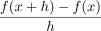 .
.
Solution.
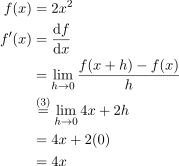
1.
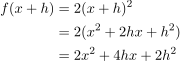
2.
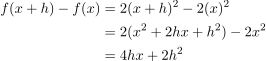
3.
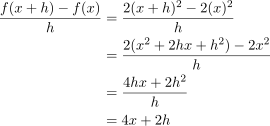

Remark.
The first step to derivation from first principles, is calculate the slope of tangent
,
and put the limit  , i.e.,
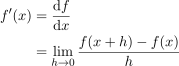
a right-hand limit.
Afterword.

物理子衿
If , find expressions for:
1. .
2. .
3. .
Solution.
1.
2.
3.
Remark.
The first step to derivation from first principles, is calculate the slope of tangent
,
and put the limit , i.e.,
a right-hand limit.
Afterword.
If  , find the values of
  ,
,  ,
,  ,
,  ,
,  ,
,  .
.
Solution.

On reflection.
Suppose you are given an unknown quadratic function  such that

and you are asked to make polynomial interpolation.


And then is the interpolated polynomial  .
.
If  , find the values of , , ,
  ,
,  ,
,  .
.
Solution.
Given .

This exercise is done.
On reflection.
Suppose you are given the following conditions:

and you are asked to interpolate by Lagrange polynomials over the range ![[0,2]](https://physicspupil.com/wp-content/ql-cache/quicklatex.com-1571666a47302be9ed925a760be14ff0_l3.svg "Rendered by QuickLaTeX.com") .
.

The interpolating polynomial  checks with the original function
  .
.