202009260344 Exercise 2.5.1

Show that x=e^{2\theta}\sin\theta satisfies the equation x''-4x'+5x=0.


Solution.

(bottom-up)

Let x' denote \displaystyle{\frac{\mathrm{d}x}{\mathrm{d}\theta}}, x'' denote \displaystyle{\frac{\mathrm{d}^2x}{\mathrm{d}\theta^2}}.

\begin{aligned} x' & = \frac{\mathrm{d}}{\mathrm{d}\theta} \big( e^{2\theta} \sin\theta  \big) \\ & = e^{2\theta} \cdot \frac{\mathrm{d}}{\mathrm{d}\theta} \big( \sin\theta  \big) + \sin\theta \cdot \frac{\mathrm{d}}{\mathrm{d}\theta} \big( e^{2\theta} \big) \\ & = e^{2\theta} \cos\theta + 2e^{2\theta}\sin\theta \\ & = e^{2\theta}(\cos\theta + 2\sin\theta ) \\ \end{aligned}

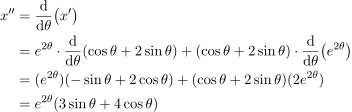
\begin{aligned} x'' & = \frac{\mathrm{d}}{\mathrm{d}\theta} \big( x'  \big) \\ & = e^{2\theta} \cdot \frac{\mathrm{d}}{\mathrm{d}\theta} (\cos\theta +2\sin\theta ) + (\cos\theta + 2\sin\theta )\cdot \frac{\mathrm{d}}{\mathrm{d}\theta} \big( e^{2\theta} \big) \\ & = (e^{2\theta})(-\sin\theta + 2\cos\theta ) + (\cos\theta + 2\sin\theta )(2e^{2\theta }) \\ & = e^{2\theta}(3\sin\theta + 4 \cos\theta ) \\ \end{aligned}

To know whether or not x=e^{2\theta}\sin\theta is a solution, I simply do substitution in the equation x''-4x'+5x=0.

\begin{aligned} \textrm{LHS} & = x''-4x'+5x \\ & = e^{2\theta}(3\sin\theta +4\cos\theta )-4\big[ e^{2\theta}(\cos\theta +2\sin\theta )\big] + 5\big(e^{2\theta}\sin\theta \big) \\ & = \dots \\ & = 0 \\ & = \textrm{RHS} \\ \end{aligned}


Revision.

(top-down)

We are given a second-order linear homogeneous ordinary differential equation (ODE):

x''-4x'+5x = 0

with some independent variable \theta and some dependent variable x(\theta )=e^{2\theta }\sin\theta, the coefficients of x'', x', and x being constants 1, -4, and 5.

Let the primed [ *]' be the function derived wrt. to \theta. Following the routine procedures,

\begin{aligned} x & = e^{r\theta} \\ x' & = re^{r\theta }\\ x'' & = r\cdot ( e^{r\theta })' + r' \cdot ( e^{r\theta }) \\ & = r^2e^{r\theta} \end{aligned}

rewrite it,

\begin{aligned} x''-4x'+5x & = 0 \\ r^2e^{r\theta} - 4re^{r\theta} + 5e^{r\theta} & = 0 \\ \dots  \textrm{\quad excepting\quad} & x=e^{r\theta}=0\textrm{\quad \dots} \\ r^2 -4r+5 & = 0 \\ \end{aligned}

and we shall obtain the auxiliary equation (aka. the characteristic equation) on the very last line.

r=\displaystyle{\frac{-(-4)\pm\sqrt{(-4)^2-4(1)(5)}}{2(1)}}=2\pm \textrm{i}.


Note.

If the roots of the auxiliary equation ar^2+br+c=0 are the complex numbers r_1=\alpha +\textrm{i}\beta and r_2=\alpha -\textrm{i}\beta, the general solution of ay''+by'+cy=0 is

y=e^{\alpha x}(c_1\cos\beta x+c_2\sin\beta x)

(please refer to J. Stewart’s Calculus, Second-Order Linear Differential Equations)


Now that r_1=2+\textrm{i} and r_2=2-\textrm{i} and c_1, c_2 are arbitrary constants, to this 2^{\textrm{nd}}-order ODE, the general solution is

x=e^{2\theta}(c_1\cos\theta +c_2\sin\theta ).


Examination.

It is a good practice, no matter how much time one would allow oneself, to countercheck one’s solution…

Here it goes,

\begin{aligned} x & =e^{2\theta}(c_1\cos\theta +c_2\sin\theta )  \\ & = (c_2e^{2\theta })(\sin\theta ) + (c_1e^{2\theta })(\cos\theta ) \\ \end{aligned}.

\begin{aligned} x' & = e^{2\theta}(-c_1\sin\theta +c_2\cos\theta ) + 2e^{2\theta}(c_1\cos\theta +c_2\sin\theta ) \\ & = (2c_2e^{2\theta }-c_1e^{2\theta})(\sin\theta ) + (2c_1e^{2\theta} + c_2e^{2\theta} )(\cos\theta ) \\ \end{aligned}

\begin{aligned} x''& = \big[ (2c_2e^{2\theta }-c_1e^{2\theta})(\sin\theta ) \big]' + \big[ (2c_1e^{2\theta} + c_2e^{2\theta} )(\cos\theta ) \big]' \\ & = \big[ (2c_2e^{2\theta}-c_1e^{2\theta })(\cos\theta )+(4c_2e^{2\theta }-2c_1e^{2\theta })(\sin\theta ) \big] \\ & \qquad\quad + \big[ (2c_1e^{2\theta }+c_2e^{2\theta })(-\sin\theta )+(4c_1e^{2\theta }+2c_2e^{2\theta })(\cos\theta ) \big] \\ & = (-4c_1e^{2\theta }+3c_2e^{2\theta })(\sin\theta ) + (3c_1e^{2\theta }+4c_2e^{2\theta })(\cos\theta ) \\ \end{aligned}

Then,

\begin{aligned} \textrm{LHS} & =  x'' - 4x' + 5x \\ & = \big( (-4c_1e^{2\theta }+3c_2e^{2\theta })-4(2c_2e^{2\theta}-c_1e^{2\theta})+5c_2e^{2\theta}\big)(\sin\theta ) \\ & \qquad\quad + \big( (3c_1e^{2\theta}+4c_2e^{2\theta}) - 4(2c_1e^{2\theta}+c_2e^{2\theta})+5c_1e^{2\theta} \big)(\cos\theta ) \\ & = 0 \\ & = \textrm{RHS} \end{aligned}


In conclusion, x=e^{2\theta}\sin\theta is a particular solution, the general solution being x=e^{2\theta}(c_1\cos\theta +c_2\sin\theta ).

202009250041 Exercise 5.8.1

Find out if any the asymptote(s) of the curve given by:

y=\displaystyle{\frac{x^2-6x+3}{x-3}}.


Attempts.

\begin{aligned} & & x & -3 & &  \\\cline{3-5} x & -3 \Big) & x^2 & -6x & +3 & \\ & & x^2 & -3x & & \\ \cline{3-5} & & & -3x & +3 \\ & & & -3x & +9 \\\cline{4-5} & & & & -6 \end{aligned}

The curve is given by

\begin{aligned} y & =\displaystyle{\frac{x^2-6x+3}{x-3}} \\ & = x-3 - \displaystyle{\frac{6}{x-3}} \end{aligned}.


Ans. Of the given curve, x=3 is a vertical asymptote and y=x-3 an oblique asymptote.


Retrospectively, for f(x)=\displaystyle{\frac{x^2-6x+3}{x-3}}, maybe one could also have checked the conditions as follow:

i. \displaystyle{\lim_{x\to 0}}f(x);

ii. \displaystyle{\lim_{x\to 3^{+}}}f(x);

iii. \displaystyle{\lim_{x\to 3^{-}}}f(x);

iv. \displaystyle{\lim_{x\to +\infty}}f(x); and

iv. \displaystyle{\lim_{x\to -\infty}}f(x).


i.

\begin{aligned} \lim_{x\to 0}f(x) & = \lim_{x\to 0} \frac{x^2-6x+3}{x-3} \\ & = \frac{(0)^2-6(0)+3}{(0)-3} \\ & = -1 \end{aligned}

iii.

\begin{aligned} \lim_{x\to 3^{-}}f(x) & = \lim_{x\to 3^{-}} \frac{x^2-6x+3}{x-3} \\ & = \lim_{x\to 3^{-}} \bigg(  x-3-\frac{6}{x-3} \bigg) \\ & = 3^{-} -3-\frac{6}{3^{-}-3} \\ & = (3^{-}-3) + \bigg( \frac{6}{3-3^{-}} \bigg) \\ & \\ \hline & \\ & \because 3^{-} < 3 \\ & \therefore 3^{-}-3<0\qquad \textrm{and}\qquad 3-3^{-}>0 \\ & \dots \textrm{excuse me for writing with no more ado,}\dots \\ & \\ \hline & \\ & = 0^{-} + \frac{6}{0^{+}} \\ & = +\infty \\ \end{aligned}

ii., iv., and iv. are not checked.


Just work with it like whom I was taught:

First, find the slope of tangent to the curve,

\begin{aligned} f(x) & = \frac{x^2-6x+3}{x-3} \\ f'(x) & = \frac{\mathrm{d}}{\mathrm{d}x}\big( f(x) \big) \\ & = \frac{(x-3)(2x-6)-(x^2-6x+3)(1)}{(x-3)^2}  \\ & = \frac{(2x^2-12x+18)-(x^2-6x+3)}{(x-3)^2} \\ & = \frac{x^2-6x+15}{x^2-6x+9} \\ & = 1 + \frac{6}{x^2-6x+9} \end{aligned}

The purpose is to find out any crests or troughs, because at the tip or bottom of a plotted curve, the slope of tangent will be zero, i.e., f'(x)=0.

Secondly, find the change of slope of tangent to the curve,

\begin{aligned} f''(x) & = \frac{\mathrm{d}}{\mathrm{d}x}\big[ f'(x) \big] \\ & = \frac{\mathrm{d}}{\mathrm{d}x} \bigg( 1+\frac{6}{x^2-6x+9}  \bigg) \\ & = \frac{\mathrm{d}}{\mathrm{d}x} \big( 1 \big) + \frac{\mathrm{d}}{\mathrm{d}x} \bigg(  \frac{6}{x^2-6x+9} \bigg) \\ & = 0 + \frac{(x^2-6x+9)(0)+(6)(2x-6)}{(x^2-6x+9)^2} \\ & = \frac{12x-36}{(x^2-6x+9)^2} \\ \end{aligned}

The purpose is to find out if there were any inflexion points (i.e., f''(x)=0) upon which curvature changes sign.


It begins, assuming x\neq 3, I will set f(x)=0:

\begin{aligned} f(x) & = 0 \\ \Leftrightarrow \qquad\qquad x^2-6x+3 & = 0 \\ x & = \frac{-(-6)\pm \sqrt{(-6)^2-4(1)(3)}}{2(1)} \\ & = 3 \pm \sqrt{6} \\ \end{aligned}

The x-intercepts are thus two, 3+\sqrt{6} and 3-\sqrt{6} .

Then I needs set f'(x)=0 with the same assumption x\neq 3.

\begin{aligned} f'(x) & = 0 \\ \Leftrightarrow \qquad \qquad 1+\frac{6}{x^2-6x+9} & = 0 \\ & \\ \textrm{\dots \quad by assumption }x\neq 3 & \enspace \textrm{jump legitimately to the next step\quad \dots} \\ & \\ x^2-6x+9+6 & = 0 \\ x^2 -6x +15 & = 0 \\ x & = \frac{-(-6)\pm \sqrt{(-6)^2-4(1)(15)}}{2(1)} \\ & = 3 \pm \sqrt{6}\, \textrm{i} \end{aligned}

As curvature here permits of no nonreal points, there are neither convex point(s) nor concave point(s).

Besides, there are none any one point of inflexion because if on one hand f''(x)=0 and on the other x\neq 3 be assumed,

\begin{aligned} \frac{12x-36}{(x^2-6x+9)^2} & = 0 \\ \Rightarrow 12x-36 & = 0 \\ \Rightarrow x & =3\qquad\qquad\qquad \bot \\ \end{aligned}

it would have resulted in contradiction.


In conclusion, this exercise was overdone.