
A right pyramid,  high, stands on a rectangular base
  by
by  . Calculate
 (a) the length of an edge of the pyramid; (b) the angles the triangular faces made with the base; (c) the volume of the pyramid.
Extracted from A. Godman & J. F. Talbert. (1973). Additional Mathematics Pure and Applied in SI Units.
Roughwork.
Commit my visualization to drawing.
A right pyramid is a pyramid where the base is circumscribed about the circle and the altitude of the pyramid meets at the circle’s center.
Wikipedia on Pyramid (geometry)

The pyramid above has a polygonal base, here the rectangle  , and an apex
  , here the common vertex of triangles
  ,
,  ,
,  , and
, and  . The altitude is based on the origin
  . To suit our coordinates to this problem, we write
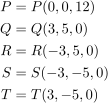

such that
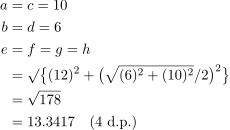
For the edges of its base, write
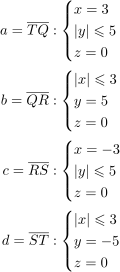
and for, the lateral, edge  :
:

edge  :
:

edge  :
:

and edge  :
:

For lateral surface  enclosed by edges
  ,
,  , and
, and  , write
![A(x,y,z):\begin{cases} (x,y,z)\in [0,3]\times [-5,5]\times [0,12] \\ \textrm{s.t. }\displaystyle{\frac{|y|}{5}\leqslant \frac{x}{3}=1-\frac{z}{12}} \\ \end{cases}](https://physicspupil.com/wp-content/ql-cache/quicklatex.com-59d2f630b733430dc75304d173637862_l3.svg "Rendered by QuickLaTeX.com")

for lateral surface  by edges
  , , and
  , write:
![B(x,y,z):\begin{cases} (x,y,z)\in [-3,3]\times [0,5]\times [0,12] \\ \textrm{s.t. }\displaystyle{\frac{|x|}{3}\leqslant \frac{y}{5}=1-\frac{z}{12}} \\ \end{cases}](https://physicspupil.com/wp-content/ql-cache/quicklatex.com-f8db9d0cedb3ec91bd6288b8bee1475d_l3.svg "Rendered by QuickLaTeX.com")

for lateral surface  by edges
  , , and
  , write:
![C(x,y,z):\begin{cases} (x,y,z)\in [-3,0]\times [-5,5]\times [0,12] \\ \textrm{s.t. }\displaystyle{\frac{|y|}{5}\leqslant -\frac{x}{3}=1-\frac{z}{12}} \\ \end{cases}](https://physicspupil.com/wp-content/ql-cache/quicklatex.com-079c13efeb454ce6a635461d11dae48a_l3.svg "Rendered by QuickLaTeX.com")

for lateral surface  by edges
  , , and , write:
![D(x,y,z):\begin{cases} (x,y,z)\in [-3,3]\times [-5,0]\times [0,12] \\ \textrm{s.t. }\displaystyle{\frac{|x|}{3}\leqslant -\frac{y}{5}=1-\frac{z}{12}} \\ \end{cases}](https://physicspupil.com/wp-content/ql-cache/quicklatex.com-20b512cefd3f6a733132c75fa93316fc_l3.svg "Rendered by QuickLaTeX.com")

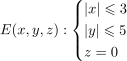
and for base  by edges , , , and :

write
This problem is not to be attempted.

 ,
, ;
;


 :
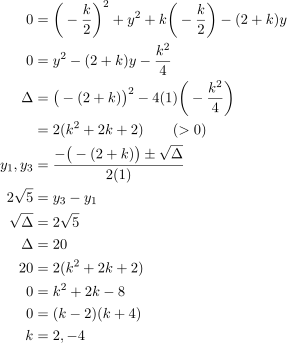
:
 :
:
 :
:


 and
and  where
where  ,
, ,
, .
.

 . Then, recall that
 at some point
 (the Maclaurin series):


 is also an acute angle, but that
 .
.

![\begin{aligned} &\quad \textrm{Area under curve }f(x)\textrm{ in }x\in [0,A+B] \\ & = \int_{0}^{A+B}f(x)\,\mathrm{d}x \\ & = \int_{0}^{A+B}\sin (x)\,\mathrm{d}x \\ & = \big[-\cos x\big]_{0}^{A+B} \\ & = 1-\cos (A+B) \\ \end{aligned}](https://physicspupil.com/wp-content/ql-cache/quicklatex.com-7a1ffee415130e89327242e3b074b258_l3.svg "Rendered by QuickLaTeX.com")
![\begin{aligned} &\quad \textrm{Area under curve }f(x)\textrm{ in }x\in [0,A] \\ & = \int_{0}^{A}f(x)\,\mathrm{d}x \\ & = \int_{0}^{A}\sin (x)\,\mathrm{d}x \\ & = \big[-\cos x\big]_{0}^{A} \\ & = 1-\cos A \\ & = 1-\frac{4}{5} \\ & = \frac{1}{5} \\ \end{aligned}](https://physicspupil.com/wp-content/ql-cache/quicklatex.com-539b5472307c7cc30ca70e73257bde59_l3.svg "Rendered by QuickLaTeX.com")
![\begin{aligned} &\quad \textrm{Area under curve }f(x)\textrm{ in }x\in [0,B] \\ & = \int_{0}^{B}f(x)\,\mathrm{d}x \\ & = \int_{0}^{B}\sin (x)\,\mathrm{d}x \\ & = \big[-\cos x\big]_{0}^{B} \\ & = 1-\cos B \\ & = 1-\frac{12}{13} \\ & = \frac{1}{13} \\ \end{aligned}](https://physicspupil.com/wp-content/ql-cache/quicklatex.com-80e157f252926927bc32bfe2e5d71e7a_l3.svg "Rendered by QuickLaTeX.com")
![\begin{aligned} &\quad \textrm{Area under curve }f(x)\textrm{ in }x\in [B,A] \\ & = \frac{1}{5}-\frac{1}{13} \\ & = \frac{8}{65} \\ \end{aligned}](https://physicspupil.com/wp-content/ql-cache/quicklatex.com-4ff65c8583fe1e9bd19789a38205903b_l3.svg "Rendered by QuickLaTeX.com")
![\begin{aligned} &\quad \textrm{Area under curve }f(x)\textrm{ in }x\in [A,A+B] \\ & = 1-\cos (A+B) - \frac{1}{5} \\ & = \frac{4}{5}-\cos (A+B) \\ \end{aligned}](https://physicspupil.com/wp-content/ql-cache/quicklatex.com-22b5f5363bb4bbdb21f88deb72538268_l3.svg "Rendered by QuickLaTeX.com")
 , and noting in a right-angled triangle the cosine of an angle admits of no negative values, so can it further be said
 be the difference in degrees between time-varying angles
  and
and  where assumed is
  without loss of generality.
 , and
, and  :
:


 .
. it states that the output value
  of
of  is determined by input values of two arguments
  ;
; that the output value
  , i.e., by one significant argument
  , and another trivial argument
  ; and
; and that the output value
  , i.e., by one trivial argument
  , and another significant argument
  .
.

![\begin{aligned} &\quad\enspace \frac{\mathrm{d}}{\mathrm{d}t}\sin (\texttt{var1}+\texttt{var2}) \\ & = \big[\cos (\texttt{var1}+\texttt{var2})\big] (\texttt{var1}'+\texttt{var2}') \\ \end{aligned}](https://physicspupil.com/wp-content/ql-cache/quicklatex.com-58fec73a7a10caf999d02267e803b8e9_l3.svg "Rendered by QuickLaTeX.com")


 in
in ![k[x,y]](https://physicspupil.com/wp-content/ql-cache/quicklatex.com-584acc935973e616ea2c851bc464e2d7_l3.svg "Rendered by QuickLaTeX.com") (
( .
. ? Why or why not?
![f_1,\dots ,f_s\in k[x_1,\dots ,x_n]](https://physicspupil.com/wp-content/ql-cache/quicklatex.com-5f08e62a15ff4e03854490db864f1aba_l3.svg "Rendered by QuickLaTeX.com") . We let
. We let  denote the collection
 ![\langle f_1,\dots ,f_s\rangle = \{ p_1f_1+\cdots +p_sf_s:p_i\in k[x_1,\dots ,x_n]\}](https://physicspupil.com/wp-content/ql-cache/quicklatex.com-f334ab4b3301b6106a075356020d5bc8_l3.svg "Rendered by QuickLaTeX.com") for
for  .
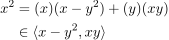
.
 .
.![p_1,p_2,p_3\in k[x,y]](https://physicspupil.com/wp-content/ql-cache/quicklatex.com-12dccf91798ff1604735efc161b91edc_l3.svg "Rendered by QuickLaTeX.com") ,
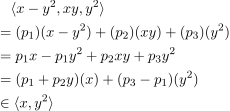
,
 .
.![p_1,p_2\in k[x,y]](https://physicspupil.com/wp-content/ql-cache/quicklatex.com-0f988f74e666d0747607e1462e98d6e8_l3.svg "Rendered by QuickLaTeX.com") ,
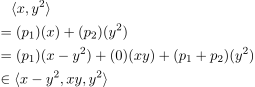
,
 .
.