202211221415 Exercise 29.4.1

Use this fact, that the difference between a vacuum energy density \rho_v and \rho_m or \rho_r is that \rho_v does not change as the universe expands (though it may change for other physical reasons), the basic Friedman equation Eq. (29.13):

\displaystyle{\dot{a}^2-\frac{8\pi G}{3}(\rho_m+\rho_r+\rho_v)a^2=K}

with K=0, and the assumption of vacuum dominance (\rho_m=\rho_r\approx 0) to show that Eq. (29.9):

a(t)=a(t_s)\exp \Big(\sqrt{\frac{8}{3}\pi G\rho_v}(t-t_s)\Big).

This form of the equation is valuable because it no longer refers to the present state of the universe.

Extracted from Thomas A. Moore. (2013). A General Relativity Workbook.


Roughwork.

This solution is not mine. It was found on the Internet some years ago, to whose author(s) I lost references.

\begin{aligned} 0 & = \dot{a}^2-\frac{8\pi G}{3}\rho_va^2\\ \bigg(\frac{\mathrm{d}a}{\mathrm{d}t}\bigg)^2 & = \frac{8\pi G}{3}\rho_va^2 \\ \frac{1}{a}\frac{\mathrm{d}a}{\mathrm{d}t} & = \sqrt{\frac{8\pi G}{3}\rho_v} \\ \ln \big( a(t)\big) & = \bigg(\sqrt{\frac{8\pi G}{3}\rho_v}\bigg)\cdot t + C \\ a(t)& =a(t_s)\exp \bigg(\sqrt{\frac{8}{3}\pi G\rho_v}(t-t_s)\bigg) \\ \end{aligned}

202110121413 Exercise 8.5.B (Q21)

This exercise is related to Einstein’s famous law E=mc^2. The relativistic momentum p of a particle of mass m moving at a speed v along a straight line (say, the x-axis) is

\displaystyle{p=\frac{mv}{\sqrt{1-\frac{v^2}{c^2}}}},

where c is the speed of light. The relativistic force on the particle along that line is

\displaystyle{F=\frac{\mathrm{d}p}{\mathrm{d}t}},

which is the same formula as Newton’s Second Law of motion in classical mechanics. Assume that the particle starts at rest at position x_1 and ends at position x_2 along the x-axis. The work done by the force F on the particle is:

\displaystyle{W=\int_{x_1}^{x_2}F\,\mathrm{d}x=\int_{x_1}^{x_2}\frac{\mathrm{d}p}{\mathrm{d}t}\,\mathrm{d}x}

(a) Show that

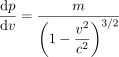
\displaystyle{\frac{\mathrm{d}p}{\mathrm{d}v}=\frac{m}{\bigg( \displaystyle{1-\frac{v^2}{c^2}}\bigg)^{3/2}}}.

(b) Use the Chain Rule formula

\displaystyle{\frac{\mathrm{d}p}{\mathrm{d}t}=\frac{\mathrm{d}p}{\mathrm{d}v}\frac{\mathrm{d}v}{\mathrm{d}x}\frac{\mathrm{d}x}{\mathrm{d}t}}

to show that

\displaystyle{F\,\mathrm{d}x=v\frac{\mathrm{d}p}{\mathrm{d}v}\,\mathrm{d}v}.

(c) Use parts (a) and (b) to show that

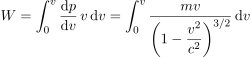
\displaystyle{W=\int_{0}^{v}\frac{\mathrm{d}p}{\mathrm{d}v}\, v\,\mathrm{d}v=\int_{0}^{v}\frac{mv}{\bigg(\displaystyle{ 1-\frac{v^2}{c^2}}\bigg)^{3/2}}\,\mathrm{d}v}.

(d) Use part (c) to show that

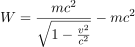
\displaystyle{W=\frac{mc^2}{\sqrt{1-\frac{v^2}{c^2}}}-mc^2}.

(e) Define the relativistic kinetic energy K of the particle to be K=W, and define the total energy E to be

\displaystyle{E=\frac{mc^2}{\sqrt{1-\frac{v^2}{c^2}}}}.

So by part (d), K=E-mc^2. Show that

E^2=p^2c^2+(mc^2)^2.

(Hint: Expand the right side of that equation.)

(f) What is E when the particle is at rest?


Solution.

(a)

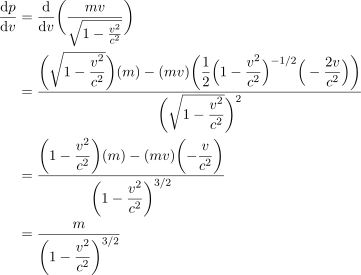
\begin{aligned} \frac{\mathrm{d}p}{\mathrm{d}v} & = \frac{\mathrm{d}}{\mathrm{d}v}\bigg( \frac{mv}{\sqrt{1-\frac{v^2}{c^2}}}\bigg) \\ & = \frac{\bigg(\sqrt{1-\displaystyle{\frac{v^2}{c^2}}}\bigg)(m)-(mv)\bigg(\displaystyle{\frac{1}{2}}\Big( 1-\displaystyle{\frac{v^2}{c^2}}\Big)^{-1/2}\Big( -\displaystyle{\frac{2v}{c^2}}\Big)\bigg)}{\bigg(\sqrt{1-\displaystyle{\frac{v^2}{c^2}}}\bigg)^2} \\ & = \frac{\bigg( 1-\displaystyle{\frac{v^2}{c^2}}\bigg) (m)-(mv)\bigg( \displaystyle{-\frac{v}{c^2}}\bigg)}{\bigg( 1-\displaystyle{\frac{v^2}{c^2}}\bigg)^{3/2}} \\ & = \frac{m}{\bigg( 1-\displaystyle{\frac{v^2}{c^2}}\bigg)^{3/2}} \end{aligned}

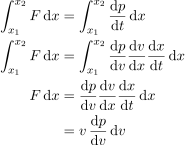
(b)

\begin{aligned} \int_{x_1}^{x_2}F\,\mathrm{d}x & = \int_{x_1}^{x_2}\frac{\mathrm{d}p}{\mathrm{d}t}\,\mathrm{d}x \\ \int_{x_1}^{x_2}F\,\mathrm{d}x & = \int_{x_1}^{x_2}\frac{\mathrm{d}p}{\mathrm{d}v}\frac{\mathrm{d}v}{\mathrm{d}x}\frac{\mathrm{d}x}{\mathrm{d}t}\,\mathrm{d}x \\ F\,\mathrm{d}x & = \frac{\mathrm{d}p}{\mathrm{d}v}\frac{\mathrm{d}v}{\mathrm{d}x}\frac{\mathrm{d}x}{\mathrm{d}t}\,\mathrm{d}x \\ & = v\,\frac{\mathrm{d}p}{\mathrm{d}v}\,\mathrm{d}v\\ \end{aligned}

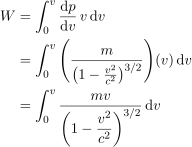
(c)

\begin{aligned} W & =\int_{0}^{v}\frac{\mathrm{d}p}{\mathrm{d}v}\, v\,\mathrm{d}v \\ & = \int_{0}^{v}\Bigg( \frac{m}{\big( 1-\frac{v^2}{c^2}\big)^{3/2}}\Bigg) (v)\,\mathrm{d}v\\ & =\int_{0}^{v}\frac{mv}{\bigg(\displaystyle{ 1-\frac{v^2}{c^2}}\bigg)^{3/2}}\,\mathrm{d}v \\ \end{aligned}.

(d)

\begin{aligned} W & = \int_{0}^{v}\frac{mv}{\bigg(\displaystyle{1-\frac{v^2}{c^2}}\bigg)^{3/2}}\,\mathrm{d}v \\ \dots\enspace & \textrm{let }u=\frac{v}{c}\enspace\dots \\ \dots\enspace & \textrm{then }\mathrm{d}v=c\,\mathrm{d}u\enspace\dots \\ & = \int_{0}^{\frac{v}{c}}\frac{mc^2u}{(1-u^2)^{\frac{3}{2}}}\,\mathrm{d}u \\ \dots\enspace & \textrm{let }u=\sin\theta\enspace\dots \\ \dots\enspace & \textrm{then }\mathrm{d}u=\cos\theta\,\mathrm{d}\theta\enspace\dots \\ & = \int\frac{mc^2\sin\theta}{\cos^3\theta}\cdot\cos\theta\,\mathrm{d}\theta \\ & = \int\frac{mc^2\sin\theta}{\cos^2\theta}\,\mathrm{d}\theta \\ \dots\enspace & \textrm{let }w=\cos\theta\enspace\dots \\ \dots\enspace & \textrm{then }\mathrm{d}w=-\sin\theta\,\mathrm{d}\theta\enspace\dots \\ & \quad -\int \frac{mc^2}{w^2}\,\mathrm{d}w \\ & = \frac{mc^2}{w} \\ & = \frac{mc^2}{\cos\theta} \\ & = mc^2\sec\theta \\ & = \frac{mc^2}{\sqrt{1-u^2}} \\ & = \enspace\dots \\ & = \bigg[\frac{mc^2}{\sqrt{1-u^2}}\bigg]\bigg|^{\frac{v}{c}}_{0} \\ & = \frac{mc^2}{\sqrt{1-\displaystyle{\frac{v^2}{c^2}}}}-mc^2 \\ \end{aligned}

Parts (e) and (f) are left to the readers.

202010260718 Exercises 2.1 (Q1)

(Sketch of a proof)

\displaystyle{\frac{\mathrm{d}^2u^{i}}{\mathrm{d}t^2}} + \Gamma_{jk}^{i}\displaystyle{\frac{\mathrm{d}u^{j}}{\mathrm{d}t}}\displaystyle{\frac{\mathrm{d}u^{k}}{\mathrm{d}t}} = h(s) \displaystyle{\frac{\mathrm{d}u^{i}}{\mathrm{d}t}}

where h(s)=-\displaystyle{\frac{\mathrm{d}^2t}{\mathrm{d}s^2}\bigg( \frac{\mathrm{d}t}{\mathrm{d}s}\bigg)^{-2}}

will reduce to Eq. (2.11):

\displaystyle{\frac{\mathrm{d}^2u^{i}}{\mathrm{d}t^2}} + \Gamma_{jk}^{i}\displaystyle{\frac{\mathrm{d}u^{j}}{\mathrm{d}t}}\displaystyle{\frac{\mathrm{d}u^{k}}{\mathrm{d}t}}=0

if and only if t=As+B.

That is to say,

h(s) \displaystyle{\frac{\mathrm{d}u^{i}}{\mathrm{d}t}}=0 if and only if t=As+B.

(if-part) Assume t=As+B, then \displaystyle{\frac{\mathrm{d}^2t}{\mathrm{d}s^2}}=0. From h(s)= - \big( 0\big) \bigg( \displaystyle{\frac{\mathrm{d}t}{\mathrm{d}s}} \bigg)^{-2}=0, we have h(s)\displaystyle{\frac{\mathrm{d}u^{i}}{\mathrm{d}t}}=0.

(only-if part). Assume h(s)\displaystyle{\frac{\mathrm{d}u^i}{\mathrm{d}t}}=0, then some one of the following should be true:

i. \displaystyle{\frac{\mathrm{d}^2t}{\mathrm{d}s^2}}=0;

ii. \bigg(\displaystyle{\frac{\mathrm{d}t}{\mathrm{d}s}}\bigg)^{-2}=0;

iii. \displaystyle{\frac{\mathrm{d}u^i}{\mathrm{d}t}}=0.

Situation ii. implies that \displaystyle{\frac{\mathrm{d}s}{\mathrm{d}t}}=0, which is impossible for \displaystyle{\frac{\mathrm{d}t}{\mathrm{d}s}}\neq \infty and t=f(s) cannot have a point at infinity.

Situation iii. is impossible because it is only for some, but not any, i‘s in spherical coordinates (i.e., r, \theta, \phi), that u^i=0. It is also for some i‘s that \displaystyle{\frac{\mathrm{d}u^i}{\mathrm{d}t}}=0. As i‘s are to be chosen arbitrarily, the equality cannot hold.

As the second and the third were ruled out, the first situation is what that could be left possible.

The proof is as yet incomplete. It remains to be shown that

\displaystyle{\iint\bigg(\frac{\mathrm{d}^2t}{\mathrm{d}s^2}\bigg)\,\mathrm{d}s\,\mathrm{d}s}=0 \qquad \Longrightarrow \qquad t=As+B.

201903030616 Exercise 17.2.1

Let \mathbf{A} and \mathbf{B} be arbitrary vector field and covariant vector field.

Following Eq. (17.17), the scalar product A^\mu B_{\mu} upon absolute differentiation is by definition:

\begin{aligned} \nabla_\alpha (A^\mu B_{\mu}) & = (\nabla_\alpha A^\mu )B_\mu + A^\mu (\nabla_\alpha B_\mu ) \\ & = \bigg( \displaystyle{\frac{\partial A^{\mu}}{\partial x^\alpha}} +\Gamma^{\mu}_{\alpha\nu} A^\nu  \bigg) B_\mu + A^\mu (\nabla_\alpha B_\mu ) \end{aligned}

On the other hand, following Eq. (17.18),

\begin{aligned} \nabla_\alpha (A^\mu B_\mu ) & =\partial_\alpha (A^\mu B_\mu ) \\ & = \displaystyle{\frac{\partial A^\mu}{\partial x^\alpha}}B_\mu + A^\mu \displaystyle{\frac{\partial B_\mu}{\partial x^\alpha}} \end{aligned}.

Equating Eq. (17.17) with Eq. (17.18):

\begin{aligned} \bigg( \displaystyle{\frac{\partial A^{\mu}}{\partial x^\alpha}} +\Gamma^{\mu}_{\alpha\nu} A^\nu  \bigg) B_\mu + A^\mu (\nabla_\alpha B_\mu )  & = \displaystyle{\frac{\partial A^\mu}{\partial x^\alpha}}B_\mu + A^\mu \displaystyle{\frac{\partial B_\mu}{\partial x^\alpha}} \\ \Gamma^\mu_{\alpha\nu}A^\nu B_\mu + A^\mu (\nabla_\alpha B_\mu )  & = A^\mu \displaystyle{\frac{\partial B_\mu}{\partial x^\alpha}} \\ A^\mu (\nabla_\alpha B_\mu ) & = A^\mu \displaystyle{\frac{\partial B_\mu}{\partial x^\alpha}} - \Gamma^\mu_{\alpha\nu} A^\nu B_\mu \\ A^\mu (\nabla_\alpha B_\mu ) & = A^\mu \displaystyle{\frac{\partial B_\mu}{\partial x^\alpha}} - \Gamma^\nu_{\alpha\mu} A^\mu B_\nu \\ \nabla_\alpha B_\mu & = \displaystyle{\frac{\partial B_\mu}{\partial x^\alpha}} - \Gamma^\nu_{\alpha\mu}B_\nu \end{aligned}

I have proven Eq. (17.7).

201903030526 Problem 6.1

The covariant derivative of v^\mu is defined:

v^\mu_{;\alpha}=\partial_\alpha v^\mu +\Gamma^\mu_{\alpha\beta}v^\beta.

The Christoffel symbols are all zeros for Cartesian coordinates in the plane. For the metric tensor of Cartesian coordinates being the 2\times 2 identity matrix, and all its elements constants, the Christoffel symbols of the first kind as well as the second should be zero:

\begin{aligned} V^x_{;x}&=\partial_xV^x\\ V^y_{;x}&=\partial_xV^y\\ V^x_{;y}&=\partial_yV^x\\ V^y_{;y}&=\partial_yV^y \end{aligned}

The metric tensor for polar coordinates in the plane is derived below:

\mathbf{r}=(r\sin\theta ,r\cos\theta)

From

\begin{aligned} \hat{\mathbf{e}}_r&=\frac{\partial}{\partial r}(\mathbf{r})=(\sin\theta ,\cos\theta) \\ \hat{\mathbf{e}}_\theta &=\frac{\partial}{\partial \theta}(\mathbf{r})=(r\cos\theta ,-r\sin\theta ) \end{aligned},

and hence

\begin{aligned} \hat{\mathbf{e}}_r\cdot \hat{\mathbf{e}}_r&=\sin^2\theta +\cos^2\theta =1\\ \hat{\mathbf{e}}_\theta\cdot \hat{\mathbf{e}}_\theta &=r^2\cos^2\theta +(-r)^2\sin^2\theta =r^2 \\ \hat{\mathbf{e}}_r\cdot \hat{\mathbf{e}}_\theta &=\hat{\mathbf{e}}_\theta\cdot \hat{\mathbf{e}}_r=r\sin\theta\cos\theta -r\sin\theta\cos\theta =0 \end{aligned},

it follows that the metric tensor \mathbf{G}=(g_{ij}) is

\begin{bmatrix} 1 & 0 \\ 0 & r^2  \end{bmatrix}.

Since only the (2,2)^{\textrm{th}} element is a non-constant dependent on r, I expect that some of the Christoffel symbols will be zeros.

Two formulae for Christoffel symbols of the second kind:

\begin{aligned} \Gamma^\alpha_{\alpha\beta}&(=\Gamma^\alpha_{\beta\alpha})=\displaystyle{\frac{\partial}{\partial x^\beta}\bigg( \frac{1}{2}\ln |g_{\alpha\alpha}| \bigg)}\\ \Gamma^\alpha_{\beta\beta}&=\displaystyle{-\frac{1}{2g_{\alpha\alpha}}\frac{\partial}{\partial x^\alpha}(g_{\beta\beta})}\qquad\quad (\alpha\neq\beta) \end{aligned}

Because the (1,1)^\textrm{th}, (1,2)^\textrm{th}, and (2,1)^\textrm{th} elements are constants, referring to the preceding formulae I can preclude these terms 0= \Gamma^1_{11}=\Gamma^1_{12}= \Gamma^1_{21}=\Gamma^2_{11}=\Gamma^2_{22} and consider only the terms \Gamma^1_{22}, \Gamma^2_{12}, and \Gamma^2_{21}.

Neatly written,

\begin{aligned} \Gamma^1_{22}&(=\Gamma^r_{\theta\theta})=\displaystyle{-\frac{1}{2(1)}\frac{\partial }{\partial r}(r^2)}=-r\\ \Gamma^2_{12}&(=\Gamma^\theta_{r\theta})=\displaystyle{\frac{\partial}{\partial r}}\bigg( \displaystyle{\frac{1}{2}\ln r^2}\bigg) =\displaystyle{\frac{1}{r}} \\ \Gamma^2_{21}&(=\Gamma^\theta_{\theta r}) =\displaystyle{\frac{1}{r}} \end{aligned}

By the formula for covariant differentiation

v^\mu_{;\alpha}=\partial_\alpha v^\mu +\Gamma^\mu_{\alpha\beta}v^\beta

the following can be obtained:

\begin{aligned} V^r_{;r}&=\partial_rV^r,\\ V^r_{;\theta}&=\partial_\theta V^r-rV^\theta ,\\ V^\theta_{;r}&=\partial_rV^\theta +\frac{1}{r}V^\theta ,\\ V^\theta_{;\theta}&=\partial_\theta V^\theta +\frac{1}{r}V^r \end{aligned}.

201903030450 Exercise 9.1.1

The Schwarzschild metric is given by Eq. (9.3):

\mathrm{d}s^2=-\bigg( 1-\displaystyle{\frac{r_s}{r}} \bigg) \mathrm{d}t^2+\bigg( 1-\displaystyle{\frac{r_s}{r}} \bigg)^{-1}\,\mathrm{d}r^2+r^2\,\mathrm{d}\theta +r^2\sin^2\theta\,\mathrm{d}\phi^2

whereas the metric for spherical coordinates in flat spacetime is given by Eq. (9.2):

\mathrm{d}s^2=-\mathrm{d}t^2+\mathrm{d}r^2+r^2\,\mathrm{d}\theta^2+r^2\sin^2\theta\,\mathrm{d}\phi^2

Along a purely radial worldline \mathrm{d}t=0, \mathrm{d}\theta =0 and \mathrm{d}\phi =0, of the Schwarzschild metric will become

\mathrm{d}s^2=\bigg( 1-\displaystyle{\frac{r_s}{r}} \bigg)^{-1}\,\mathrm{d}r^2.

Now that the Schwarzschild radius r_s is 2GM, there is Eq. (9.15):

\mathrm{d}s=\displaystyle{\frac{\mathrm{d}r}{\sqrt{1-2GM/r}}}.

The total radial distance between two events differing only by r-coordinates, i.e., r_A and r_B is calculated by definite integration, given by Eq. (9.16):

\Delta s=\displaystyle{\int \mathrm{d}s=\int_{r_A}^{r_B}\frac{\mathrm{d}r}{\sqrt{1-2GM/r}}}

Trying binomial approximation:

(1+x)^n =1+nx+\displaystyle{\frac{n(n-1)}{2!}}x^2 +\displaystyle{\frac{n(n-1)(n-2)}{3!}}x^3+O(x^4)

then,

\begin{aligned} &\quad\enspace (1-2GM/r)^{-\frac{1}{2}} \\ & =1+\bigg(-\frac{1}{2}\bigg)(-2GM/r) +\displaystyle{\frac{(-\frac{1}{2})(-\frac{1}{2}-1)}{2!}}(-2GM/r)^2+O(r^2) \\ \end{aligned}

Considering only first-order approximation:

1+\displaystyle{\frac{GM}{r}}.

Upon integration, there is Eq. (9.17):

\begin{aligned} \Delta s & \approx \displaystyle{\int_{r_A}^{r_B}}\bigg( 1+\displaystyle{\frac{GM}{r}}\bigg) \,\mathrm{d}r \\ & = \bigg[ r+GM\ln \bigg( \displaystyle{\frac{r_B}{r_A}} \bigg)  \bigg]\bigg|_{r_A}^{r_B} \\ & = (r_B-r_A) + GM\ln \bigg( \frac{r_B}{r_A} \bigg) \end{aligned}