
The blogger claims no originality of his question below.
Find the equivalent resistance between nodes  and
and  .
.

Solution:
We notice that the leftmost resistor is short-circuited, and we have the following diagram:

Or, more neatly drawn, we have

The equivalent resistance is  .
.
 and
and  .
.
 ‘s in series is
  :
:
 :
:
 in series,
  :
:
 .
. and
and  .
.

 .
.

 .
. .
. .
.
 and
and  ;
; ,
,  ,
,  , etc. Different nodes with the same electric potential will be labelled with the same label, as shown below:

 .(Alternatively one can use the
  –
– transformation.)
 . Thus
 .
.
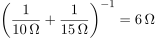 .
.
 .
.
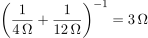 .
.
 .
.
 ,
,  ,
,  , and
, and  , when the switch is
 . Similarly, that of
  . The equivalent resistance
  of
of  . Thus
  .
.
 . Similarly, that of
  . Thus the equivalent resistance of them in series is
  .
.

 . The resistor has a uniform composition. The current direction is indicated by the arrow. In which direction (A, B or C) does the current have the least resistance?
 . After the circuit is connected to a battery, the voltmeter readings of
  and
and  are
are  and
and  respectively. Find the potential difference (p.d.) across points
  is an answer.