202401301506 Solution to 2000-CE-PHY-II-28

Two insulated uncharged metal spheres X and Y are placed in contact. A positively-charged rod is brought near X as shown below. X is then earthed momentarily. The charged rod is removed and the two spheres are then separated. Describe the charges on X and Y. (modified)


Roughwork.

Have some mental pictures (*make drawings if you don’t have ample RAM).

First, when a positively-charged rod is brought near X, charges are induced:

Notice that on surface areas X and Y making contact, as boxed below:

the net charge is zero, Q=0. Hence, the plus and the minus signs (representing positive and negative charges) are erased from the drawing:

Then, X is earthed momentarily:

it is convenient to treat the two spheres X and Y as one body X+Y:

The process of earthing enables a transfer of negative free charges (electrons being the carrier) unidirectionally between two bodies:

here from the earth to the body, but no reversed (why?); the plus and minus signs, as boxed below:

should cancel off each other, and are thus erased from the drawing:

once the charged rod is removed:

the negative charges will be redistributed over X+Y such that the electrostatic repulsive forces between them are kept to a minimum:

after the two spheres are separated,

both spheres X and Y will be negative charged. The descriptions go complete.


This problem is not to be attempted.

202312191041 Electrostatics Diagrams (Elementary) Q1

The blogger claims no originality of his problem below.

We have an arrangement of three positive (point) charges +Q_{A}, +Q_{B}, and +Q_{C} of the same quantity (=Q), as if lying in the vertices A, B, and C of an equilateral triangle \triangle ABC, where \mathbf{r}_{BA}, \mathbf{r}_{AC}, and \mathbf{r}_{CB} are the same magnitude r.

Intuitively, these three like charges are \textrm{\scriptsize{NOT}} in electrostatic equilibrium for acting between them are \textrm{\scriptsize{NET}} repulsive forces, not until we place a negative (point) charge -q of some yet unknown quantity q in the centre O, pointing to which some attractive forces of yet also unknown magnitudes.

Express q in terms of Q and r.


Setup.

\begin{aligned} |\mathbf{r}_{BA}| & = |\mathbf{r}_{AC}| = |\mathbf{r}_{CB}| = r \\ |\mathbf{r}'_{A}| & = |\mathbf{r}'_{B}| = |\mathbf{r}'_{C}| = \frac{\sqrt{3}}{3}r \\ \mathbf{r}_{BA} & = \mathbf{r}'_{A} - \mathbf{r}'_{B} \\ \mathbf{r}_{AC} & = \mathbf{r}'_{C} - \mathbf{r}'_{A} \\ \mathbf{r}_{CB} & = \mathbf{r}'_{B} - \mathbf{r}'_{C} \\ \text{}_{B}\mathbf{F}_{A} & = \text{}_{B}F_{A}\,\hat{\mathbf{r}}_{BA} \\ \text{}_{C}\mathbf{F}_{A} & = -\text{}_{C}F_{A}\,\hat{\mathbf{r}}_{AC} \\ \text{}_{C}\mathbf{F}_{B} & = \text{}_{C}F_{B}\,\hat{\mathbf{r}}_{CB} \\ \text{}_{A}\mathbf{F}_{B} & = -\text{}_{A}F_{B}\,\hat{\mathbf{r}}_{BA} \\ \text{}_{A}\mathbf{F}_{C} & = \text{}_{A}F_{C}\,\hat{\mathbf{r}}_{AC} \\ \text{}_{B}\mathbf{F}_{C} & = -\text{}_{B}F_{C}\,\hat{\mathbf{r}}_{CB} \\ \text{}_{B}F_{A} & = |\text{}_{B}\mathbf{F}_{A}| = F \\ \text{}_{C}F_{A} & = |\text{}_{C}\mathbf{F}_{A}| = F \\ \text{}_{C}F_{B} & = |\text{}_{C}\mathbf{F}_{B}| = F \\ \text{}_{A}F_{B} & = |\text{}_{A}\mathbf{F}_{B}| = F \\ \text{}_{A}F_{C} & = |\text{}_{A}\mathbf{F}_{C}| = F \\ \text{}_{B}F_{C} & = |\text{}_{B}\mathbf{F}_{C}| = F \\ \mathbf{F}_{A} & = \text{}_{B}\mathbf{F}_{A} + \text{}_{C}\mathbf{F}_{A} \\ \mathbf{F}_{B} & = \text{}_{C}\mathbf{F}_{B} + \text{}_{A}\mathbf{F}_{B} \\ \mathbf{F}_{C} & = \text{}_{A}\mathbf{F}_{C} + \text{}_{B}\mathbf{F}_{C} \\ \mathbf{F}_{A} & = F_{A}\,\hat{\mathbf{r}}'_{A} \\ \mathbf{F}_{B} & = F_{B}\,\hat{\mathbf{r}}'_{B} \\ \mathbf{F}_{C} & = F_{C}\,\hat{\mathbf{r}}'_{C} \\ F_{A} & = |\mathbf{F}_{A}| = F' \\ F_{B} & = |\mathbf{F}_{B}| = F' \\ F_{C} & = |\mathbf{F}_{C}| = F' \\ \end{aligned}

Write, by Coulomb’s law,

\begin{aligned} F & = k\frac{(Q)(Q)}{(r)^2} \\ & = k\frac{Q^2}{r^2} \\ \end{aligned}

such that

\begin{aligned} \text{}_{B}\mathbf{F}_{A} & = F\cos 60^\circ\,\hat{\mathbf{i}} + F\sin 60^\circ\,\hat{\mathbf{j}} \\ & = \bigg( k\frac{Q^2}{r^2}\bigg) \bigg(\frac{1}{2}\bigg) \,\hat{\mathbf{i}} + \bigg( k\frac{Q^2}{r^2}\bigg) \bigg(\frac{\sqrt{3}}{2}\bigg) \,\hat{\mathbf{j}} \\ \text{}_{C}\mathbf{F}_{A} & = -F\cos 60^\circ\,\hat{\mathbf{i}} + F\sin 60^\circ\,\hat{\mathbf{j}} \\ & = -\bigg( k\frac{Q^2}{r^2}\bigg) \bigg(\frac{1}{2}\bigg) \,\hat{\mathbf{i}} + \bigg( k\frac{Q^2}{r^2}\bigg) \bigg(\frac{\sqrt{3}}{2}\bigg) \,\hat{\mathbf{j}} \\ \mathbf{F}_{A} & = \text{}_{B}\mathbf{F}_{A} + \text{}_{C}\mathbf{F}_{A} \\ & = 0\,\hat{\mathbf{i}} + \bigg( k\frac{Q^2}{r^2}\bigg)(\sqrt{3})\,\hat{\mathbf{j}} \\ F' & = |\mathbf{F}_A| \\ & = \bigg( k\frac{Q^2}{r^2}\bigg)(\sqrt{3}) \\ \end{aligned}

and

\begin{aligned} F' & = k\frac{(Q)(q)}{(\sqrt{3}r/3)^2} \\ \bigg( k\frac{Q^2}{r^2}\bigg) (\sqrt{3}) & = \bigg( k\frac{Qq}{r^2}\bigg) (3)\\ q & = \frac{\sqrt{3}}{3} Q \\ \end{aligned}

\therefore We should put a negative charge -q of quantity \sqrt{3}Q/3 in order for the system to reach electrostatic equilibrium.


This problem is not to be attempted.

202311081445 Pastime Exercise 006

The figure below is a representation of the \mathbf{E}-field by electric field lines in a family R of infinitely many quadratic functions

y_t(x_{t'})=a_tx_{t'}^2+b_tx_{t'}+c_t


Roughwork.

A tangent to any quadratic curve at some point in the locus gives the \mathrm{\pm ve} direction of the electric force experienced by a (positive) test charge placed there. I.e.,

\displaystyle{T(x_{t'},y_{t})=\frac{\mathrm{d}}{\mathrm{d}x}\big( y_t(x_{t'})\big) = 2a_tx_{t'}+b_{t}},

the slope of tangent.

WLOG we work with the first quadrant. First, begin with the repulsive force \mathrm{}_Q\mathbf{F}_{q} acting on the test charge +q due to point charge +Q.

\begin{aligned} \mathrm{}_QF_{q,x}^2+\mathrm{}_QF_{q,y}^2 & = \mathrm{}_QF_{q}^2 \\ \mathrm{}_QF_{q,y} & = \bigg(\frac{y_t}{x_{t'}+d/2}\bigg)\mathrm{}_QF_{q,x} \\ \cdots\cdots & \cdots\cdots\\ \mathrm{}_QF_{q,x} & = \frac{\mathrm{}_QF_{q}}{\sqrt{1+\Big(\frac{y_t}{x_{t'}+d/2}\Big)^2}} \\ \mathrm{}_QF_{q,y} & = \bigg(\frac{y_t}{x_{t'}+d/2}\bigg) \Bigg(\frac{\mathrm{}_QF_{q}}{\sqrt{1+\Big(\frac{y_t}{x_{t'}+d/2}\Big)^2}}\Bigg) \\ \cdots\cdots & \cdots\cdots\\ \mathrm{}_Q\mathbf{F}_{q} & = \mathrm{}_QF_{q,x}\,\hat{\mathbf{i}}+ \mathrm{}_QF_{q,y}\,\hat{\mathbf{j}} \\ \end{aligned}

Next, continue with the attractive force \mathrm{}_{-Q}\mathbf{F}_{q} acting on the test charge +q due to point charge -Q.

\begin{aligned} \mathrm{}_{-Q}F_{q,x}^2+\mathrm{}_{-Q}F_{q,y}^2 & = \mathrm{}_{-Q}F_{q}^2 \\ \mathrm{}_{-Q}F_{q,y} & = \bigg(\frac{y_t}{d/2-x_{t'}}\bigg)\mathrm{}_{-Q}F_{q,x} \\ \cdots\cdots & \cdots\cdots\\ \mathrm{}_{-Q}F_{q,x} & = \frac{\mathrm{}_{-Q}F_{q}}{\sqrt{1+\Big(\frac{y_t}{d/2-x_{t'}}\Big)^2}} \\ \mathrm{}_{-Q}F_{q,y} & = \bigg(\frac{y_t}{d/2-x_{t'}}\bigg) \Bigg(\frac{\mathrm{}_{-Q}F_{q}}{\sqrt{1+\Big(\frac{y_t}{d/2-x_{t'}}\Big)^2}}\Bigg) \\ \cdots\cdots & \cdots\cdots\\ \mathrm{}_{-Q}\mathbf{F}_{q} & = \mathrm{}_{-Q}F_{q,x}\,\hat{\mathbf{i}}+ \mathrm{}_{-Q}F_{q,y}\,\hat{\mathbf{j}} \\ \end{aligned}

Adding \mathrm{}_{Q}\mathbf{F}_{q} and \mathrm{}_{-Q}\mathbf{F}_{q} will give the resultant electric force \mathbf{F}_{E}(x_{t'},y_t).

Note that

\begin{aligned} \mathrm{}_QF_q & = k\frac{Q}{\mathrm{}_Qr_{q}^2} \\ \mathrm{}_{-Q}F_q & = k\frac{-Q}{\mathrm{}_{-Q}r_{q}^2} \\ \end{aligned}

where

\begin{aligned} \mathrm{}_Qr_q & = \sqrt{(d/2+x_{t'})^2+y_t^2} \\ \mathrm{}_{-Q}r_q & = \sqrt{(d/2-x_{t'})^2+y_t^2} \\ & \\ & \\ \end{aligned}

are the distances of a test charge at q(x_{t'},y_t) from point charges +Q at A(-d/2,0) and -Q at B(d/2,0).

The smallest angle between \mathbf{F}_{E}(x_{t'},y_{t}) and the level should be equal to the slope of tangent 2a_tx_{t'}+b_{t} at point q(x_{t'},y_t).

As of the vertex of each parabola, the x-coordinate is

\displaystyle{0=x_{t'}=-\frac{b_{t}}{2a_{t}}}

s.t. b_{t}=0, and the y-coordinate c_{t}=y_t(0).

I guess, under correction, the separation distance d is none any parameter of the loci.


Visualisation is \textrm{\scriptsize{NOT}} mathematical \textrm{\scriptsize{BUT}} conceptual.

202212201748 Solution to 2020-DSE-PHY-IA-23

Three identical resistors, a battery of negligible internal resistance, and an ideal voltmeter are connected to form Circuits (a) and (b) respectively.

Given that the voltmeter reading is 8\,\mathrm{V} in Circuit (a), what is the voltmeter reading in Circuit (b)?


Roughwork.

Redrawing a labelled diagram for (a),

and noting that

\begin{aligned} I_1=I_2 & = I/2 \\ I_3 & = 0 \\ I_4 & = I \\ R_\textrm{V}\parallel R & = R \\ R\parallel R & = R/2 \\ R_{\textrm{eq}} & = 3R/2 \\ \end{aligned}

we are about to write

\begin{aligned} I_4R & =8\,\mathrm{V}\textrm{ is given} \\ \mathcal{E} & =IR_{\textrm{eq}}\\ & = I\bigg(\frac{3R}{2}\bigg) \\ & = \frac{3}{2}(8) \\ & = 12\,\mathrm{V} \\ \end{aligned}

and obtain that the battery has an emf \mathcal{E} of 12\,\mathrm{V}. Likewise for (b),

where

\begin{aligned} I_2 & = I_4 \\ I_3 & = 0 \\ R_\textrm{V}\parallel R & = R \\ R+R_\textrm{V}\parallel R & = 2R \\ R\parallel (R+R_\textrm{V}\parallel R) & = 2R/3 \\ 12= \mathcal{E} & = I\bigg(\frac{2R}{3}\bigg) \\ \Longrightarrow\enspace IR & = 18 \\ \end{aligned}

\begin{aligned} & \quad\enspace \begin{cases} I_1R  =I_2(2R) \\ I_1+I_2 = 18/R \\ \end{cases} \\ & \Longrightarrow \begin{cases} I_1 = 12/R\\ I_2 = 6/R\\ \end{cases} \end{aligned}

being now asked for V=I_4R, the voltmeter reading, it is left to the reader.

202212071217 Solution to 1971-HL-PHY-I-7

The figure below shows a three-dimensional network in the form of a pyramid, in which A is the apex, and BCDE the square base.

Each of the eight edges of the pyramid is a wire of resistance 1\,\mathrm{\Omega}. A 12\,\mathrm{V} battery with internal resistance of 0.1\,\mathrm{\Omega} is connected across B and D. Calculate

(a) the power input of the network,
(b) the terminal voltage across the battery when current flows through the network, and
(c) the potential at the points B, C, D, and E if the apex A is earthed.


Roughwork.

Draw the circuit.

Label the potential.

Straighten the main.

Calculate the equivalent.

\begin{aligned} R_{\textrm{eq}} & = \big( R\parallel R\parallel R\big) + \big( R\parallel R\parallel R\big) \\ & = \frac{1}{\frac{1}{R}+\frac{1}{R}+\frac{1}{R}}\times 2 \\ & = \frac{2R}{3} \\ & = \frac{2(1)}{3} \\ & = \frac{2}{3}\,\mathrm{\Omega} \\ \end{aligned}

This problem is not to be attempted.

202211221451 Problem 4.10

A sphere of radius R carries a polarization

\mathbf{P}(\mathbf{r})=k\mathbf{r},

where k is a constant and \mathbf{r} the vector from the centre.
(a) Calculate the bound charges \sigma_b and \rho_b.
(b) Find the field inside and outside the sphere.

Extracted from David J. Griffiths. (1999). Introduction to Electrodynamics.


Roughwork.

The surface charge is defined by Eq. (4.11):

\sigma_b\equiv \mathbf{P}\cdot\hat{\mathbf{n}}

whereas the volume charge by Eq. (4.12):

\rho_b\equiv -\nabla \cdot \mathbf{P}.

Text on pp. 167-168

On the surface r=|\mathbf{r}|=R:

\begin{aligned} \sigma_b & = P(R\,\hat{\mathbf{r}})\cdot\hat{\mathbf{r}} \\ & = k(R\,\hat{\mathbf{r}})\cdot\hat{\mathbf{r}} \\ & = kR \end{aligned}

Under the surface \mathbf{r}=\mathbf{r}(x,y,z):

\begin{aligned} \rho_b & = -\nabla\cdot\mathbf{P} \\ & = -\bigg(\frac{\partial}{\partial x},\frac{\partial}{\partial y},\frac{\partial}{\partial z}\bigg)\cdot k(x,y,z) \\ & = -k\bigg(\frac{\partial x}{\partial x}+\frac{\partial y}{\partial y}+\frac{\partial z}{\partial z}\bigg) \\ & = -3k \end{aligned}

Notice \displaystyle{(-3k)\bigg(\frac{4\pi R^3}{3}\bigg) +(kR)(4\pi R^2)=0}, so the sphere has zero net charge, i.e., Q_\textrm{net}=0, and thus produces no electric field outside, i.e., \mathbf{E}(\mathbf{r}:r>R)=\mathbf{0}.

Eq. (4.13):

V(\mathbf{r})=\displaystyle{\frac{1}{4\pi\epsilon_0}\iint_S\frac{\sigma_b}{r}\,\mathrm{d}a'+\frac{1}{4\pi\epsilon_0}\iiint_V\frac{\rho_b}{r}\,\mathrm{d}\tau'}

and the rest is left as an exercise to the reader.

202209281050 Exercise 22.2 (Q23)

An electric field is given by \overrightarrow{E}=E_0\,\hat{\jmath}, where E_0 is a constant. Find the potential as a function of position, taking V=0 at y=0.

Extracted from R. Wolfson. (2016). Essential University Physics.


Background.

Electric field vector \overrightarrow{E} is related to electric potential V by:

\displaystyle{\overrightarrow{E}= -\bigg( \frac{\partial V}{\partial x}\,\hat{\mathbf{i}} + \frac{\partial V}{\partial y}\,\hat{\mathbf{j}} + \frac{\partial V}{\partial z}\,\hat{\mathbf{k}} \bigg)}

or reversely,

\displaystyle{V(r)=-\int\overrightarrow{E}\cdot\mathrm{d}\vec{r}}.


Write

\displaystyle{(0,E_0,0) = \bigg( -\frac{\partial V}{\partial x},-\frac{\partial V}{\partial y},-\frac{\partial V}{\partial z}\bigg) }

that implies V=V(y) is x– and z-independent.

Hence

\begin{aligned} V(y) & = -\int E_0\,\mathrm{d}y \\ & = -E_0y+C\qquad \textrm{for some constant }C \\ \because\enspace 0 & = V(y=0) = -E_0(0)+C \\ \Rightarrow C& = 0 \\ \therefore\enspace V&=V(y)=-E_0y\\ \end{aligned}

202105251532 Homework 2 (Q1)

Prove that the electric field is always perpendicular to equipotential surface.


Solution.

(The solution below is based on the manuscript of 2016-2017 PHYS3450 Electromagnetism Homework 2 Solution.)

\mathbf{E} is the electric field vector; \mathbf{dr} is a line element vector on the equipotential surface.

For any two arbitrary points a and b on the equipotential surface, we have the same potential there (i.e., V(a)=V(b)). From -\int_a^b\mathbf{E}\cdot\mathbf{dr}=V(b)-V(a)=0. Thus \mathbf{E}\cdot \mathbf{dr}=0, or, \mathbf{E}\perp\mathbf{dr}.

202105241204 Homework 1 (Q3)

Prove

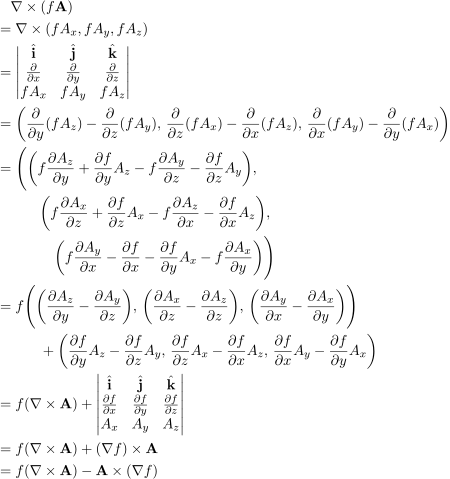
(a) \nabla \times (f\mathbf{A}) = f(\nabla \times \mathbf{A})-A\times (\nabla f)

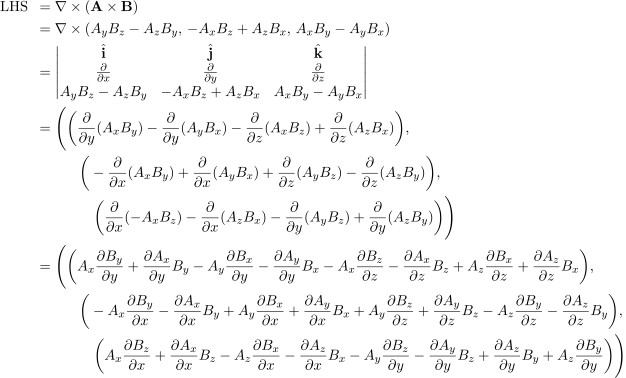
(b) \nabla \times (\mathbf{A}\times \mathbf{B})=(\mathbf{B}\cdot\nabla )\mathbf{A}+(\nabla\cdot\mathbf{B})\mathbf{A}-(\mathbf{A}\cdot\nabla )\mathbf{B}-(\nabla\cdot\mathbf{A})\mathbf{B}


Attempts. (brute force)

(a)

\begin{aligned} & \quad \nabla\times (f\mathbf{A}) \\ & = \nabla \times (fA_x,fA_y,fA_z) \\ & = \begin{vmatrix} \hat{\mathbf{i}} & \hat{\mathbf{j}} & \hat{\mathbf{k}} \\ \frac{\partial}{\partial x} & \frac{\partial}{\partial y} & \frac{\partial}{\partial z} \\ fA_x & fA_y & fA_z \end{vmatrix} \\ & = \bigg( \frac{\partial}{\partial y}(fA_z)-\frac{\partial}{\partial z}(fA_y),\, \frac{\partial}{\partial z}(fA_x) - \frac{\partial}{\partial x}(fA_z),\, \frac{\partial}{\partial x}(fA_y) - \frac{\partial}{\partial y}(fA_x) \bigg) \\ & = \Bigg( \bigg( f\frac{\partial A_z}{\partial y} + \frac{\partial f}{\partial y}A_z - f\frac{\partial A_y}{\partial z} - \frac{\partial f}{\partial z}A_y \bigg) , \\ & \quad \qquad \bigg( f\frac{\partial A_x}{\partial z} + \frac{\partial f}{\partial z}A_x - f\frac{\partial A_z}{\partial x} - \frac{\partial f}{\partial x}A_z \bigg) , \\ & \qquad \qquad \bigg( f\frac{\partial A_y}{\partial x}-\frac{\partial f}{\partial x} - \frac{\partial f}{\partial y}A_x - f\frac{\partial A_x}{\partial y} \bigg) \Bigg) \\ & = f\Bigg( \bigg( \frac{\partial A_z}{\partial y} - \frac{\partial A_y}{\partial z} \bigg) ,\, \bigg( \frac{\partial A_x}{\partial z} - \frac{\partial A_z}{\partial z} \bigg),\, \bigg( \frac{\partial A_y}{\partial x} - \frac{\partial A_x}{\partial y}\bigg) \Bigg) \\ & \quad \qquad + \bigg( \frac{\partial f}{\partial y}A_z - \frac{\partial f}{\partial z}A_y,\, \frac{\partial f}{\partial z}A_x - \frac{\partial f}{\partial x}A_z,\, \frac{\partial f}{\partial x}A_y - \frac{\partial f}{\partial y}A_x \bigg) \\ & = f(\nabla \times \mathbf{A}) + \begin{vmatrix} \hat{\mathbf{i}} & \hat{\mathbf{j}} & \hat{\mathbf{k}} \\ \frac{\partial f}{\partial x} & \frac{\partial f}{\partial y} & \frac{\partial f}{\partial z} \\ A_x & A_y & A_z \end{vmatrix} \\ & = f(\nabla \times \mathbf{A}) + (\nabla f)\times\mathbf{A} \\ & = f(\nabla \times \mathbf{A}) - \mathbf{A}\times (\nabla f) \\ \end{aligned}

(b)

\begin{aligned} \textrm{LHS}\enspace & = \nabla \times (\mathbf{A}\times \mathbf{B}) \\ & = \nabla \times (A_yB_z-A_zB_y,\, -A_xB_z+A_zB_x,\, A_xB_y-A_yB_x) \\ & = \begin{vmatrix} \hat{\mathbf{i}} & \hat{\mathbf{j}} & \hat{\mathbf{k}} \\ \frac{\partial}{\partial x} & \frac{\partial}{\partial y} & \frac{\partial}{\partial z} \\ A_yB_z-A_zB_y & -A_xB_z + A_zB_x & A_xB_y - A_yB_x \end{vmatrix} \\ & = \Bigg( \bigg( \frac{\partial}{\partial y}(A_xB_y) - \frac{\partial}{\partial y}(A_yB_x) - \frac{\partial}{\partial z}(A_xB_z) + \frac{\partial}{\partial z}(A_zB_x) \bigg) ,\, \\ & \quad \qquad \bigg( -\frac{\partial}{\partial x}(A_xB_y) + \frac{\partial}{\partial x}(A_yB_x) + \frac{\partial}{\partial z}(A_yB_z) - \frac{\partial}{\partial z}(A_zB_y) \bigg) ,\, \\ & \qquad \qquad \bigg( \frac{\partial}{\partial x}(-A_xB_z) - \frac{\partial}{\partial x}(A_zB_x) - \frac{\partial}{\partial y}(A_yB_z) + \frac{\partial}{\partial y}(A_zB_y) \bigg) \Bigg) \\ & = \Bigg( \bigg( A_x\frac{\partial B_y}{\partial y} + \frac{\partial A_x}{\partial y}B_y - A_y\frac{\partial B_x}{\partial y} - \frac{\partial A_y}{\partial y}B_x - A_x\frac{\partial B_z}{\partial z} - \frac{\partial A_x}{\partial z}B_z + A_z\frac{\partial B_x}{\partial z} + \frac{\partial A_z}{\partial z}B_x \bigg) ,\, \\ & \quad \qquad \bigg( -A_x\frac{\partial B_y}{\partial x} - \frac{\partial A_x}{\partial x}B_y + A_y\frac{\partial B_x}{\partial x}+\frac{\partial A_y}{\partial x}B_x + A_y\frac{\partial B_z}{\partial z} + \frac{\partial A_y}{\partial z}B_z - A_z\frac{\partial B_y}{\partial z} - \frac{\partial A_z}{\partial z}B_y \bigg) ,\, \\ & \qquad \qquad \bigg( A_x\frac{\partial B_z}{\partial x} + \frac{\partial A_x}{\partial x}B_z - A_z\frac{\partial B_x}{\partial x} - \frac{\partial A_z}{\partial x}B_x - A_y\frac{\partial B_z}{\partial y} - \frac{\partial A_y}{\partial y}B_z + \frac{\partial A_z}{\partial y}B_y + A_z\frac{\partial B_y}{\partial y} \bigg) \Bigg) \\ \end{aligned}

\textrm{RHS}=(\mathbf{B}\cdot\nabla )\mathbf{A}+(\nabla\cdot\mathbf{B})\mathbf{A}-(\mathbf{A}\cdot\nabla )\mathbf{B}-(\nabla\cdot\mathbf{A})\mathbf{B}

Inspect these four terms on the right hand side by expanding one after the other.

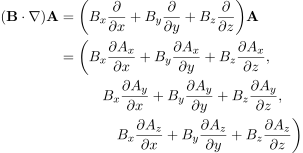
The first term being

\begin{aligned} (\mathbf{B}\cdot\nabla )\mathbf{A} & = \bigg( B_x\frac{\partial}{\partial x} + B_y\frac{\partial}{\partial y} + B_z\frac{\partial}{\partial z} \bigg) \mathbf{A} \\ & = \bigg( B_x\frac{\partial A_x}{\partial x} + B_y\frac{\partial A_x}{\partial y} + B_z\frac{\partial A_x}{\partial z},\, \\ & \quad \qquad B_x\frac{\partial A_y}{\partial x} + B_y\frac{\partial A_y}{\partial y} + B_z\frac{\partial A_y}{\partial z},\, \\ & \qquad \qquad B_x\frac{\partial A_z}{\partial x} + B_y\frac{\partial A_z}{\partial y} + B_z\frac{\partial A_z}{\partial z} \bigg)\end{aligned}

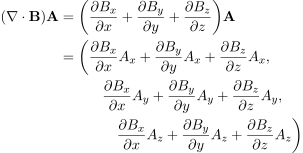
the second term being

\begin{aligned} (\nabla \cdot \mathbf{B})\mathbf{A} & = \bigg( \frac{\partial B_x}{\partial x} + \frac{\partial B_y}{\partial y} + \frac{\partial B_z}{\partial z}\bigg)\mathbf{A} \\ & = \bigg( \frac{\partial B_x}{\partial x}A_x + \frac{\partial B_y}{\partial y}A_x + \frac{\partial B_z}{\partial z}A_x ,\, \\ & \quad \qquad \frac{\partial B_x}{\partial x}A_y + \frac{\partial B_y}{\partial y}A_y + \frac{\partial B_z}{\partial z}A_y , \, \\ & \qquad \qquad \frac{\partial B_x}{\partial x}A_z + \frac{\partial B_y}{\partial y}A_z + \frac{\partial B_z}{\partial z}A_z \bigg) \\ \end{aligned}

the third term being

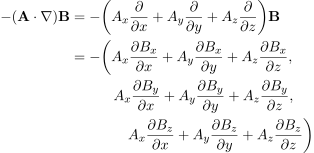
\begin{aligned} -(\mathbf{A}\cdot\nabla )\mathbf{B} & = - \bigg( A_x\frac{\partial}{\partial x} + A_y\frac{\partial}{\partial y} + A_z\frac{\partial}{\partial z} \bigg) \mathbf{B} \\ & = -\bigg( A_x\frac{\partial B_x}{\partial x} + A_y\frac{\partial B_x}{\partial y} + A_z\frac{\partial B_x}{\partial z},\, \\ & \quad\qquad A_x\frac{\partial B_y}{\partial x} + A_y\frac{\partial B_y}{\partial y} + A_z\frac{\partial B_y}{\partial z},\, \\ & \qquad\qquad A_x\frac{\partial B_z}{\partial x} + A_y\frac{\partial B_z}{\partial y} + A_z\frac{\partial B_z}{\partial z} \bigg) \\\end{aligned}

and the fourth and last term being

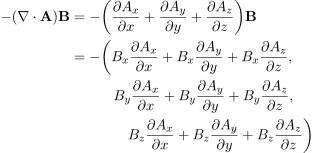
\begin{aligned} -(\nabla \cdot \mathbf{A})\mathbf{B} & = -\bigg( \frac{\partial A_x}{\partial x} +\frac{\partial A_y}{\partial y} + \frac{\partial A_z}{\partial z} \bigg)\mathbf{B} \\ & = - \bigg( B_x\frac{\partial A_x}{\partial x} + B_x\frac{\partial A_y}{\partial y} + B_x\frac{\partial A_z}{\partial z} ,\, \\ & \quad\qquad B_y\frac{\partial A_x}{\partial x} + B_y\frac{\partial A_y}{\partial y} + B_y\frac{\partial A_z}{\partial z} ,\, \\ & \qquad \qquad B_z\frac{\partial A_x}{\partial x} + B_z\frac{\partial A_y}{\partial y} + B_z\frac{\partial A_z}{\partial z}\bigg) \\ \end{aligned}

One can check that \textrm{LHS}=\textrm{RHS}.


Solution. (proof)

(The solution below is based on the manuscript of 2016-2017 PHYS3450 Electromagnetism Homework 1 Solution.)

Using Einstein summation (/notation) and the Levi-Civita symbol \varepsilon_{ijk},

(a)

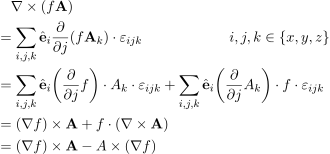
\begin{aligned} & \quad \nabla \times (f\mathbf{A}) \\ & = \sum_{i,j,k}\hat{\mathbf{e}}_i\frac{\partial}{\partial j}(f\mathbf{A}_k)\cdot\varepsilon_{ijk}\qquad\qquad\qquad i,j,k\in\{ x,y,z\} \\ & = \sum_{i,j,k}\hat{\mathbf{e}}_i\bigg(\frac{\partial}{\partial j}f\bigg)\cdot A_k\cdot\varepsilon_{ijk}+\sum_{i,j,k}\hat{\mathbf{e}}_i\bigg( \frac{\partial}{\partial j}A_k \bigg)\cdot f\cdot \varepsilon_{ijk} \\ & = (\nabla f)\times \mathbf{A} + f\cdot (\nabla\times\mathbf{A}) \\ & = (\nabla f)\times \mathbf{A} - A\times (\nabla f) \end{aligned}

(b)

\begin{aligned} \mathbf{A}\times\mathbf{B} & = \sum_{k,l,m}\hat{\mathbf{e}}_kA_lB_m\varepsilon_{klm}\\ \nabla\times (\mathbf{A}\times\mathbf{B}) & = \sum_{i,j,k}\hat{\mathbf{e}}_i\frac{\partial}{\partial j}(\sum_{l,m}A_lB_m\varepsilon_{klm})\varepsilon_{ijk} \\ & = \sum_{i,j,k,l,m}\hat{\mathbf{e}}_i \bigg[ \bigg( \frac{\partial}{\partial j}A_l \bigg) B_m + A_l\cdot \bigg( \frac{\partial}{\partial j}B_m\bigg) \bigg] \varepsilon_{klm}\varepsilon_{ijk} \\ \textrm{by } & \varepsilon_{klm}\varepsilon_{ijk} = \delta_{il}\delta_{jm} - \delta_{im}\delta_{jl} \\ \textrm{Thus, }& = \sum_{i,j,k,l,m}\hat{\mathbf{e}}_i \bigg[ \bigg( \frac{\partial}{\partial j}A_l \bigg) B_m + A_l\cdot \bigg( \frac{\partial}{\partial j}B_m\bigg) \bigg] (\delta_{il}\delta_{jm}-\delta_{im}\delta_{jl}) \\ & = \sum_{i,j,k,l,m}\bigg[ \hat{\mathbf{e}}_i\bigg( \frac{\partial}{\partial j}A_l \bigg) B_m\delta_{il}\delta_{jm} + \hat{\mathbf{e}}_i\bigg( \frac{\partial}{\partial j}A_l \bigg) B_m (-\delta_{im}\delta_{jl}) \\ & \quad\qquad + \hat{\mathbf{e}}_i\bigg( \frac{\partial}{\partial j}B_m\bigg) A_l\delta_{il}\delta_{jm} + \hat{\mathbf{e}}_i \bigg( \frac{\partial}{\partial j}B_m \bigg) A_l (-\delta_{im}\delta_{jl}) \bigg] \\ & = (\mathbf{B}\cdot\nabla )\mathbf{A}+(\nabla\cdot\mathbf{B})\mathbf{A}-(\mathbf{A}\cdot\nabla )\mathbf{B}-(\nabla\cdot\mathbf{A})\mathbf{B} \end{aligned}

QED

and the proof is more concise.