202202071039 Dynamics Figures (Elementary) Q2

The ends of a rope are fastened at separate but horizontal points on a ceiling. A 10\,\mathrm{lb} weight is hung from the rope such that the two segments of the rope make angles of 30^\circ and 45^\circ with the ceiling. Compute the tension in each segment of the rope.

Extracted from R. L. Gray. (1973). Physics Problems: Mechanics and Heat.


Solution.

Draw a free-body diagram below:

Separating the vertical and the horizontal component:

\begin{aligned} T_1\cos 45^\circ + T_2\cos 60^\circ & = W \\ T_1\sin 45^\circ & = T_2\sin 60^\circ \\ \end{aligned}

we have two equations with two unknowns (i.e., T_1 and T_2).

The rest is left the reader as an exercise.

202202070828 Dynamics Figures (Elementary) Q1

As shown in the sketch above, a mass m is suspended from a string of length L. Gravity \mathbf{g} is acting downward in the diagram. A second string exerts a horizontal force \mathbf{F} such that m is in equilibrium at a horizontal distance x.

(a) Draw a diagram showing all forces acting on m.

(b) What is the tension in the suspension string? Give both direction and magnitude.

Extracted from R. L. Gray. (1973). Physics Problems: Mechanics and Heat.


Solution.

(a) The free body diagram is shown below:

(b) Obviously,

\begin{aligned} \mathbf{T} & =F\,\hat{\mathbf{i}}+mg\,\hat{\mathbf{j}} \\ T & =|\mathbf{T}|=\sqrt{(F)^2+(mg)^2} \\ \end{aligned}.

Or, in an old-school way, we have horizontally

F=T\cos\theta

and vertically

mg=T\sin\theta,

squaring and summing up the equations,

\begin{aligned} (F)^2+(mg)^2 & =(T\cos\theta )^2+(T\sin\theta )^2 \\ F^2+m^2g^2 & = T^2(\cos^2\theta +\sin^2\theta ) \\ F^2+m^2g^2 & = T^2 \\ T & = \sqrt{F^2+m^2g^2} \\ \end{aligned}

Dividing the equation of the vertical by the horizontal,

\begin{aligned} \frac{mg}{F} & = \frac{T\sin\theta}{T\cos\theta} \\ \frac{mg}{F} & = \tan\theta \\ \theta & = \tan^{-1}\bigg(\frac{mg}{F}\bigg) \\ \end{aligned}

the direction of tension makes an angle \theta =\tan^{-1}(\frac{mg}{F}) with the level.

202112100933 Kinematics graphs (Elementary) Q2

This post is depreciated as it is misleading the reader about the speed of train.

The number 038 should be the “mission order” of the train which indicates to stationed staff of its running railway, service time, and need of assistance if any (MTR Academy, 2017).


An MTR train enters the station at a speed of 38 kilometres an hour, i.e., 38\,\mathrm{km/h}.

Retrieved image from http://mtr.hk365day.com/

If the subway is 100\,\mathrm{m} long and the train terminates at the stop with constant deceleration, i.e., \mathbf{a}=-a\,\hat{\mathbf{i}}\quad (a=\textrm{Const.}>0),

Modified figures retrieved from https://www.shutterstock.com/

what is the time required for the train to come to a full stop?


Background. (Equations of linear motion in uniform acceleration)

\begin{cases} \enspace & v = u + at \\ \enspace & s = \displaystyle{\frac{(u+v)}{2}t} \\ \enspace & s = \displaystyle{ut+\frac{1}{2}at^2} \\ \enspace & v^2 = u^2 + 2as \\ \end{cases}


Solution.

Take the rightward to be positive direction.

Provided that the initial velocity \mathbf{u} is

\begin{aligned} \mathbf{u} & =+38\,(\mathrm{km\, h^{-1}})\,\hat{\mathbf{i}} \\ & = +38\times\frac{1000}{60\times 60}\,(\mathrm{m\, s^{-1}})\,\hat{\mathbf{i}} \\ & = +10.5556\,(\mathrm{m\, s^{-1}})\,\hat{\mathbf{i}}\quad (4\,\mathrm{d.p.}) \\ \end{aligned}

the final velocity \mathbf{v} is

\mathbf{0}, or simply put, 0;

and the displacement \mathbf{s} for the duration is

\begin{aligned} \mathbf{s} & =s\,\hat{\mathbf{i}} \\ & =+100\,\hat{\mathbf{i}}\\ \end{aligned},

so, out of five variables:

a, s, t, u, and v,

we already know three exactly:

\mathbf{s} (of magnitude s);
\mathbf{u} (of magnitude u);
\mathbf{v} (of magnitude v).

If the first step were to solve for only one unknown in the equations of motion i iv below,

i. v=u+at is \textrm{\scriptsize{NOT}} solvable for there are two unknowns a and t;

ii. s=\frac{(u+v)}{2}t solvable for there is \textrm{\scriptsize{ONLY}} one unknown t;

iii. s=ut+\frac{1}{2}at^2 \textrm{\scriptsize{NOT}} solvable for there are two unknowns a and t;

iv. v^2=u^2+2as solvable for there is \textrm{\scriptsize{ONLY}} one unknown a.

thus, we should pick equation ii. to calculate the unknown t.

That said, solving for time t,

\begin{aligned} s & = \frac{(u+v)}{2}t \\ 100 & = \frac{(10.5556+0)}{2}t \\ t & = 18.9\,\mathrm{s}\quad \textrm{(3 s.f.)} \\ \end{aligned}


Afterword.

\dagger If you wish to know about the rate of deceleration -a, you can use equation iv., yet this is left the reader.

\ddagger The time t might seem longer than expected, because normally the deceleration of train is non-constant.

202112031054 Kinematics graphs (Elementary) Q1

The graph below illustrates three paths in Red (R), Green (G), and Blue (B).

For a person walking along paths R, G, and B at a constant speed 2\,\mathrm{m\, s^{-1}}, find, in each path,

(a) the distance travelled;
(b) the time needed from start to finish; and
(c) the displacement and velocity on the journey.


Solution.

(a)

Along path R, the walking distance d is

\begin{aligned} \textrm{Distance }d & = \bigg(\frac{1}{2}\bigg) \big(\pi (90-50)\big) + \bigg(\frac{1}{2}\bigg) \big( \pi (50-30)\big) \\ & = \bigg(\frac{1}{2}\bigg) (40\pi ) + \bigg(\frac{1}{2}\bigg) (20\pi ) \\ & = 20\pi + 10\pi \\ & = 30\pi\,\mathrm{m} \\ \end{aligned}

Along path G, the walking distance d is

\begin{aligned} \textrm{Distance }d & = \sqrt{(30-0)^2+(60-20)^2} + \sqrt{(30-0)^2+(100-60)^2} \\ & = \sqrt{900+1600} + \sqrt{900+1600} \\ & = \sqrt{2500} + \sqrt{2500} \\ & = 50+50 \\ & = 100\,\mathrm{m} \end{aligned}

Along path B, the walking distance d is

\begin{aligned} \textrm{Distance }d & = (20-0) + (20-0) + (50-20) + (50-20) \\ & \qquad\quad + (100-50) + (100-50) \\ & = 20+20+30+30+50+50 \\ & = 200\,\mathrm{m} \\ \end{aligned}

(b)

Along path R, the time t needed is

\begin{aligned} \textrm{Time }t & = \frac{30\pi\,\mathrm{m}}{2\,\mathrm{m\, s^{-1}}} \\ & = 47.1\,\mathrm{s}\\ \end{aligned}

Along path G, the time t needed is

\begin{aligned} \textrm{Time }t & = \frac{100\,\mathrm{m}}{2\,\mathrm{m\, s^{-1}}} \\ & = 50\,\mathrm{s}\\ \end{aligned}

Along path B, the time t needed is

\begin{aligned} \textrm{Time }t & = \frac{200\,\mathrm{m}}{2\,\mathrm{m\, s^{-1}}} \\ & = 100\,\mathrm{s}\\ \end{aligned}

(c)

Read the following graph, and you shall see each and every displacement in dashed lines.

For path R, the displacement \mathbf{s} travelled is

\begin{aligned} \textrm{Displacement }\mathbf{s} & = - s\,\hat{\mathbf{i}} \\ & = - (90-30)\,\hat{\mathbf{i}} \\ & = - 60\,\mathrm{m}\,\hat{\mathbf{i}} \\ \end{aligned}

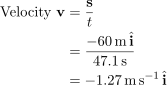
and the velocity \mathbf{v} is

\begin{aligned} \textrm{Velocity }\mathbf{v} & = \frac{\mathbf{s}}{t} \\ & = \frac{- 60\,\mathrm{m}\,\hat{\mathbf{i}}}{47.1\,\mathrm{s}} \\ & = -1.27\,\mathrm{m\, s^{-1}}\,\hat{\mathbf{i}} \\ \end{aligned}

For path G, the displacement \mathbf{s} travelled is

\begin{aligned} \textrm{Displacement }\mathbf{s} & = s\,\hat{\mathbf{j}} \\ & = (100-20)\,\hat{\mathbf{j}} \\ & = 80\,\mathrm{m}\,\hat{\mathbf{j}} \\ \end{aligned}

and the velocity \mathbf{v} is

\begin{aligned} \textrm{Velocity }\mathbf{v} & = \frac{\mathbf{s}}{t} \\ & = \frac{80\,\mathrm{m}\,\hat{\mathbf{j}}}{50\,\mathrm{s}} \\ & = +1.6\,\mathrm{m\, s^{-1}}\,\hat{\mathbf{j}} \\ \end{aligned}

For path B, the displacement \mathbf{s} travelled is

\begin{aligned} \textrm{Displacement }\mathbf{s} & = 100\,\mathrm{m}\,\hat{\mathbf{i}} + 100\,\mathrm{m}\,\hat{\mathbf{j}} \\ \end{aligned}

or, the magnitude s of displacement \mathbf{s} is

\begin{aligned} s & = \sqrt{(100)^2+(100)^2} \\ & = 100\sqrt{2}\,\mathrm{m} \\ \end{aligned}

such that

\mathbf{s} = s\cos 45^\circ\,\hat{\mathbf{i}} + s\sin 45^\circ\,\hat{\mathbf{j}}

the velocity \mathbf{v} is

\begin{aligned} \textrm{Velocity }\mathbf{v} & = \frac{\mathbf{s}}{t} \\ & = \frac{100\,\mathrm{m}\,\hat{\mathbf{i}} + 100\,\mathrm{m}\,\hat{\mathbf{j}}}{100\,\mathrm{s}} \\ & = +1\,\mathrm{m\, s^{-1}}\,\hat{\mathbf{i}} + 1\,\mathrm{m\, s^{-1}}\,\hat{\mathbf{j}}\\ \end{aligned}