When two billiard balls collide, the instantaneous forces between them are very large but act only in an infinitesimal time  , in such a manner that the quantity

remains finite. Such forces are described as impulsive forces, and the integral over is known as the impulse of the force. Show that if impulsive forces are present Lagrange’s equations may be transformed into
 ,
,
where the subscripts  and
and  refer to the state of the system before and after the impulse,
  is the impulse of the generalized impulsive force corresponding to
  , and
, and  is the Lagrangian including all the non-impulsive forces.
Solution.
This solution is not mine. It was found on the Internet some years ago, to whose author(s) I lost references.
For billiard-balls collision, the Euler-Lagrange (E-L) equation is
 ,
,
where  is the generalised impulsive force corresponding to and not derivable from the potential.
Taking integral over on both sides,
LHS becomes
 .
.
The second term upon integration is zero,
because  for infinitesimal time
  .
.
The first term is
![\displaystyle{\int_{\Delta t}\mathrm{d}\bigg( \frac{\partial L}{\partial \dot{q_j}} \bigg)}=\bigg[ \frac{\partial L}{\partial \dot{q_j}}\bigg]^{t+\Delta t}_{t}](https://physicspupil.com/wp-content/ql-cache/quicklatex.com-1e3b7bf3cc0fa5186d619199e4bbfa33_l3.svg "Rendered by QuickLaTeX.com") .
.
Rename  the (final) state of system after the impulse and
  the (initial) state of system before the impulse.
LHS reads

whereas RHS reads
 ,
,
i.e., the impulse of generalised impulsive force.
The transformed E-L equation in the presence of impulsive forces is
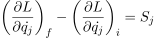 ,
,
as desired.

 and
and  may be written in the form
 and
and  .
. ,
, , where
  is a constant. The particle travels from
  to
to  in a time interval
  . Assume the motion of the particle can be expressed in the form
  . Find the values of
  ,
,  , and
, and  such that the action is a minimum.
 .
.
 .
. .
. .
. gives
gives .
. gives
gives .
. .
.
 and
and  is given by a function
  , with
  being the first derivative of the curve.
 ,
, ,
, and
and  .
. ,
,
 for any
  continuous through second derivative, then
  must identically vanish in the interval
  .
. of the position vector for the center of mass from an arbitrary origin is given by the equation
 .
. .
. .
. , squaring it,
 ,
, .
.
 ,
, .
.

