
By using

or otherwise, evaluate
 .
.
Warm-up.


 is an even function such that
 .
.
Assume  is a periodic function for some
 ![T\in (0,2\pi ]](https://physicspupil.com/wp-content/ql-cache/quicklatex.com-6fa3a274097e96e3c0b1eb1cafdfa916_l3.svg "Rendered by QuickLaTeX.com") .
.

where  ,
,  , and
, and  .
.
![g:[0,\pi ]\to [-1,1]](https://physicspupil.com/wp-content/ql-cache/quicklatex.com-28f41495bcab02694c1f6cde16faa83c_l3.svg "Rendered by QuickLaTeX.com") by
by  is one-to-one and onto.
![h:[-1,1]\to [-1,1]](https://physicspupil.com/wp-content/ql-cache/quicklatex.com-9fcdc55bce03e1b86a74522c0f5e6234_l3.svg "Rendered by QuickLaTeX.com") by
by  is injective and surjective as well.
Hence  , the composition
  of bijections
  and
and  , is also bijective. Besides
 ![f:[0,\pi ]\to [-1,1]](https://physicspupil.com/wp-content/ql-cache/quicklatex.com-ff4a0990b92d2c60284151cb0ab26d1a_l3.svg "Rendered by QuickLaTeX.com") is a continuously differentiable function that
is a continuously differentiable function that  ,
,  , and
, and  .
.
How do you evaluate the integral below:

where  is an odd function such that

The curve of function is flat at point(s) whose slope  is zero, i.e.,

Roughwork. Show
![\begin{aligned} \int_{0}^{\pi}\cos^7x\,\mathrm{d}x & = \int_{0}^{\pi}\cos^6x\,\mathrm{d}(\sin x) \\ & = \big[\cos^6x\sin x\big]\big|_{0}^{\pi} - \int_{0}^{\pi}\sin x\,\mathrm{d}(\cos^6x)\\ & = 0 + \int_{0}^{\pi}6\sin^2x\cos^5x\,\mathrm{d}x \\ & = \int_{0}^{\pi}6(1-\cos^2x)\cos^5x\,\mathrm{d}x \\ & = \int_{0}^{\pi}6\cos^5x\,\mathrm{d}x - \int_{0}^{\pi}6\cos^7x\,\mathrm{d}x \\ \int_{0}^{\pi}7\cos^7x\,\mathrm{d}x & = \int_{0}^{\pi}6\cos^5x\,\mathrm{d}x \\ \int_{0}^{\pi}\cos^7x\,\mathrm{d}x & = \frac{6}{7}\int_{0}^{\pi}\cos^5x\,\mathrm{d}x \\ & = \frac{6}{7}\int_{0}^{\pi}\cos^4x\,\mathrm{d}(\sin x) \\ &= \frac{6}{7}\bigg\{ \big[\cos^4x\sin x\big]\big|_{0}^{\pi} - \int_{0}^{\pi}\sin x\,\mathrm{d}(\cos^4x)\bigg\} \\ &= \frac{6}{7}\bigg\{ 0 + \int_{0}^{\pi}4\sin^2 x\cos^3x\,\mathrm{d}x\bigg\} \\ & = \frac{24}{7}\int_{0}^{\pi} (1-\cos^2x)\cos^3x\,\mathrm{d}x \\ \frac{30}{7}\int_{0}^{\pi}\cos^5x\,\mathrm{d}x & = \frac{24}{7} \int_{0}^{\pi}\cos^3x\,\mathrm{d}x \\ \int_{0}^{\pi}\cos^5x\,\mathrm{d}x & = \frac{4}{5}\int_{0}^{\pi}\cos^3x\,\mathrm{d}x \\ \end{aligned}](https://physicspupil.com/wp-content/ql-cache/quicklatex.com-31445326a7b1124dd634df8fc94df9bf_l3.svg "Rendered by QuickLaTeX.com")
![\begin{aligned} \int_{0}^{\pi}\cos^7x\,\mathrm{d}x & = \frac{6}{7}\bigg\{ \frac{4}{5}\int_{0}^{\pi}\cos^3x\,\mathrm{d}x \bigg\} \\ & = \frac{24}{35} \int_{0}^{\pi} \cos^2x\,\mathrm{d}(\sin x) \\ & = \frac{24}{35}\bigg\{ \big[ \cos^2x\sin x\big]\big|_{0}^{\pi} - \int_{0}^{\pi}\sin x\,\mathrm{d}(\cos^2x) \bigg\} \\ & = \frac{24}{35} \bigg\{ 0 + \int_{0}^{\pi}2\sin^2x\cos x\,\mathrm{d}x \bigg\} \\ & = \frac{48}{35} \int_{0}^{\pi}(1-\cos^2x)\cos x\,\mathrm{d}x \\ \bigg(\frac{24}{35}+\frac{48}{35}\bigg) \int_{0}^{\pi} \cos^3x\,\mathrm{d}x & = \frac{48}{35}\int_{0}^{\pi}\cos x\,\mathrm{d}x \\ \int_{0}^{\pi} \cos^3x\,\mathrm{d}x & = \frac{2}{3}\int_{0}^{\pi}\cos x\,\mathrm{d}x \\ \int_{0}^{\pi}\cos^7x\,\mathrm{d}x & = \frac{24}{35}\bigg\{ \frac{2}{3}\int_{0}^{\pi}\cos x\,\mathrm{d}x \bigg\} \\ & = \frac{16}{35}\big[ \sin x\big]\big|_{0}^{\pi} \\ & = 0 \\ \end{aligned}](https://physicspupil.com/wp-content/ql-cache/quicklatex.com-ce61d6e9537eacef7b16e34667bae82b_l3.svg "Rendered by QuickLaTeX.com")
Solution.
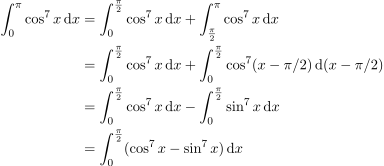
The rest is left as an exercise to the reader.