201911190435 Homework 1 (Q4)

A point particle moves in space under the influence of force derivable from a generalized potential of the form

U(\mathbf{r},\mathbf{v})=V(r)+\sigma\cdot\textrm{\textbf{L}}

where \mathbf{r} is the radius vector from a fixed point, \textrm{\textbf{L}} is the angular momentum about that point, and \sigma is a fixed vector in space.

1. Find the components of the force on the particle in both Cartesian and spherical polar coordinates, on the basis of Eq. (1.58) in Goldstein’s book.

2. Show that the components in the two coordinates systems are related to each other as in Eq. (1.49) in Goldstein’s book.

3. Obtain the equation of motion in spherical polar coordinates.


Solution. (bad, probably wrong)

1.

i. In Cartesian coordinates (x,y,z), the potential V(r)=V(x,y,z). Here I take the definition of angular momentum \mathbf{L} to be the vector product of position \mathbf{r}=\mathbf{r}(x,y,z) and linear momentum \mathbf{p}=(\mathbf{p}_x,\mathbf{p}_y,\mathbf{p}_z): \begin{aligned} \mathbf{L} & =\mathbf{r}\times \mathbf{p}=\begin{vmatrix} \hat{\mathbf{i}} & \hat{\mathbf{j}} & \hat{\mathbf{k}} \\ x & y & z \\ m\dot{x} & m\dot{y} & m\dot{z}\\ \end{vmatrix}\\ (L_x,L_y,L_z) & =m(y\dot{z}-z\dot{y},z\dot{x}-x\dot{z},x\dot{y}-y\dot{x})\end{aligned}

In passing, \sigma is given as a fixed vector, thus it is, in particular, independent of position \mathbf{r} and vector \dot{\mathbf{r}}, and, in general, independent of generalized coordinates and generalized velocities.

Goldstein’s Classical Mechanics, the generalized force is given by the equation below:

Eq. (1-54):

Q_i=-\displaystyle{\frac{\partial U}{\partial q_i}}+\displaystyle{\frac{\mathrm{d}}{\mathrm{d}t}\bigg( \frac{\partial U}{\partial \dot{q_i}} \bigg)}

In Cartesian coordinates, write the general potential in the form of
U(x,y,z,\dot{x},\dot{y},\dot{z})=V(x,y,z)+\sigma\cdot (L_x,L_y,L_z).
Compute the partial derivatives with respect to x, y, z:
\begin{aligned} \displaystyle{\frac{\partial U}{\partial x}} & = \partial_xV+\sigma\cdot \partial_x(L_x,L_y,L_z)\\ & = -F_x+\sigma\cdot m(0,-\dot{z},\dot{y}) \\ \displaystyle{\frac{\partial U}{\partial y}} & = \partial_yV+\sigma\cdot \partial_y(L_x,L_y,L_z)\\ & = -F_y+\sigma\cdot m(\dot{z},0,-\dot{x}) \\ \displaystyle{\frac{\partial U}{\partial z}} & = \partial_zV+\sigma\cdot \partial_z(L_x,L_y,L_z)\\ & = -F_z+\sigma\cdot m(-\dot{y},\dot{x},0)\\ \end{aligned}
Compute the partial derivatives with respect to \dot{x}, \dot{y}, \dot{z}:
\begin{aligned} \displaystyle{\frac{\partial U}{\partial \dot{x}}} & = \sigma\cdot \partial_{\dot{x}}(L_x,L_y,L_z) \\ & = \sigma\cdot m(0,z,-y)\\ \displaystyle{\frac{\partial U}{\partial \dot{y}}} & = \sigma\cdot \partial_{\dot{y}}(L_x,L_y,L_z)\\ & = \sigma\cdot m(-z,0,x)\\ \displaystyle{\frac{\partial U}{\partial \dot{z}}} & = \sigma\cdot \partial_{\dot{z}}(L_x,L_y,L_z)\\ & = \sigma\cdot m(y,-x,0)\\ \end{aligned}
Finally, taking total derivatives w.r.t. time t on the preceding:
\begin{aligned} \displaystyle{\frac{\mathrm{d}}{\mathrm{d}t}\bigg(\frac{\partial U}{\partial \dot{x}}\bigg)} & = \sigma\cdot m(0,\dot{z},-\dot{y})\\ \displaystyle{\frac{\mathrm{d}}{\mathrm{d}t}\bigg(\frac{\partial U}{\partial \dot{y}}\bigg)} & = \sigma\cdot m(-\dot{z},0,\dot{x})\\ \displaystyle{\frac{\mathrm{d}}{\mathrm{d}t}\bigg(\frac{\partial U}{\partial \dot{z}}\bigg)} & = \sigma\cdot m(\dot{y},-\dot{x},0)\\ \end{aligned}
I shall obtain the following generalized forces:
\begin{aligned} Q_x & = -\Big( -F_x+\sigma\cdot m(0,-\dot{z},\dot{y})\Big)+\Big(\sigma\cdot m(0,\dot{z},-\dot{y})\Big)\\ & = F_x+2\sigma m(0,\dot{z},-\dot{y})\\ Q_y & =-\Big( -F_y+\sigma\cdot m(\dot{z},0,-\dot{x})\Big)+\Big(\sigma\cdot m(-\dot{z},0,\dot{x})\Big)\\ & = F_y+2\sigma m(-\dot{z},0,\dot{x})\\ Q_z & =-\Big( -F_z+\sigma\cdot m(-\dot{y},\dot{x},0)\Big)+\Big(\sigma\cdot m(\dot{y},-\dot{x},0)\Big)\\ & = F_z+2\sigma m(\dot{y},-\dot{x},0)\\ \end{aligned}
ii. In spherical (or, polar, as may be reduced) coordinates (r,\theta ,\phi) we have the potential V(r) with only r-dependence. The angular momentum \mathbf{L} is said to be \mathbf{L}=m(\mathbf{r}\times\mathbf{v}), where the position \mathbf{r}=\mathbf{r}(r,\theta ,\phi ) and the velocity \mathbf{v}=\mathbf{v}(r,\theta ,\phi) are in terms of spherical coordinates.
The transformation between spherical and Cartesian coordinates is:
\begin{aligned} x & =r\sin\theta\cos\phi \\ y & =r\sin\theta\sin\phi \\ z & =r\cos\theta \\ \end{aligned}.
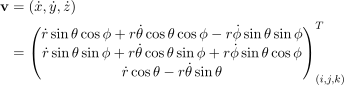
The velocity vector \mathbf{v} may thus be represented as:
\begin{aligned} \mathbf{v} & =(\dot{x},\dot{y},\dot{z})\\ & = \begin{pmatrix} \dot{r}\sin\theta\cos\phi +r\dot{\theta}\cos\theta\cos\phi -r\dot{\phi}\sin\theta\sin\phi \\ \dot{r}\sin\theta\sin\phi +r\dot{\theta}\cos\theta\sin\phi +r\dot{\phi}\sin\theta\cos\phi \\ \dot{r}\cos\theta -r\dot{\theta}\sin\theta \\ \end{pmatrix}^T_{(i,j,k)}\\ \end{aligned}
Using the fact which was derived formerly:

(L_x,L_y,L_z)=m(y\dot{z}-z\dot{y},z\dot{x}-x\dot{z},x\dot{y}-y\dot{x})
and by some direct computation below
\begin{aligned} & L_x/m \\ & = y\dot{z}-z\dot{y} \\ & = (r\sin\theta\sin\phi )(\dot{r}\cos\theta -r\dot{\theta}\sin\theta ) \\ &\qquad\qquad -(r\cos\theta )(\dot{r}\sin\theta\sin\phi +r\dot{\theta}\cos\theta\sin\phi +r\dot{\phi}\sin\theta\cos\phi )\\ & = -r^2\dot{\theta}\sin^2\theta\sin\phi -r^2\dot{\theta}\cos^2\theta\sin\phi +r^2\dot{\phi}\sin 2\theta\cos\phi \\ & = r^2(\dot{\phi}\sin 2\theta\cos\phi -\dot{\theta}\sin\phi )\\ \end{aligned}
\begin{aligned} & L_y/m\\ & = z\dot{x}-x\dot{z} \\ & = (r\cos\theta )(\dot{r}\sin\theta\cos\phi +r\dot{\theta}\cos\theta\cos\phi -r\dot{\phi}\sin\theta\sin\phi )\\ &\qquad\qquad -(r\sin\theta\cos\phi )(\dot{r}\cos\theta -r\dot{\theta}\sin\theta )\\ & = r^2\dot{\theta}\cos^2\theta \cos\phi -r^2\dot{\phi}\sin 2\theta\sin\phi +r^2\dot{\theta}\sin^2\theta\cos\phi \\ & = r^2(\dot{\theta}\cos\phi -\dot{\phi}\sin 2\theta\sin\phi )\\ \end{aligned}
\begin{aligned} & L_z/m \\ & = x\dot{y}-y\dot{x} \\ & = (r\sin\theta\cos\phi )(\dot{r}\sin\theta\sin\phi +r\dot{\theta}\cos\theta\sin\phi +r\dot{\phi}\sin\theta\cos\phi )\\ & \qquad -(r\sin\theta\sin\phi )(\dot{r}\sin\theta\cos\phi +r\dot{\theta}\cos\theta\cos\phi -r\dot{\phi}\sin\theta\sin\phi )\\ & =r^2\dot{\phi}\sin^2\theta\cos^2\phi +r^2\dot{\phi}\sin^2\theta\sin^2\phi \\ & = r^2\dot{\phi}\sin^2\theta \\ \end{aligned}
then summing up what is up till now, the angular momentum \mathbf{L} in terms of spherical coordinate components in Cartesian natural bases is
\mathbf{L}=\begin{pmatrix} L_r \\ L_\theta \\ L_\phi \\ \end{pmatrix}^T=mr^2\begin{pmatrix} \dot{\phi}\sin 2\theta\cos\phi -\dot{\theta}\sin\phi \\ \dot{\theta}\cos\phi -\dot{\phi}\sin 2\theta\sin\phi \\ \dot{\phi}\sin^2\theta \\ \end{pmatrix}^T_{(i,j,k)}
In spherical coordinates, write the general potential in the form of

U(r,\theta ,\phi ,\dot{r},\dot{\theta},\dot{\phi})=V(r)+\sigma\cdot \mathbf{L}(L_r,L_\theta ,L_\phi ).
Then,
\begin{aligned}[t] Q_r & =-\displaystyle{\frac{\partial U}{\partial r}}+\displaystyle{\frac{\mathrm{d}}{\mathrm{d}t}\bigg( \frac{\partial U}{\partial \dot{r}} \bigg)}\\ & = -(\partial_rV+\sigma\cdot \partial_r\mathbf{L})+\displaystyle{\frac{\mathrm{d}}{\mathrm{d}t}(\sigma\cdot \partial_{\dot{r}}\mathbf{L})}\\ & = -\partial_rV-\sigma\cdot \partial_r\mathbf{L}+\displaystyle{\sigma\cdot \frac{\mathrm{d}}{\mathrm{d}t}(\partial_{\dot{r}}\mathbf{L})}\\ \end{aligned}
\begin{aligned} Q_\theta & =-\displaystyle{\frac{\partial U}{\partial \theta}}+\displaystyle{\frac{\mathrm{d}}{\mathrm{d}t}\bigg( \frac{\partial U}{\partial \dot{\theta}} \bigg)}\\ & = -(\sigma\cdot \partial_\theta\mathbf{L})+\displaystyle{\frac{\mathrm{d}}{\mathrm{d}t}(\sigma\cdot \partial_{\dot{\theta}}\mathbf{L})}\\ & = -\sigma\cdot \partial_\theta\mathbf{L}+\displaystyle{\sigma\cdot \frac{\mathrm{d}}{\mathrm{d}t}(\partial_{\dot{\theta}}\mathbf{L})}\\ \end{aligned}
\begin{aligned} Q_\phi & =-\displaystyle{\frac{\partial U}{\partial \phi}}+\displaystyle{\frac{\mathrm{d}}{\mathrm{d}t}\bigg( \frac{\partial U}{\partial \dot{\phi}} \bigg)}\\ & = -(\sigma\cdot \partial_\phi\mathbf{L})+\displaystyle{\frac{\mathrm{d}}{\mathrm{d}t}(\sigma\cdot \partial_{\dot{\phi}}\mathbf{L})}\\ & = -\sigma\cdot \partial_\phi\mathbf{L}+\displaystyle{\sigma\cdot \frac{\mathrm{d}}{\mathrm{d}t}(\partial_{\dot{\phi}}\mathbf{L})}\\ \end{aligned}
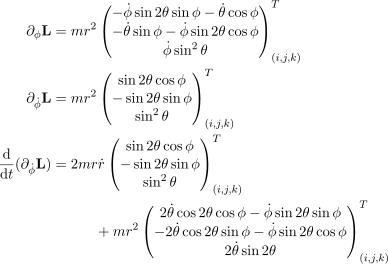
Hence I need to compute the following six partial derivatives:
\partial_r\mathbf{L}, \partial_{\dot{r}}\mathbf{L}, \partial_\theta\mathbf{L}, \partial_{\dot{\theta}}\mathbf{L}, \partial_{\phi}\mathbf{L}, and \partial_{\dot{\phi}}\mathbf{L}:
In the case of r,
\begin{aligned} \partial_r\mathbf{L} & = 2mr \begin{pmatrix} \dot{\phi}\sin 2\theta\cos\phi -\dot{\theta}\sin\phi \\ \dot{\theta}\cos\phi -\dot{\phi}\sin 2\theta\sin\phi \\ \dot{\phi}\sin^2\theta \\ \end{pmatrix}^T_{(i,j,k)}\\ \partial_{\dot{r}}\mathbf{L} & = \mathbf{0}\\ \displaystyle{\frac{\mathrm{d}}{\mathrm{d}t}(\partial_{\dot{r}}}\mathbf{L}) & = \mathbf{0} \\ \end{aligned}
In the case of \theta,
\begin{aligned} \partial_\theta\mathbf{L} & = mr^2\begin{pmatrix} 2\dot{\phi}\cos 2\theta\cos\phi -\dot{\theta}\sin\phi \\ \dot{\theta}\cos\phi -2\dot{\phi}\cos 2\theta\sin\phi \\ 2\dot{\phi}\sin 2\theta \\ \end{pmatrix}^T_{(i,j,k)}\\ \partial_{\dot{\theta}}\mathbf{L} & = mr^2\begin{pmatrix} -\sin\phi \\ \cos\phi \\ 0 \\ \end{pmatrix}^T_{(i,j,k)} \\ \displaystyle{\frac{\mathrm{d}}{\mathrm{d}t}(\partial_{\dot{\theta}}}\mathbf{L}) & = 2mr\dot{r}\begin{pmatrix} -\sin\phi \\ \cos\phi \\ 0 \\ \end{pmatrix}^T_{(i,j,k)} + mr^2\begin{pmatrix} -\dot{\phi}\cos\phi \\ -\dot{\phi}\sin\phi \\ 0 \\ \end{pmatrix}^T_{(i,j,k)}\\ & = mr\begin{pmatrix} -2\dot{r}\sin\phi -r\dot{\phi}\cos\phi \\ 2\dot{r}\cos\phi -r\dot{\phi}\sin\phi \\ 0 \\ \end{pmatrix}^T_{(i,j,k)} \\ \end{aligned}
In the case of \phi,
\begin{aligned} \partial_{\phi}\mathbf{L} & = mr^2\begin{pmatrix} -\dot{\phi}\sin 2\theta\sin\phi -\dot{\theta}\cos\phi \\ -\dot{\theta}\sin\phi -\dot{\phi}\sin 2\theta\cos\phi \\ \dot{\phi}\sin^2\theta \\ \end{pmatrix}^T_{(i,j,k)}\\ \partial_{\dot{\phi}}\mathbf{L} & =mr^2\begin{pmatrix} \sin 2\theta\cos\phi \\ -\sin 2\theta\sin\phi \\ \sin^2\theta \\ \end{pmatrix}^T_{(i,j,k)}\\ \displaystyle{\frac{\mathrm{d}}{\mathrm{d}t}}(\partial_{\dot{\phi}}\mathbf{L}) & = 2mr\dot{r} \begin{pmatrix} \sin 2\theta\cos\phi \\ -\sin 2\theta\sin\phi \\ \sin^2\theta \\ \end{pmatrix}^T_{(i,j,k)} \\ & \qquad\quad +mr^2 \begin{pmatrix} 2\dot{\theta}\cos 2\theta\cos\phi -\dot{\phi}\sin 2\theta\sin\phi \\ -2\dot{\theta}\cos 2\theta\sin\phi -\dot{\phi}\sin 2\theta\cos\phi \\ 2\dot{\theta}\sin 2\theta \\ \end{pmatrix}^T_{(i,j,k)} \\ \end{aligned} Substitution of these partial derivatives into the formulae of generalized forces, (recall that [in Goldstein’s Classical Mechanics] the generalized force is given by)
Eq. (1-54):
Q_i=-\displaystyle{\frac{\partial U}{\partial q_i}}+\displaystyle{\frac{\mathrm{d}}{\mathrm{d}t}\bigg( \frac{\partial U}{\partial \dot{q_i}} \bigg)}
one can obtain:
\begin{aligned}Q_r & =-\partial_rV-\sigma\cdot \partial_{r}\mathbf{L}+\sigma\cdot \displaystyle{\frac{\mathrm{d}}{\mathrm{d}t}}\partial_{\dot{r}}\mathbf{L}\\ & =F_r-2mr\sigma\cdot \begin{pmatrix} \dot{\phi}\sin 2\theta\cos\phi -\dot{\theta}\sin\phi \\ \dot{\theta}\cos\phi -\dot{\phi}\sin 2\theta\sin\phi \\ \dot{\phi}\sin^2\theta \\ \end{pmatrix}^T_{(i,j,k)}\\ \end{aligned}
\begin{aligned} Q_\theta & = -\sigma\cdot \partial_\theta\mathbf{L}+\displaystyle{\sigma\cdot \frac{\mathrm{d}}{\mathrm{d}t}(\partial_{\dot{\theta}}\mathbf{L})}\\ & = -mr\sigma \cdot \Bigg\{ r\begin{pmatrix} 2\dot{\phi}\cos 2\theta\cos\phi -\dot{\theta}\sin\phi \\ \dot{\theta}\cos\phi -2\dot{\phi}\cos 2\theta\sin\phi \\ 2\dot{\phi}\sin 2\theta \\ \end{pmatrix}- \begin{pmatrix} -2\dot{r}\sin\phi -r\dot{\phi}\cos\phi \\ 2\dot{r}\cos\phi -r\dot{\phi}\sin\phi \\ 0 \\ \end{pmatrix} \Bigg\} \\ & = -mr\sigma\cdot \begin{pmatrix} (2\cos 2\theta +1)r\dot{\phi}\cos\phi +(2\dot{r}-r\dot{\theta})\sin\phi \\ (1-2\cos 2\theta )r\dot{\phi}\sin\phi +(r\dot{\theta}-2\dot{r})\cos\phi \\ 2r\dot{\phi}\sin 2\theta \\ \end{pmatrix}^T_{(i,j,k)}\\ \end{aligned}
\begin{aligned} Q_\phi & = -\sigma\cdot \partial_\phi\mathbf{L}+\displaystyle{\sigma\cdot \frac{\mathrm{d}}{\mathrm{d}t}(\partial_{\dot{\phi}}\mathbf{L})}\\ & =-mr\sigma\cdot \Bigg\{ r\begin{pmatrix} -\dot{\phi}\sin 2\theta\sin\phi -\dot{\theta}\cos\phi \\ -\dot{\theta}\sin\phi -\dot{\phi}\sin 2\theta\cos\phi \\ \dot{\phi}\sin^2\theta \\ \end{pmatrix}-2\dot{r} \begin{pmatrix} \sin 2\theta\cos\phi \\ -\sin 2\theta\sin\phi \\ \sin^2\theta \\ \end{pmatrix}\\ &\qquad\quad -r \begin{pmatrix} 2\dot{\theta}\cos 2\theta\cos\phi -\dot{\phi}\sin 2\theta\sin\phi \\ -2\dot{\theta}\cos 2\theta\sin\phi -\dot{\phi}\sin 2\theta\cos\phi \\ 2\dot{\theta}\sin 2\theta \\ \end{pmatrix} \Bigg\}\\ & = -mr\sigma \cdot \begin{pmatrix} -(r\dot{\theta}+2\dot{r}\sin 2\theta +2r\dot{\theta}\cos 2\theta )\cos\phi \\ -(r\dot{\theta}+2\dot{r}\sin 2\theta +2r\dot{\theta}\cos 2\theta )\sin\phi \\ \big( (r\dot{\phi}-2\dot{r})\sin\theta -2r\dot{\theta}\cos\theta \big) \sin\theta \\ \end{pmatrix}^T_{(i,j,k)} \end{aligned}

2.

In Goldstein’s Classical Mechanics, the components of the generalized force is defined
Eq. (1.49):
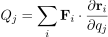
Q_j=\displaystyle{\sum_{i}\mathbf{F}_i\cdot \frac{\partial \mathbf{r}_i}{\partial q_j}}
Hence I am to check the following three identities:
(I): Q_r=\mathbf{F}_x\cdot \displaystyle{\frac{\partial x}{\partial r}}+\mathbf{F}_y\cdot \displaystyle{\frac{\partial y}{\partial r}}+\mathbf{F}_z\cdot \displaystyle{\frac{\partial z}{\partial r}};
(II): Q_\theta =\mathbf{F}_x\cdot \displaystyle{\frac{\partial x}{\partial \theta}}+\mathbf{F}_y\cdot \displaystyle{\frac{\partial y}{\partial \theta}}+\mathbf{F}_z\cdot \displaystyle{\frac{\partial z}{\partial \theta}};
(III): Q_\phi =\mathbf{F}_x\cdot \displaystyle{\frac{\partial x}{\partial \phi}}+\mathbf{F}_y\cdot \displaystyle{\frac{\partial y}{\partial \phi }}+\mathbf{F}_z\cdot \displaystyle{\frac{\partial z}{\partial \phi}}
By abusage of notation, in what follows Q_x shall replace \mathbf{F}_x and be referred to as the generalized force in generalized coordinate x; and F_x shall be referred to as the x-component of the (usual) force F due to the (usual) potential V. The same notation applies likewise to Q_y, Q_z, F_y, F_z, etc.
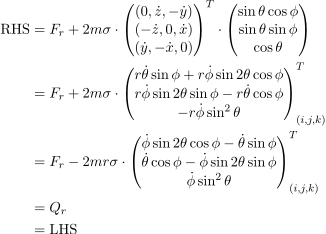
It is convenient to check from the RHS. And let me begin with identity (I):
\begin{aligned} \textrm{RHS} & = \begin{pmatrix} Q_x\\ Q_y \\ Q_z \\ \end{pmatrix}^T\cdot \begin{pmatrix} \displaystyle{\frac{\partial x}{\partial r}} \\ \displaystyle{\frac{\partial y}{\partial r}} \\ \displaystyle{\frac{\partial z}{\partial r}} \\ \end{pmatrix} = \begin{pmatrix} F_x+2m\sigma\cdot (0,\dot{z},-\dot{y}) \\ F_y+2m\sigma\cdot (-\dot{z},0,\dot{x}) \\ F_z+2m\sigma\cdot (\dot{y},-\dot{x},0) \\ \end{pmatrix}^T\cdot \begin{pmatrix} \displaystyle{\frac{\partial x}{\partial r}} \\ \displaystyle{\frac{\partial y}{\partial r}} \\ \displaystyle{\frac{\partial z}{\partial r}} \\ \end{pmatrix}\\ & = \displaystyle{\sum_{i=x,y,z}F_i\cdot \displaystyle{\frac{\partial r_i}{\partial r}}} + \begin{pmatrix} 2m\sigma\cdot (0,\dot{z},-\dot{y}) \\ 2m\sigma\cdot (-\dot{z},0,\dot{x}) \\ 2m\sigma\cdot (\dot{y},-\dot{x},0) \\ \end{pmatrix}^T\cdot \begin{pmatrix} \sin\theta\cos\phi \\ \sin\theta\sin\phi \\ \cos\theta \\ \end{pmatrix}\\ & =F_r + 2m\sigma\cdot \begin{pmatrix} (0,\dot{z},-\dot{y}) \\ (-\dot{z},0,\dot{x}) \\ (\dot{y},-\dot{x},0) \\ \end{pmatrix}^T\cdot \begin{pmatrix} \sin\theta\cos\phi \\ \sin\theta\sin\phi \\ \cos\theta \\ \end{pmatrix}\\ \end{aligned}
Computing term-by-term, the first term is
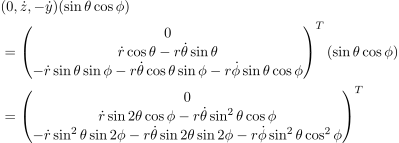
\begin{aligned} & (0,\dot{z},-\dot{y})(\sin\theta\cos\phi) \\ & = \begin{pmatrix} 0 \\ \dot{r}\cos\theta -r\dot{\theta}\sin\theta \\ -\dot{r}\sin\theta\sin\phi -r\dot{\theta}\cos\theta\sin\phi -r\dot{\phi}\sin\theta\cos\phi \\ \end{pmatrix}^T(\sin\theta\cos\phi )\\ & = \begin{pmatrix} 0 \\ \dot{r}\sin 2\theta\cos\phi -r\dot{\theta}\sin^2\theta\cos\phi \\ -\dot{r}\sin^2\theta\sin 2\phi -r\dot{\theta}\sin 2\theta\sin 2\phi -r\dot{\phi}\sin^2\theta\cos^2\phi \\ \end{pmatrix}^T\\ \end{aligned}
the second term is
\begin{aligned} & (-\dot{z},0,\dot{x})(\sin\theta\sin\phi ) \\ & = \begin{pmatrix} -\dot{r}\cos\theta +r\dot{\theta}\sin\theta \\ 0\\ \dot{r}\sin\theta\cos\phi +r\dot{\theta}\cos\theta\cos\phi -r\dot{\phi}\sin\theta\sin\phi \\ \end{pmatrix}^T (\sin\theta\sin\phi ) \\ & = \begin{pmatrix} -\dot{r}\sin 2\theta\sin\phi +r\dot{\theta}\sin^2\theta\sin\phi \\ 0 \\ \dot{r}\sin^2\theta\sin 2\phi +r\dot{\theta}\sin 2\theta\sin 2\phi -r\dot{\phi}\sin^2\theta\sin^2\phi \\ \end{pmatrix}^T\\ \end{aligned}
and the third and last term is
\begin{aligned} & (\dot{y},-\dot{x},0)(\cos\theta )\\ & = \begin{pmatrix} \dot{r}\sin\theta\sin\phi +r\dot{\theta}\cos\theta\sin\phi +r\dot{\phi}\sin\theta\cos\phi \\ -\dot{r}\sin\theta\cos\phi -r\dot{\theta}\cos\theta\cos\phi +r\dot{\phi}\sin\theta\sin\phi \\ 0\\ \end{pmatrix}^T(\cos\theta )\\ & = \begin{pmatrix} \dot{r}\sin 2\theta\sin\phi +r\dot{\theta}\cos^2\theta\sin\phi +r\dot{\phi}\sin 2\theta\cos\phi \\ -\dot{r}\sin 2\theta\cos\phi -r\dot{\theta}\cos^2\theta\cos\phi +r\dot{\phi}\sin 2\theta \sin\phi \\ 0 \\ \end{pmatrix}^T\\ \end{aligned}
Summing over these three terms, i.e.,
(0,\dot{z},-\dot{y})(\sin\theta\cos\phi)+(-\dot{z},0,\dot{x})(\sin\theta\sin\phi )+(\dot{y},-\dot{x},0)(\cos\theta ),
and one shall obtain from it
\begin{pmatrix} r\dot{\theta}\sin\phi +r\dot{\phi}\sin 2\theta \cos\phi \\ r\dot{\phi}\sin 2\theta\sin\phi -r\dot{\theta}\cos\phi \\ -r\dot{\phi}\sin^2\theta \\ \end{pmatrix}^T_{(i,j,k)}
Thus,
\begin{aligned} \textrm{RHS}& = F_r + 2m\sigma\cdot \begin{pmatrix} (0,\dot{z},-\dot{y}) \\ (-\dot{z},0,\dot{x}) \\ (\dot{y},-\dot{x},0) \\ \end{pmatrix}^T\cdot \begin{pmatrix} \sin\theta\cos\phi \\ \sin\theta\sin\phi \\ \cos\theta \\ \end{pmatrix}\\ & =F_r+2m\sigma \cdot \begin{pmatrix} r\dot{\theta}\sin\phi +r\dot{\phi}\sin 2\theta \cos\phi \\ r\dot{\phi}\sin 2\theta\sin\phi -r\dot{\theta}\cos\phi \\ -r\dot{\phi}\sin^2\theta \\ \end{pmatrix}^T_{(i,j,k)}\\ & = F_r-2mr\sigma\cdot \begin{pmatrix} \dot{\phi}\sin 2\theta\cos\phi -\dot{\theta}\sin\phi \\ \dot{\theta}\cos\phi -\dot{\phi}\sin 2\theta\sin\phi \\ \dot{\phi}\sin^2\theta \\ \end{pmatrix}^T_{(i,j,k)}\\ & = Q_r \\ & = \textrm{LHS}\\ \end{aligned}
The identity (I) is checked.
By applying the same procedure one can easily check that identities (II) and (III) are also satisfied. This is left as a tedious exercise to the reader. And the components of (generalized/usual) force in two coordinates systems are indeed related to each other as
Eq. (1.49):

Q_j=\displaystyle{\sum_{i}\mathbf{F}_i\cdot \frac{\partial \mathbf{r}_i}{\partial q_j}}

3.

In this part I shall obtain the equation of motion, or the Euler-Lagrange equations, where the Lagrangian \mathcal{L} is defined to be the difference of kinetic energy and generalized potential, i.e., \mathcal{L}=T-U.
To begin with, I shall show that owing to its linearity, the Lagrangian is separable in the sense of the following:
\begin{aligned} \displaystyle{\frac{\mathrm{d}}{\mathrm{d}t}\bigg( \frac{\partial \mathcal{L}}{\partial \dot{q_i}} \bigg)}-\displaystyle{\frac{\partial \mathcal{L}}{\partial q_i}} & =0\\ \displaystyle{\frac{\mathrm{d}}{\mathrm{d}t}\bigg( \frac{\partial}{\partial \dot{q_i}}\big( T-U \big)\ \bigg)}-\displaystyle{\frac{\partial }{\partial q_i}}\big( T-U \big) & =0\\ \displaystyle{\frac{\mathrm{d}}{\mathrm{d}t}\bigg( \frac{\partial}{\partial \dot{q_i}}\big( T \big) - \frac{\partial}{\partial \dot{q_i}}\big( U \big) \bigg)}-\displaystyle{\frac{\partial }{\partial q_i}}\big( T \big) + \displaystyle{ \frac{\partial }{\partial q_i}}\big( U \big) & =0\\ \displaystyle{\frac{\mathrm{d}}{\mathrm{d}t}\bigg( \frac{\partial}{\partial \dot{q_i}}\big( T \big) \bigg)}-\displaystyle{\frac{\partial }{\partial q_i}}\big( T \big) & =\displaystyle{\frac{\mathrm{d}}{\mathrm{d}t}\bigg( \frac{\partial}{\partial \dot{q_i}}\big( U \big) \bigg)} - \displaystyle{ \frac{\partial }{\partial q_i}}\big( U \big) \\ \displaystyle{\frac{\mathrm{d}}{\mathrm{d}t}\bigg( \frac{\partial}{\partial \dot{q_i}}\big( T \big) \bigg)}-\displaystyle{\frac{\partial }{\partial q_i}}\big( T \big) & =Q_i \\ \end{aligned}
where Q_i is the generalized force defined in the previous parts (a) & (b).
Based on the transformation equation of velocity between spherical and Cartesian coordinates as derived in part (a):
\begin{aligned} \mathbf{v} & =(\dot{x},\dot{y},\dot{z})\\ & = \begin{pmatrix} \dot{r}\sin\theta\cos\phi +r\dot{\theta}\cos\theta\cos\phi -r\dot{\phi}\sin\theta\sin\phi \\ \dot{r}\sin\theta\sin\phi +r\dot{\theta}\cos\theta\sin\phi +r\dot{\phi}\sin\theta\cos\phi \\ \dot{r}\cos\theta -r\dot{\theta}\sin\theta \\ \end{pmatrix}^T_{(i,j,k)}\\ \end{aligned},
the conversion of kinetic energy T into spherical coordinates can be derived in the form:
\begin{aligned} T & =\displaystyle{\frac{1}{2}m\mathbf{v}^2=\frac{1}{2}m(\dot{x}^2+\dot{y}^2+\dot{z}^2)}\\ & = \cdots \\ & = \displaystyle{\frac{1}{2}mr^2(\dot{\theta}^2+\sin^2\theta \dot{\phi}^2)} \\\end{aligned}
That said, I shall compute the following derivatives:
\displaystyle{\frac{\partial T}{\partial r}}=mr(\dot{\theta}^2+\sin^2\theta\dot{\phi}^2), \displaystyle{\frac{\partial T}{\partial \dot{r}}}=0\displaystyle{\frac{\mathrm{d}}{\mathrm{d}t}\bigg(\frac{\partial T}{\partial \dot{r}}\bigg)}=0
\displaystyle{\frac{\partial T}{\partial \theta}}=mr^2\dot{\phi}^2\sin 2\theta, \displaystyle{\frac{\partial T}{\partial \dot{\theta}}}=mr^2\dot{\theta}, \displaystyle{\frac{\mathrm{d}}{\mathrm{d}t}\bigg(\frac{\partial T}{\partial \dot{\theta}}\bigg)}=mr^2\ddot{\theta}+2m\dot{\theta}r\dot{r}
\displaystyle{\frac{\partial T}{\partial \phi}}=0, \displaystyle{\frac{\partial T}{\partial \dot{\phi}}}=mr^2\dot{\phi}, \displaystyle{\frac{\mathrm{d}}{\mathrm{d}t}\bigg(\frac{\partial T}{\partial \dot{\phi}}\bigg)}=mr^2\ddot{\phi}+2m\dot{\phi}r\dot{r}
Thus, the LHS of the separable Lagrangian equations are
\begin{aligned}\widetilde{T}_r & =-mr(\dot{\theta}^2+\sin^2\theta\dot{\phi}^2)\\ \widetilde{T}_\theta & =mr^2\ddot{\theta}+2m\dot{\theta}r\dot{r}-mr^2\dot{\phi}^2\sin 2\theta \\ \widetilde{T}_\phi & =mr^2\ddot{\phi}+2m\dot{\phi}r\dot{r}\end{aligned}
Equating them with the Q_r, Q_\theta, and Q_\phi which were derived in part (a), we obtain three equations of motion:

-mr(\dot{\theta}^2+\sin^2\theta\dot{\phi}^2)=F_r-2mr\sigma\cdot \begin{pmatrix} \dot{\phi}\sin 2\theta\cos\phi -\dot{\theta}\sin\phi \\ \dot{\theta}\cos\phi -\dot{\phi}\sin 2\theta\sin\phi \\ \dot{\phi}\sin^2\theta \\ \end{pmatrix}^T_{(i,j,k)}
mr^2\ddot{\theta}+2m\dot{\theta}r\dot{r}-mr^2\dot{\phi}^2\sin 2\theta = -mr\sigma\cdot \begin{pmatrix} (2\cos 2\theta +1)r\dot{\phi}\cos\phi +(2\dot{r}-r\dot{\theta})\sin\phi \\ (1-2\cos 2\theta )r\dot{\phi}\sin\phi +(r\dot{\theta}-2\dot{r})\cos\phi \\ 2r\dot{\phi}\sin 2\theta \\ \end{pmatrix}^T_{(i,j,k)}
mr^2\ddot{\phi}+2m\dot{\phi}r\dot{r} =-mr\sigma \cdot \begin{pmatrix} -(r\dot{\theta}+2\dot{r}\sin 2\theta +2r\dot{\theta}\cos 2\theta )\cos\phi \\ -(r\dot{\theta}+2\dot{r}\sin 2\theta +2r\dot{\theta}\cos 2\theta )\sin\phi \\ \big( (r\dot{\phi}-2\dot{r})\sin\theta -2r\dot{\theta}\cos\theta \big) \sin\theta \\ \end{pmatrix}^T_{(i,j,k)}

Remark.

The F_r in the first equation of motion is the central force. The fixed vector \sigma should be in component form \sigma =\sigma (r,\theta ,\phi )=(\sigma_r,\sigma_\theta ,\sigma_\phi ). Once \sigma having dotted with the rightmost row vector, a scalar will be obtained.

Leave a Reply

Your email address will not be published. Required fields are marked *