
Draw a circle of radius  around the center
  .
.

As the center of a circle is equidistant from all points on the circumference, using Pythagorean theorem, we have

Attempts. (reinventing the wheel)
Considering the differentials  and
and  , we have

Suppose I do not know the circumference is  long. Let its unknown length be
  , and let it be partitioned into infinitesimal
  , such that

Assume we may write
 .
.
Expand the right hand side as follows

Then

Suppose I evaluate the integral above  by direct substitution
  by Riemann sum, so the definite integral due to Riemann is given by
 .
.
For  , let
, let  be a regular partition of
 ![[0,2R]](https://physicspupil.com/wp-content/ql-cache/quicklatex.com-fb09bc7b93218a036256f8e15dab160e_l3.svg "Rendered by QuickLaTeX.com") . Then
. Then
 .
.
By right-endpoint approximation for Riemann sums, for each interval ![[x_{i-1},x_i]](https://physicspupil.com/wp-content/ql-cache/quicklatex.com-fad958508b658fc27e7653f8da54b43d_l3.svg "Rendered by QuickLaTeX.com") , we have
, we have
![\displaystyle{x_i=x_0+ix=0+i\bigg[\frac{2R}{n}\bigg]=\frac{2Ri}{n}}](https://physicspupil.com/wp-content/ql-cache/quicklatex.com-4c51443c9a4838ef917c7c064b034ba0_l3.svg "Rendered by QuickLaTeX.com") .
.
Let  . Thus,

Writing the Riemann sum in the form

Inspecting  where
where

I guess, under correction, that  .
.
(to be continued)
Solution. (arc-length parametrization)
Referring to the equation of locus on the very first line:
 ,
,
then parameterizing  ,
,  by
by  ,
,

and computing the derivatives wrt :

Note that

where
 .
.
Then,
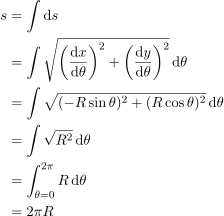
(to be continued)