
Let  . Find
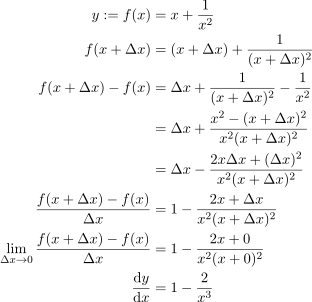
  from first principles.
Solution.
From first principles,
Playground.
To make fun of calculus, do let
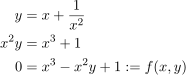
where  is a degree
  polynomial in two variables
  and
and  .
.
The set of solutions to  is
is

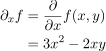
Computing  and
and  as follow:
and
 ,
,
we oversee the relation
 .
.
Definition. (Singularity and Smoothness)
A point  on a curve
  is said to be singular if
 .
.
A point that is not singular is called smooth. If there is at least one singular point on  , then curve is called a singular curve. If there are no singular points on , the curve is called a smooth curve.
C.f. Definition 1.9.1, T. Carrity, et al., Algebraic Geometry: A Problem Solving Approach
That said, in our scenario
 ,
,
the set of candidates for singularity
 .
.
is empty.
 The curve
  is smooth, thus everywhere differentiable.
Wait, the function in question should be the curve
 ;
;
still, for better or worse,  is
is  a differentiable function because the derivative does exist at
  , for that point is a discontinuity.