
The blogger claims no originality of his problem below.

Let there be a rubber band of constant mass  (an invariable) but of non-constant length
  (a variable), whose relaxed length (when unstretched) is
  . May it sustain longitudinal elongation
  to any degree,
i.e.,  ;
;
and withstand uni-directional tension  to any extent,
i.e.,  ;
;
as and when its cross-sectional area approaches the limit  .
.
Let there also be some pencil(s) of rigid body and in diameter comparable to the thickness of a slack rubber band.
Let the rubber band obey Hooke’s law.

where  is the magnitude of restoring force,
  the spring constant, and
  the magnitude of displacement from the equilibrium position.
Let the pencils be held firmly in any positions as desired, to each of which applies whenever necessary some force  in direction pointing away from the centre of rubber band.
For your information.
The process of parallel layers sliding past each other is known as shearing.

A pile of papers, a pack of cards with rectangular cross-section can be pushed to obtain a parallelogram cross-section. In such cases, the angle between the sides has changed, but all that has actually happened is some parallel sliding.
Byju’s on Shearing stress
Setup.
Figures  drawn to scale.

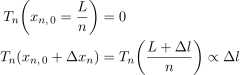
Problem.
Discuss what resistive (/restrictive) force  the rubber band exerts on itself when it is in a circle, i.e.,
  , expanding (radially), i.e.,
  ; such that in any infinitesimal sections, the direction of is orthogonal to that of tension
  , i.e.,
 .
.
This problem is not to be attempted.