
A right pyramid,  high, stands on a rectangular base
  by
by  . Calculate
 (a) the length of an edge of the pyramid; (b) the angles the triangular faces made with the base; (c) the volume of the pyramid.
Extracted from A. Godman & J. F. Talbert. (1973). Additional Mathematics Pure and Applied in SI Units.
Roughwork.
Commit my visualization to drawing.
A right pyramid is a pyramid where the base is circumscribed about the circle and the altitude of the pyramid meets at the circle’s center.
Wikipedia on Pyramid (geometry)

The pyramid above has a polygonal base, here the rectangle  , and an apex
  , here the common vertex of triangles
  ,
,  ,
,  , and
, and  . The altitude is based on the origin
  . To suit our coordinates to this problem, we write
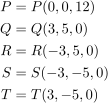

such that
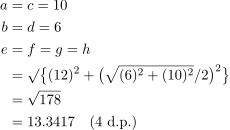
For the edges of its base, write
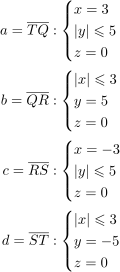
and for, the lateral, edge  :
:

edge  :
:

edge  :
:

and edge  :
:

For lateral surface  enclosed by edges
  ,
,  , and
, and  , write
![A(x,y,z):\begin{cases} (x,y,z)\in [0,3]\times [-5,5]\times [0,12] \\ \textrm{s.t. }\displaystyle{\frac{|y|}{5}\leqslant \frac{x}{3}=1-\frac{z}{12}} \\ \end{cases}](https://physicspupil.com/wp-content/ql-cache/quicklatex.com-59d2f630b733430dc75304d173637862_l3.svg "Rendered by QuickLaTeX.com")

for lateral surface  by edges
  , , and
  , write:
![B(x,y,z):\begin{cases} (x,y,z)\in [-3,3]\times [0,5]\times [0,12] \\ \textrm{s.t. }\displaystyle{\frac{|x|}{3}\leqslant \frac{y}{5}=1-\frac{z}{12}} \\ \end{cases}](https://physicspupil.com/wp-content/ql-cache/quicklatex.com-f8db9d0cedb3ec91bd6288b8bee1475d_l3.svg "Rendered by QuickLaTeX.com")

for lateral surface  by edges
  , , and
  , write:
![C(x,y,z):\begin{cases} (x,y,z)\in [-3,0]\times [-5,5]\times [0,12] \\ \textrm{s.t. }\displaystyle{\frac{|y|}{5}\leqslant -\frac{x}{3}=1-\frac{z}{12}} \\ \end{cases}](https://physicspupil.com/wp-content/ql-cache/quicklatex.com-079c13efeb454ce6a635461d11dae48a_l3.svg "Rendered by QuickLaTeX.com")

for lateral surface  by edges
  , , and , write:
![D(x,y,z):\begin{cases} (x,y,z)\in [-3,3]\times [-5,0]\times [0,12] \\ \textrm{s.t. }\displaystyle{\frac{|x|}{3}\leqslant -\frac{y}{5}=1-\frac{z}{12}} \\ \end{cases}](https://physicspupil.com/wp-content/ql-cache/quicklatex.com-20b512cefd3f6a733132c75fa93316fc_l3.svg "Rendered by QuickLaTeX.com")

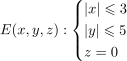
and for base  by edges , , , and :

write
This problem is not to be attempted.