202405101842 Exercise 16.67

The cross product of a vector with itself is

A. the vector \mathbf{i}^2+\mathbf{j}^2+\mathbf{k}^2.
B. the vector \mathbf{i}+\mathbf{j}+\mathbf{k}.
C. the zero vector.
D. the scalar quantity 1.
E. the scalar quantity 0.

Extracted from Stan Gibilisco. (2006). Technical Math Demystified.


Erratum.

Option A should be a scalar.

Roughwork.

Most commonly, it is the three-dimensional Euclidean space \mathbf{E}^3 (or \mathbb{E}^3) that models physical space \mathbf{R}^3 (or \mathbb{R}^3).

Wikipedia on Three-dimensional space

The Euclidean metric is given by

\mathbf{G}=(g_{\alpha\beta})\equiv \begin{bmatrix}1 & 0 & 0 \\ 0 & 1 & 0 \\ 0 & 0 & 1 \\\end{bmatrix}

and so line element \mathrm{d}s

\begin{aligned} \mathrm{d}s^2 & = g_{\alpha\beta}\,\mathrm{d}x^\alpha\,\mathrm{d}x^\beta \\ & = (\mathrm{d}x^1)^2 + (\mathrm{d}x^2)^2 + (\mathrm{d}x^3)^2 \\ & = \mathrm{d}x^2+\mathrm{d}y^2+\mathrm{d}z^2 \\ \end{aligned}

or distance

d=\sqrt{(x_2-x_1)^2+(y_2-y_1)^2+(z_2-z_1)^2}

is equivalent to applying twice the Pythagorean equation

a^2+b^2=c^2

to two points (x_1,y_1,z_1) and (x_2,y_2,z_2) with respect to the standard basis (\mathbf{e}_x,\mathbf{e}_y,\mathbf{e}_z):

\begin{cases} \hat{\mathbf{i}}=\mathbf{e}_x=(1,0,0) \\ \hat{\mathbf{j}}=\mathbf{e}_y=(0,1,0) \\ \hat{\mathbf{k}}=\mathbf{e}_z=(0,0,1) \\ \end{cases}

of a Cartesian coordinate system. To carry a point from one position to another, a vector \mathbf{v} has both magnitude v=|\mathbf{v}| and direction \hat{\mathbf{v}}=\frac{\mathbf{v}}{|\mathbf{v}|}. Scalar multiplication c\mathbf{v} will scale its magnitude by some factor c (the scalar) without change in its direction. I.e.,

\begin{aligned} \mathbf{u} & \stackrel{\mathrm{def}}{=}c\mathbf{v} \\ u & = |\mathbf{u}| = |c\mathbf{v}| = c|\mathbf{v}|\\ & = cv \\ \hat{\mathbf{u}} & = \frac{\mathbf{u}}{|\mathbf{u}|} = \frac{c\mathbf{v}}{c|\mathbf{v}|} = \frac{\mathbf{v}}{|\mathbf{v}|} \\ & = \hat{\mathbf{v}} \\ \end{aligned}

Vector multiplication is for whose vectors be the products scalar or vector. For instance, we have

Dot product (aka scalar product) of two vectors \mathbf{u}=(u_x,u_y,u_z) and \mathbf{v}=(v_x,v_y,v_z)

\begin{aligned} \mathbf{u}\cdot\mathbf{v} & = \sum_{x,y,z}u_iv_i \\ & = u_xv_x+u_yv_y+u_zv_z \\ & = |\mathbf{u}| |\mathbf{v}|\cos\theta \\ \end{aligned}

as a scalar quantity; but their cross product (aka vector product)

\begin{aligned} \mathbf{u}\times\mathbf{v} & = \begin{vmatrix} \hat{\mathbf{i}} & \hat{\mathbf{j}} & \hat{\mathbf{k}} \\ u_x & u_y & u_z \\ v_x & v_y & v_z \\ \end{vmatrix} \\ & = (u_yv_z-u_zv_y, u_zv_x-u_xv_z, u_xv_y-u_yv_x) \\ & = |\mathbf{u}||\mathbf{v}|\sin\theta\,\hat{\mathbf{n}} \\ \end{aligned}

a vector quantity. Added on are tensor product \mathbf{u}\otimes\mathbf{v}, wedge product \mathbf{u}\wedge\mathbf{v}, and more.


This problem is not to be attempted.

202405091824 Pastime Exercise 011

About the graph below, tell some stories as probable as probable can be.


Roughwork.

Assuming linear (/rectilinear) motion in a single direction.

Assuming uniform acceleration, there are two cases: i. zero acceleration and ii. non-zero (constant) acceleration; in the former velocity being (a) constant and the latter (b) non-constant.

Assuming a flat spacetime metric of which the spatial part does not expands with the temporal part.

Imagine a man walking along a straight line from point (x_1,y_1) to point (x_2,y_2). From

\displaystyle{\textrm{Speed }(v)=\frac{\textrm{Distance }(s)}{\textrm{Time }(t)}}

as the path is fixed, i.e., \Delta s=\textrm{Const.}, we see speed v and time t

\begin{aligned} v\uparrow\enspace \Leftrightarrow \enspace& t\downarrow \\ v\downarrow\enspace\Leftrightarrow\enspace& t\uparrow \\ \end{aligned}

in an inverse relationship. As the man keeps his own fair pace and makes himself a good timekeeper, we can treat speed v as an independent variable, and time t a dependent variable.

\textrm{\scriptsize{CASE} \textbf{\texttt{(a)}}}: velocity being constant

Parameterize the Cartesian equation y=mx+c by the parameter t' (*as distinguished from the natural/unit-speed/arc-length parameter time t) so as to write a set of parametric equations:

\begin{aligned} & \begin{cases} s_x(t')=t' \\ s_y(t')=mt'+c \\ \end{cases} \\ & \\ & \begin{cases} v_x(t') =s_x'(t') = 1 \\ v_y(t') = s_y'(t') = m \\ \end{cases} \\ \end{aligned}

\begin{aligned} v^2(t') & = v_x^2(t')+v_y^2(t') \\ v(t') & = \displaystyle{\sqrt{\bigg(\frac{\mathrm{d}s_x(t')}{\mathrm{d}t'}\bigg)^2 +\bigg(\frac{\mathrm{d}s_y(t')}{\mathrm{d}t'}\bigg)^2}} \\ |\mathbf{v}(t')| & = \sqrt{1+m^2} \\ t & = \int_{0}^{t'}|\mathbf{v}(t)|\,\mathrm{d}t \\ & = (\sqrt{1+m^2})t'\\ \end{aligned}

\textrm{\scriptsize{CASE} \textbf{\texttt{(b)}}}: velocity being non-constant

The man begins with initial speed v_1 at start point (x_1,y_1) and ends with final speed v_2 at finish point (x_2,y_2). We have

\displaystyle{\textrm{Acceleration }(a)=\frac{\textrm{Change in speed }(v-u)}{\textrm{Time }(t)}}

Write by SUVAT equations of motion:

\begin{aligned} \mathbf{u} & = (u_x,u_y) \\ \mathbf{v} & = (v_x,v_y) \\ \mathbf{a} & = (a_x,a_y) \\ & = \bigg( \frac{v_x-u_x}{t}, \frac{v_y-u_y}{t}\bigg) \\ \mathbf{s} & = (s_x,s_y) \\ & = \bigg( u_xt+\frac{1}{2}a_xt^2, u_yt+\frac{1}{2}a_yt^2\bigg) \\ & = \bigg(\frac{1}{2}(u_x+v_x)t, \frac{1}{2}(u_y+v_y)t\bigg) \\ & = (x_2-x_1,y_2-y_1) \\ \end{aligned}

Is this time t also a natural parameter?

For a given parametric curve, the natural parametrization is unique up to a shift of parameter.

Wikipedia on Differentiable curve


(to be continued)

202405081402 Pastime Exercise 010

About the graph below, tell some stories as probable as probable can be.


Roughwork.

We naturally assume there are no forms of negative energy. That is, kinetic energy \textrm{KE: } K\geqslant 0, potential energy \textrm{PE: }U\geqslant 0, and (total) mechanical energy K+U=E=\textrm{Const.}\geqslant 0.

The graph is divided into Zone ①, Zone ②, and Zone ③.

\begin{aligned} V(x) & = \begin{cases} +\infty & \textrm{for }x\leqslant 1 \\ 2 & \textrm{for }1<x\leqslant 2 \\ -2|x-3|+4& \textrm{for }2\leqslant x\leqslant 5 \\ \frac{1}{2}(x^2-10x+25) & \textrm{for }5\leqslant x\\ \end{cases} \\ \end{aligned}

For any conservative system, total energy E takes the form of a horizontal line y=\textrm{Const.} as in a graph. Take E=2 as an example:

\begin{aligned} & \qquad E: y=2 \\ & \Longrightarrow \begin{cases} (E-U=)K> 0\Rightarrow x\in (4,7) \\ (E-U=)K = 0\Rightarrow x \in (1,2]\cup\{ 4\}\cup\{ 7\} \\ (E-U=)K< 0\Rightarrow x\in (-\infty ,1]\cup (2,4)\cup (7,\infty) \\ \end{cases} \\ \end{aligned}

\begin{aligned} & \qquad K=\frac{1}{2}mv^2 = \frac{p^2}{2m} \\ & \Longrightarrow \begin{cases} K(x)>0\Rightarrow \textrm{a particle moves at }x \\ K(x)=0\Rightarrow\textrm{a particle stays at }x \\ K(x)<0\Rightarrow \textrm{no particle exists at }x \\ \end{cases} \\ \end{aligned}


(to be continued)

202405071349 Exercise 13.2.1

A right pyramid, 12\,\mathrm{cm} high, stands on a rectangular base 6\,\mathrm{cm} by 10\,\mathrm{cm}. Calculate (a) the length of an edge of the pyramid; (b) the angles the triangular faces made with the base; (c) the volume of the pyramid.

Extracted from A. Godman & J. F. Talbert. (1973). Additional Mathematics Pure and Applied in SI Units.


Roughwork.

Commit my visualization to drawing.

right pyramid is a pyramid where the base is circumscribed about the circle and the altitude of the pyramid meets at the circle’s center.

Wikipedia on Pyramid (geometry)

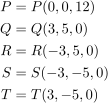
The pyramid above has a polygonal base, here the rectangle QRST, and an apex P, here the common vertex of triangles \triangle PTQ, \triangle PQR, \triangle PRS, and \triangle PST. The altitude is based on the origin O. To suit our coordinates to this problem, we write
\begin{aligned} P & =P(0,0,12) \\ Q & =Q(3,5,0) \\ R & =R(-3,5,0) \\ S & =S(-3,-5,0) \\ T & =T(3,-5,0) \\ \end{aligned}

such that

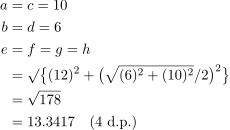
\begin{aligned} a & = c = 10 \\ b & = d = 6 \\ e & = f = g = h \\ & = \surd \big\{ (12)^2 + \big( \sqrt{(6)^2+(10)^2}/2\big)^2 \big\} \\ & = \sqrt{178} \\ & = 13.3417\quad\textrm{(4 d.p.)} \\ \end{aligned}

For the edges of its base, write

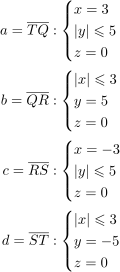
\begin{aligned} a=\overline{TQ} & :\begin{cases} x=3 \\ |y|\leqslant 5 \\ z=0 \\ \end{cases} \\ b=\overline{QR} & :\begin{cases} |x|\leqslant 3 \\ y=5 \\ z=0 \\ \end{cases} \\ c=\overline{RS} & :\begin{cases} x=-3 \\ |y|\leqslant 5 \\ z=0 \\ \end{cases} \\ d=\overline{ST}& :\begin{cases} |x|\leqslant 3 \\ y=-5 \\ z=0 \\ \end{cases} \\ \end{aligned}

and for, the lateral, edge e=\overline{PQ}:

\begin{aligned} \frac{x-3}{0-3} & = \frac{y-5}{0-5} = \frac{z-0}{12-0} \\ \end{aligned}

edge f=\overline{PR}:

\begin{aligned} \frac{x-(-3)}{0-(-3)} & = \frac{y-5}{0-5} = \frac{z-0}{12-0} \\ \end{aligned}

edge g=\overline{PS}:

\begin{aligned} \frac{x-(-3)}{0-(-3)} & = \frac{y-(-5)}{0-(-5)} = \frac{z-0}{12-0} \\ \end{aligned}

and edge h=\overline{PT}:

\begin{aligned} \frac{x-3}{0-3} & = \frac{y-(-5)}{0-(-5)} = \frac{z-0}{12-0} \\ \end{aligned}

For lateral surface A enclosed by edges a, h, and e, write

A(x,y,z):\begin{cases} (x,y,z)\in [0,3]\times [-5,5]\times [0,12] \\ \textrm{s.t. }\displaystyle{\frac{|y|}{5}\leqslant \frac{x}{3}=1-\frac{z}{12}} \\ \end{cases}

for lateral surface B by edges b, e, and f, write:

B(x,y,z):\begin{cases} (x,y,z)\in [-3,3]\times [0,5]\times [0,12] \\ \textrm{s.t. }\displaystyle{\frac{|x|}{3}\leqslant \frac{y}{5}=1-\frac{z}{12}} \\ \end{cases}

for lateral surface C by edges c, f, and g, write:

C(x,y,z):\begin{cases} (x,y,z)\in [-3,0]\times [-5,5]\times [0,12] \\ \textrm{s.t. }\displaystyle{\frac{|y|}{5}\leqslant -\frac{x}{3}=1-\frac{z}{12}} \\ \end{cases}

for lateral surface D by edges d, g, and h, write:

D(x,y,z):\begin{cases} (x,y,z)\in [-3,3]\times [-5,0]\times [0,12] \\ \textrm{s.t. }\displaystyle{\frac{|x|}{3}\leqslant -\frac{y}{5}=1-\frac{z}{12}} \\ \end{cases}

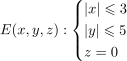
and for base E by edges a, b, c, and d:

write

E(x,y,z):\begin{cases} |x|\leqslant 3 \\ |y|\leqslant 5 \\ z=0 \\ \end{cases}


This problem is not to be attempted.

202405061531 不求甚解

埃及人:符號造形,意由物事。獨體曰文,合體曰字。華語以外,率歸拼音。

中國人:請以「相看兩不厭」的「相看」承言。相者,左木右目,曲直長短,為之匠察良材;看者,上手下目,日頭掁眼,即便掌搭涼篷。

日本人:「是藥三分毒」尚有通理;敝國「今度(こんど)」是「以後、下一次」、「留守(るす)」是「外出、不在家」,則相去霄壤,殊為難解。

中國人:《大學》的「止於至善」、《易經》的「既濟」然後「未濟」,也只可意會,非以言象。