A light ray passes through a spherical air bubble in water. Which of the following represents the path of the emergent ray?

A. 
B. 
C. 
D. 
Roughwork.
Refractive (/refraction) index of a pure substance, with some exceptions, is proportional to its density; and of a mixture of substances, as a rule, to its mass concentration.
Thus water, higher in density than air, should have a larger refractive index than air:
 ;
;
alternatively, as light travels in air faster than in water, from
 ,
,
it can be seen also.

Let  and
and  be the angle of incidence and of refraction when light is refracted through the first interface; and and
  , when through the second interface.
Assuming WLOG  and noting
  (non-negative) for
 ![\theta\in \big[ 0,\frac{\pi}{2}\big]](https://physicspupil.com/wp-content/ql-cache/quicklatex.com-eb31fdb43359ab42ea682435eb79b44f_l3.svg "Rendered by QuickLaTeX.com") . By Snell’s Law, write
. By Snell’s Law, write


Answer. Path .

Reverse the direction of incidence and emergence:

Light ray along path: bends away from and then towards the normal; bends towards the normal once and again; bends away from the normal once and again; bends towards and then away from the normal. Wits have it that and are unlikely. So we turn our attention to light rays and .

Fussy enough, path is symmetric with respect to straight line  ; but there across path is no line of symmetry were it to be
  .
.
This problem is not to be attempted.


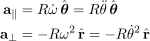
 in an anti-clockwise direction, and the displacement
  in a rightward and an upward direction.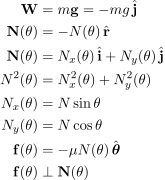

 be kept constant, i.e.,
  .
.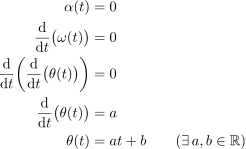
 assumed,
 ,
, wrt time
  will be a polynomial in an indeterminate
  or higher,
 .
. is less often mentioned than is its parallel tangential acceleration
  as the pair to centripetal (/centrifugal) acceleration
  .
.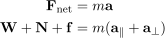
 , is necessary for any circular motion, be it uniform or not; but not sufficient for the absence of a tangential acceleration
  (why?). One knows instinctively, that the vehicle should possess a minimum angular speed
  to do this dangerous stunt. And so much the better if beyond this bound
  one has all degrees of freedom.