202402151329 Solution to 1985-CE-AMATH-II-5

If the equation

x^2+y^2+kx-(2+k)y=0

represents a circle with radius \sqrt{5},

(a) find the value(s) of k;
(b) find the equation(s) of the circle(s).


As if sitting an exam in additional mathematics, it certainly not being showing off, we should perhaps involve ourselves with some sort of calculus.

Roughwork.

As always, have in mind some pictures. Hence, we draw:

and also

after the stage got set, we write

\begin{aligned} 0 & = x^2+y^2+kx-(2+k)y \\ 0 & = 2x\,\mathrm{d}x+2y\,\mathrm{d}y + k\,\mathrm{d}x - (2+k)\,\mathrm{d}y \\ y' & = \frac{\mathrm{d}y}{\mathrm{d}x} = \frac{2x+k}{k-2y+2} \\ \end{aligned}

and furthermore,

\begin{aligned} \frac{\mathrm{d}y}{\mathrm{d}x} & = 0 \\ & \Rightarrow 2x+k=0 \\ & \Rightarrow x = -\frac{k}{2} \\ \frac{\mathrm{d}y}{\mathrm{d}x} & = \infty \\ & \Rightarrow k-2y+2 = 0 \\ & \Rightarrow y = \frac{k}{2}+1 \\ \end{aligned}

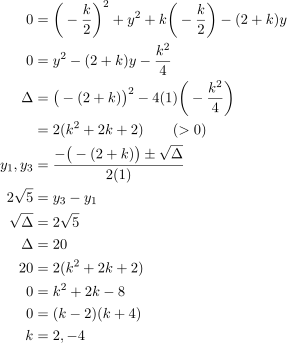
In the case of x=-\frac{k}{2}:

\begin{aligned} 0 & = \bigg( -\frac{k}{2}\bigg)^2+y^2+k\bigg( -\frac{k}{2}\bigg) -(2+k)y \\ 0 & = y^2 - (2+k)y - \frac{k^2}{4} \\ \Delta & = \big( -(2+k)\big)^2 - 4(1)\bigg( -\frac{k^2}{4}\bigg) \\ & = 2(k^2+2k+2)\qquad (> 0) \\ y_1,y_3 & = \frac{-\big( -(2+k)\big) \pm \sqrt{\Delta}}{2(1)} \\ 2\sqrt{5} & = y_3-y_1 \\ \sqrt{\Delta} & = 2\sqrt{5} \\ \Delta & = 20 \\ 20 & = 2(k^2+2k+2) \\ 0 & = k^2+2k-8 \\ 0 & = (k-2)(k+4) \\ k & = 2,-4 \\ \end{aligned}

and the case of y=\frac{k}{2}+1:

\begin{aligned} 0 & = x^2 + \bigg( \frac{k}{2}+1\bigg)^2 + kx - (2+k)\bigg( \frac{k}{2}+1\bigg) \\ 0 & = x^2+kx - \bigg(\frac{k}{2}+1\bigg)^2\\ \Delta & = (k)^2 - 4(1)\bigg( -\bigg(\frac{k}{2}+1\bigg)^2\bigg) \\ & = 2(k^2+2k+2) \qquad (> 0) \\ x_1,x_3 & = \frac{-(k)\pm\sqrt{\Delta}}{2(1)} \\ 2\sqrt{5} & = x_3 - x_1 \\ \sqrt{\Delta} & = 2\sqrt{5} \\ \Delta & = 20 \\ 20 & = 2(k^2+2k+2) \\ 0 & = k^2+2k-8 \\ 0 & = (k-2)(k+4) \\ k & = 2,-4 \\ \end{aligned}

Targeting the centre C(a,b):

\begin{aligned} a_{i=1,2} & = \frac{x_3 - x_1}{2} = -\frac{k}{2}\bigg|_{k=2,-4} = -1,2 \\ b_{i=1,2} & = \frac{y_3-y_1}{2} = \frac{-\big( -(2+k)\big)}{2}\bigg|_{k=2,-4} = 2,-1 \\ (a,b) & = (-1,2)\cup (2,-1) \\ \end{aligned}

Of the equation of circle, the standard form is

\left\{ \begin{aligned} (x+1)^2 + (y-2)^2 & = (\sqrt{5})^2 \\ (x-2)^2 + (y+1)^2 & = (\sqrt{5})^2 \\ \end{aligned}\right\}

and the general form

\left\{ \begin{aligned} x^2+y^2+2x-4y & = 0 \\ x^2+y^2-4x+2y & = 0 \\ \end{aligned}\right\}


This problem is not to be attempted.