
The blogger claims no originality of his problem below.
On a rollover road,

a vehicle performs circular motion:

Discuss how the driver could prevent a traffic accident.
Roughwork.
Take positive both, the angle  in an anti-clockwise direction, and the displacement
  in a rightward and an upward direction.
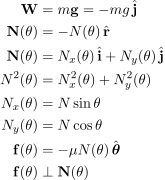
In order for the vehicle not to leave the track, the radius of curvature 
 be kept constant, i.e.,
  .
.
Recall, in uniform circular motion there isn’t any (angular) acceleration in angular velocity, i.e.,
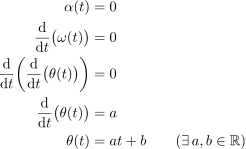
If uniform circular motion is  assumed,
i.e.,  ,
,
then angular displacement  wrt time
  will be a polynomial in an indeterminate of degree
  or higher,
i.e.,  .
.
Angular acceleration  is less often mentioned than is its parallel tangential acceleration
  as the pair to centripetal (/centrifugal) acceleration
  .
.
By Newton 2nd Law, write
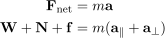
The presence of a centripetal acceleration, i.e.,  , is necessary for any circular motion, be it uniform or not; but not sufficient for the absence of a tangential acceleration
  (why?). One knows instinctively, that the vehicle should possess a minimum angular speed
  to do this dangerous stunt. And so much the better if beyond this bound
  one has all degrees of freedom.
By definition,
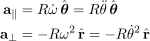
Stepping on and off the accelerator (/gas pedal), however delicately, is designed to keep a constant acceleration for the gear.
This problem is not to be attempted.