
The blogger claims no originality of the problem below.
The image files are licensed under the Creative Commons Attribution-Share Alike 2.5 Generic license in the public domain.

Xiangqi, commonly known as Chinese chess or elephant chess, is a strategy board game for two players.
Wikipedia on Xiangqi
Setup.
Let “帥/將” be referred to as  ; “仕/士” as
  , “相/象” as
  ; “傌/馬” as
  ; “俥/車” as
  ; and “兵/卒” as
  .
.
Any intersection of the ten horizontal and the nine vertical lines is called a point on the board; there are ninety points.
Let  be the number of time(s) of movement of pieces from the start (
 ). Each player moves in turn such that for one army
  and for its enemy
  .
.
And ![\mathbf{l}(x_{[*]}(t),y_{[*]}(t))\in\{1,2,3,\dots ,9\}\times \{1,2,3,\dots ,10\}](https://physicspupil.com/wp-content/ql-cache/quicklatex.com-36b296d8ef762a4cd243ba9e6ea91e82_l3.svg "Rendered by QuickLaTeX.com") be the location of a piece
be the location of a piece ![[*]\in\{a,b,c,d,e,f\}](https://physicspupil.com/wp-content/ql-cache/quicklatex.com-7c34616fb0d63d32c83090f4ad8be695_l3.svg "Rendered by QuickLaTeX.com") at time(s)
at time(s)  of movement.
And  be the displacement of the piece after one succession
  , and by the inverse
  a retreat to the original location is such that displacements for an advance and a retreat
  are equal in magnitudes.
And  be the instantaneous speed at some point
  in a series of movements
  .
.
And ![\mathrm{ord}[*]](https://physicspupil.com/wp-content/ql-cache/quicklatex.com-103e85a02a0304a8a7b48f55b32f0af9_l3.svg "Rendered by QuickLaTeX.com") called the order of a set
called the order of a set ![[*]](https://physicspupil.com/wp-content/ql-cache/quicklatex.com-4d63f8204e8c2fb497e5296ac85bcbcd_l3.svg "Rendered by QuickLaTeX.com") be the number of elements in that collection. For instance, in a peaceful match
be the number of elements in that collection. For instance, in a peaceful match  the number of times of movements could be in such countably and indefinitely infinite.
In the case of (“帥/將”):

 ;
;
 ;
;
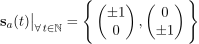
such that  ;
;
 ;
;
 ;
;
 .
.
In the case of (“仕/士”):

 ;
;
 ;
;
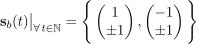
such that  ;
;
 ;
;
 ;
;
 .
.
In the case of (“相/象”):

 ;
;
 ;
;
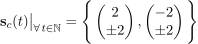
such that  ;
;
 ;
;
 ;
;
 .
.
In the case of (“傌/馬”):

 ;
;
 ;
;

such that  ;
;
 ;
;
 ;
;
 .
.
In the case of (“俥/車”):

 ;
;
 ;
;

such that  ;
;
 ;
;
![\begin{aligned} v_e(t) & =[\min v_e(t),\max v_e(t)]\big|_{\in n/2\textrm{ for } n\in\mathbb{N}\backslash\{ 0 \} } \\ & = \bigg[ \frac{\sqrt{(1)^2+(0)^2}}{2},\frac{\sqrt{(0)^2+(9)^2}}{2}\bigg] \\ &= \{ 1/2,1,3/2,\dots , \, 9/2\}\,\mathrm{unit/time} \\ \end{aligned}](https://physicspupil.com/wp-content/ql-cache/quicklatex.com-d216f23ccd8e10f7accc13d202ca661e_l3.svg "Rendered by QuickLaTeX.com") ;
;
 .
.
In the case of (“兵/卒”):

Exercise.