202308311431 Solution to 2007-AL-PHY-IIA-9

A diver at a depth of d below the water surface looks up and finds that the sky appears to be within a circle of radius r. Which of the following correctly gives the expression for the critical angle?

A. \tan c=\displaystyle{\frac{r}{d}}
B. \sin c=\displaystyle{\frac{r}{d}}
C. \tan c=\displaystyle{\frac{d}{r}}
D. \sin c=\displaystyle{\frac{d}{r}}


Background.

The critical angle is the smallest angle of incidence that yields total reflection, or equivalently the largest angle for which a refracted ray exists.

Wikipedia on Critical angle (optics)

The light travelling from air to water cannot suffer total internal reflection because for total internal reflection, the essential condition is that light should travel from a denser medium to a rarer medium with incidence angle more than the critical angle.

Toppr on Total internal reflection


Roughwork. (making a short story long)

Subscripts \text{}_a and \text{}_w stand for air and water respectively.

\begin{aligned} n_w\sin \theta_w & = n_a\sin\theta_a \\ \textrm{Eq. (1):\qquad }\frac{n_w}{n_a} & = \frac{\sin\theta_a}{\sin\theta_w}} \\ \frac{\mathrm{d}}{\mathrm{d}t}\bigg( \frac{n_w}{n_a} \bigg) & = \frac{\mathrm{d}}{\mathrm{d}t}\bigg( \frac{\sin\theta_a}{\sin\theta_w}\bigg) \\ 0 & = \frac{\dot{\theta}_a\sin\theta_w\cos\theta_a-\dot{\theta}_w\sin\theta_a\cos\theta_w}{\sin^2\theta_w} \\ \textrm{Eq. (2):\qquad }\frac{\dot{\theta}_a}{\dot{\theta}_w} & = \frac{\tan\theta_a}{\tan\theta_w}=\textrm{non-constant}\\ \end{aligned}

At some height h above the water surface, where \theta_a is the angle of refraction:

\begin{aligned} \textrm{Eq. (3):\qquad }\tan\theta_a & = \frac{r_a}{h} \\ \textrm{where\qquad }\theta_a & \in [0,90^\circ] \\ \textrm{and \qquad }h & = \textrm{Const.}\in [0,\infty ) \\ r_a & = r_a(\theta_a) \in [0,\infty )\\ \end{aligned}

To some depth d beneath the water surface, where \theta_w is the angle of incidence:

\begin{aligned} \textrm{Eq. (4):\qquad }\tan\theta_w & = \frac{r_w}{d} \\ \textrm{where\qquad }\theta_w & \in [0,90^\circ] \\ \textrm{and \qquad }d & = \textrm{Const.}\in [0,\infty ) \\ r_w & = r_w(\theta_w ) \in [0,\infty ) \\ \end{aligned}

Differentiating \textrm{Eq. (3)} and \textrm{Eq. (4)}:

\begin{aligned} \textrm{Eq. (3)':\qquad }h\dot{\theta}_a\sec^2\theta_a & = \dot{r}_a \\ \dot{\theta}_a & = \frac{\dot{r}_a}{h\sec^2\theta_a} \\ \end{aligned}

\begin{aligned} \textrm{Eq. (4)':\qquad }d\dot{\theta}_w\sec^2\theta_w & = \dot{r}_w \\ \dot{\theta}_w & = \frac{\dot{r}_w}{d\sec^2\theta_w} \\ \end{aligned}

Dividing \textrm{Eq. (3)'} by \textrm{Eq. (4)'}:

\textrm{Eq. (5):\qquad }\displaystyle{\frac{\dot{\theta}_a}{\dot{\theta}_w} =\bigg(\frac{\dot{r}_a}{\dot{r}_w}\bigg) \bigg(\frac{d}{h}\bigg)\bigg(\frac{\sec^2\theta_w}{\sec^2\theta_a}\bigg)}

Equating \textrm{Eq. (2)} and \textrm{Eq. (5)}:

\begin{aligned} \textrm{Eq. (6):\qquad }\frac{\tan\theta_a}{\tan\theta_w} & =\bigg(\frac{\dot{r}_a}{\dot{r}_w}\bigg) \bigg(\frac{d}{h}\bigg)\bigg(\frac{\sec^2\theta_w}{\sec^2\theta_a}\bigg) \\ \frac{\tan\theta_a}{\tan\theta_w} & = \frac{(r_a/h)'}{(r_w/d)'}\bigg(\frac{\sec\theta_w}{\sec\theta_a}\bigg)^2\\ \frac{\tan\theta_a}{\tan\theta_w} & = \frac{(\tan\theta_a)'}{(\tan\theta_w)'}\bigg(\frac{\sec\theta_w}{\sec\theta_a}\bigg)^2\\ \frac{\tan\theta_a}{\tan\theta_w} & = \bigg(\frac{\dot{\theta}_a}{\dot{\theta}_w}\bigg)\bigg(\frac{\sec\theta_a}{\sec\theta_w}\bigg)^2\bigg(\frac{\sec\theta_w}{\sec\theta_a}\bigg)^2=\frac{\dot{\theta}_a}{\dot{\theta}_w}\\ \end{aligned}

This \textrm{Eq. (6)} is redundant as it is the same as \textrm{Eq. (2)}. Never mind. But rewrite \textrm{Eq. (6)} (/\textrm{Eq. (2)}) as follows:

\begin{aligned} \dot{\theta}_w\cot\theta_w & = \dot{\theta}_a\cot\theta_a \\ \frac{\mathrm{d}}{\mathrm{d}t}\big(\ln |\sin \theta_w|\big) & = \frac{\mathrm{d}}{\mathrm{d}t}\big(\ln |\sin \theta_a|\big) \\ \ln|\sin\theta_w| & = \ln|\sin\theta_a| \\ \theta_w & = k\pi -\theta_a \qquad (k\in\mathbb{Z})\\ \textrm{and}\qquad \theta_a & \geq \theta_w \\ \end{aligned}

Note that refractive index for air is (approximately) n_a=1,

\begin{aligned} \textrm{Eq. (7):\qquad }\frac{\sin\theta_a}{\sin\theta_w} & =n_w \\ \sin\theta_a & = n_w \sin\theta_w \\ \sin\theta_a & = n_w\sin (90^\circ-\theta_a) \\ \sin\theta_a & = n_w\cos\theta_a \\ \textrm{Eq. (7)':\qquad }n_w & =\tan\theta_a\\ \sin (90^\circ -\theta_w) & = n_w\sin\theta_w \\ \cos\theta_w & = n_w\sin\theta_w \\ \textrm{Eq. (7)'':\qquad }n_w & = \frac{1}{\tan\theta_w}} \\ \end{aligned}

Equating \textrm{Eq. (7)'} and \textrm{Eq. (7)''}:

\begin{aligned} \tan\theta_a & = \frac{1}{\tan\theta_w} \\ \tan\theta_a\tan\theta_w & = 1 \\ \textrm{Eq. (8):\qquad }\tan (90^\circ -\theta_w)\tan\theta_w & = 1 \\ \end{aligned}

Taking limit on \textrm{Eq. (8)},

\begin{aligned} \Big(\lim_{\theta_w\to c}\tan (90^\circ -\theta_w)\Big)\Big(\lim_{\theta_w\to c}\tan\theta_w\Big) & =1 \\ (\cot c)\bigg(\frac{r}{d}\bigg) & = 1 \\ \tan c & =\frac{r}{d} \\ \end{aligned}

And the answer is A.

202308301657 Pastime Exercise 002

The blogger claims no originality of the problem below.

The image files are licensed under the Creative Commons Attribution-Share Alike 2.5 Generic license in the public domain.


Xiangqi, commonly known as Chinese chess or elephant chess, is a strategy board game for two players.

Wikipedia on Xiangqi

Setup.

Let “帥/將” be referred to as a; “仕/士” as b, “相/象” as c; “傌/馬” as d; “俥/車” as e; and “兵/卒” as f.

Any intersection of the ten horizontal and the nine vertical lines is called a point on the board; there are ninety points.

Let t\in \{1,2,3,\dots ,\{+\infty\}\} be the number of time(s) of movement of pieces from the start (t=0). Each player moves in turn such that for one army t\in\{1,3,5,\dots ,1+2n\, |\, n\in\mathbb{N}\} and for its enemy t\in\{2,4,6,\dots ,2n\, |\, n\in\mathbb{N}\}.

And \mathbf{l}(x_{[*]}(t),y_{[*]}(t))\in\{1,2,3,\dots ,9\}\times \{1,2,3,\dots ,10\} be the location of a piece [*]\in\{a,b,c,d,e,f\} at time(s) t of movement.

And \mathbf{s}(t)=\mathbf{l}(t)-\mathbf{l}(t-2) be the displacement of the piece after one succession \Delta t=(t+2)-(t)=2, and by the inverse \mathbf{s}^{-1}(t)=\mathbf{l}(t-4)-\mathbf{l}(t-2)=-\mathbf{s}(t-2) a retreat to the original location is such that displacements for an advance and a retreat s^{-1}(t)=|\mathbf{s}^{-1}(t)|=|-\mathbf{s}(t-2)|=s(t-2) are equal in magnitudes.


And v(t)=|\mathbf{v}(t)|=\displaystyle{\bigg|\frac{\Delta\mathbf{s}(t)}{\Delta t}\bigg|=\bigg|\frac{\mathbf{s}(t)-\mathbf{s}(t-2)}{(t)-(t-2)}\bigg|} be the instantaneous speed at some point t_i in a series of movements i\in \mathbb{N}.

And \mathrm{ord}[*] called the order of a set [*] be the number of elements in that collection. For instance, in a peaceful match \mathrm{ord}(t)=+\infty the number of times t of movements could be in such countably and indefinitely infinite.


In the case of a (“帥/將”):

\mathbf{l}_a(t)=\{4,5,6\}\,\hat{\mathbf{i}}+\{1,2,3\}\,\hat{\mathbf{j}};

\mathrm{ord}(\mathbf{l}_a)=9;

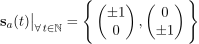
\mathbf{s}_a(t)\big|_{\forall\, t\in\mathbb{N}}=\Bigg\{\begin{pmatrix}\pm 1\\0\end{pmatrix},\begin{pmatrix}0\\ \pm 1\end{pmatrix}\Bigg\}

such that \mathbf{l}_a\to \mathbf{l}_a:\mathbf{l}_a(t-2)\stackrel{\mathbf{s}_a}{\mapsto}\mathbf{l}_a(t);

\mathrm{ord}(\mathbf{s}_a)=4;

v_a(t)=\displaystyle{\frac{\sqrt{(\pm 1)^2+(0)^2}}{\Delta t}=\frac{1}{2}\,\mathrm{unit/time}};

\mathrm{ord}_a(v)=1.


In the case of b (“仕/士”):

\mathbf{l}_b(t)=\{(4,1),(4,3),(5,2),(6,1),(6,3)\};

\mathrm{ord}(\mathbf{l}_b)=5;

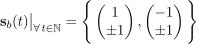
\mathbf{s}_b(t)\big|_{\forall\, t\in\mathbb{N}}=\Bigg\{\begin{pmatrix}1\\\pm 1\end{pmatrix},\begin{pmatrix}-1\\ \pm 1\end{pmatrix}\Bigg\}

such that \mathbf{l}_b\to \mathbf{l}_b:\mathbf{l}_b(t-2)\stackrel{\mathbf{s}_b}{\mapsto}\mathbf{l}_b(t);

\mathrm{ord}(\mathbf{s}_b)=4

v_b(t)=\displaystyle{\frac{\sqrt{(\pm 1)^2+(\pm 1)^2}}{\Delta t}=\frac{\sqrt{2}}{2}\,\mathrm{unit/time}};

\mathrm{ord}(v_b)=1.


In the case of c (“相/象”):

\mathbf{l}_c(t)=\{(3,1),(7,1),(1,3),(5,3),(9,3),(3,5),(7,5)\};

\mathrm{ord}(\mathbf{l}_c)=7;

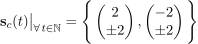
\mathbf{s}_c(t)\big|_{\forall\, t\in\mathbb{N}}=\Bigg\{\begin{pmatrix}2\\\pm 2\end{pmatrix},\begin{pmatrix}-2\\ \pm 2\end{pmatrix}\Bigg\}

such that \mathbf{l}_c\to \mathbf{l}_c:\mathbf{l}_c(t-2)\stackrel{\mathbf{s}_c}{\mapsto}\mathbf{l}_c(t);

\mathrm{ord}(\mathbf{s}_c)=4

v_c(t)=\displaystyle{\frac{\sqrt{(\pm 2)^2+(\pm 2)^2}}{\Delta t}=\frac{2\sqrt{2}}{2}=\sqrt{2}\,\mathrm{unit/time}};

\mathrm{ord}(v_c)=1.


In the case of d (“傌/馬”):

\mathbf{l}_d(t)=\{ 1,2,3,\dots ,9\}\,\hat{\mathbf{i}}+\{1,2,3,\dots ,10\}\,\hat{\mathbf{j}};

\mathrm{ord}(\mathbf{l}_d)=9\times 10=90;

\mathbf{s}_d(t)\big|_{\forall\, t\in\mathbb{N}}=\Bigg\{\begin{pmatrix}-1\\\pm 2\end{pmatrix},\begin{pmatrix}2\\ \pm 1\end{pmatrix},\begin{pmatrix}1\\ \pm 2\end{pmatrix},\begin{pmatrix}-2\\ \pm 1\end{pmatrix}\Bigg\}

such that \mathbf{l}_d\to \mathbf{l}_d:\mathbf{l}_d(t-2)\stackrel{\mathbf{s}_d}{\mapsto}\mathbf{l}_d(t);

\mathrm{ord}(\mathbf{s}_d)=8

v_d(t)=\displaystyle{\frac{\sqrt{(\pm 1)^2+(\pm 2)^2}}{\Delta t}=\frac{\sqrt{5}}{2}\,\mathrm{unit/time}};

\mathrm{ord}(v_d)=1.


In the case of e (“俥/車”):

\mathbf{l}_e(t)=\{ 1,2,3,\dots ,9\}\,\hat{\mathbf{i}}+\{1,2,3,\dots ,10\}\,\hat{\mathbf{j}};

\mathrm{ord}(\mathbf{l}_e)=9\times 10=90;

\mathbf{s}_e(t)\big|_{\forall\, t\in\mathbb{N}}=\Bigg\{\pm\begin{pmatrix}\{1,2,3,\dots ,8\}\\0\end{pmatrix},\pm\begin{pmatrix}0\\ \{1,2,3,\dots , 9\}\end{pmatrix}\Bigg\}

such that \mathbf{l}_e\to \mathbf{l}_e:\mathbf{l}_e(t-2)\stackrel{\mathbf{s}_e}{\mapsto}\mathbf{l}_e(t);

\mathrm{ord}(\mathbf{s}_e)=8\times 2+9\times 2=34

\begin{aligned} v_e(t) & =[\min v_e(t),\max v_e(t)]\big|_{\in n/2\textrm{ for } n\in\mathbb{N}\backslash\{ 0 \} } \\ & = \bigg[ \frac{\sqrt{(1)^2+(0)^2}}{2},\frac{\sqrt{(0)^2+(9)^2}}{2}\bigg] \\ &= \{ 1/2,1,3/2,\dots , \, 9/2\}\,\mathrm{unit/time} \\ \end{aligned};

\mathrm{ord}(v_e)=9.


In the case of f (“兵/卒”):

Exercise.