
To tell time on an analog clock, you look at where the hands are pointing.

The short/small hand tells you the hour, the long/big hand tells you the minute of the current hour, and the thinnest hand indicates the seconds of the current minute.
Extracted from Malcolm McKinsey. (2023). How To Tell Time; Read An Analog Clock
Roughwork.
Define two periodic functions by
![\begin{aligned} \theta_\textrm{h}(t) &:[0,12)\in [T\textrm{ (in hours)}]\rightarrow [0,2\pi )\in [\Theta\textrm{ (in radians)}] \\ \theta_\textrm{m}(t) & :[0,1)\in [T\textrm{ (in hours)}]\rightarrow [0,2\pi )\in [\Theta\textrm{ (in radians)}] \\ \end{aligned}](https://physicspupil.com/wp-content/ql-cache/quicklatex.com-486feeba28bd207ae3a14b7c334440c4_l3.svg "Rendered by QuickLaTeX.com")
for angular displacement  of the hour hand
  and the minute hand
  as of time
  , with

such that
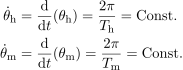
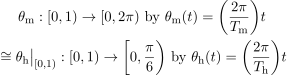
observing an isomorphism  between
  and the restriction
  of
of  to
to  at one-hour time intervals:
Then, let

so that digital format of clocks is given as the Cartesian product:
 .
.
Synchronised at the start time:
 .
.
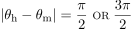
(a) Find the time(s) exact to minutes when the hour hand and the minute hand are perpendicular to each other, i.e.,
(b) Find also the time(s) exact to minutes when the hour hand and the minute hand are parallel to each other, i.e.,

(c) Is the aforementioned isomorphism  perturbed when the clock is losing or gaining time
  ?
?
This problem is not to be attempted.