
In the figure below, two objects are connected by a string which is threaded through a pulley.

Using its weight, object  moves object
  along a flat surface. The acceleration
  of the two objects can be determined by the following formula

where  and
and  are the masses of object and object , respectively, in kilograms,
  is the acceleration due to Earth’s gravity measured in
  , and
, and  is a constant known as the coefficient of friction. Which of the following expresses in terms of the other variables?
A. 
B. 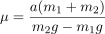
C. 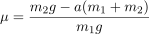
D. 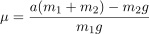
If the masses of both object and object were doubled, how would the acceleration of the two objects be affected?
A. The acceleration would stay the same.
B. The acceleration would be halved.
C. The acceleration would be doubled.
D. The acceleration would be quadrupled (multipled by a factor of  ).
).
Extracted from Phu Nielson. (2015). SAT Math Advanced Guide and Workbook.
Roughwork.
First, begin with free-body diagrams:

Next, carry on by Newton’s 2nd law:

jotting positive the motion directing to,

then writing Euler-Lagrange (E-L) equation with Rayleigh dissipation function  :
:

where

or by noting the undissipated Hamiltonian  as in:

where though it is not uncommon for some few to despise differentiating with respect to vectors whom I hereby ignore.
 .
.
This problem is not to be attempted.