
In the figure below,  is a diameter of the circle.

If  , which of the following gives the area of triangle
  in terms of
  ?
?
A. 
B. 
C. 
D. 
Extracted from Phu Nielson. (2015). SAT Math Advanced Guide and Workbook.
Remark.
The quantity angle is dimensionless as it is the ratio of arc length to radius, i.e.,
![\frac{[L]}{[L]}=[L]^0](https://physicspupil.com/wp-content/ql-cache/quicklatex.com-0baa0c43d21c9558e63440d6ff54e35d_l3.svg "Rendered by QuickLaTeX.com") ;
;
the sine, the cosine, and the tangent of which, as in a right-angled triangle, are
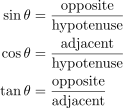
also dimensionless, i.e., ![[L]^0](https://physicspupil.com/wp-content/ql-cache/quicklatex.com-62ad87e92ce76b23b9dd23683709f317_l3.svg "Rendered by QuickLaTeX.com") . Note that the quantity area is
. Note that the quantity area is ![[L]^2](https://physicspupil.com/wp-content/ql-cache/quicklatex.com-a76f9e402f3b342ee567ba2d4bdb70c3_l3.svg "Rendered by QuickLaTeX.com") in dimension. Hence, choices
in dimension. Hence, choices A. to D. are being understood as:
A. 
B. 
C. 
D. 
Warm-up.

Set-up.

where

Observe that

proceed with
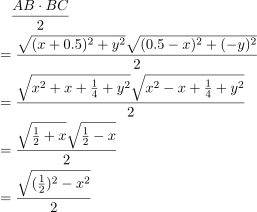
by noting  the radius being
  :
:
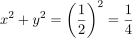 .
.
The function

will output the area by inputting  under constraint on ,
  :
:
 .
.
(to be refreshed)
Now ready for problem-solving, write simply

and the answer is D.