202305301123 Exercise 5.1

The operators \hat{Q}_1, \hat{Q}_2, and \hat{Q}_3 are defined to act as follow upon a (well-behaved) function f(x):

\hat{Q}_1 squares the first derivative of f(x);
\hat{Q}_2 differentiates f(x) twice;
\hat{Q}_3 multiplies f(x) by x^4.

(a) For each of these operators, write down an explicit expression for \hat{Q}_i\,f(x).
(b) Simplify the operators expression \hat{Q}_2\hat{Q}_3-\hat{Q}_3\hat{Q}_2, writing your result in terms of the variable x. Do \hat{Q}_2 and \hat{Q}_3 commute?
(c) Derive an expression for \hat{Q}_2\hat{Q}_3-\hat{Q}_3\hat{Q}_2
in terms of the operators \hat{x} and \hat{p}.
(d) An operator \hat{Q} is linear if, for arbitrary well-behaved functions f_1(x) and f_2(x), the following property holds:

\hat{Q}\,[c_1f_1(x)+c_2f_2(x)]=c_1\,\hat{Q}\,f_1(x)+c_2\,\hat{Q}\,f_2(x).

Prove whether or not each of the three operators defined above is linear.

Extracted from M. A. Morrison. (1990). Understanding Quantum Physics A User’s Manual.


Roughwork.

(a)

\begin{aligned} \hat{Q}_1\,f(x) & =\bigg[\frac{\mathrm{d}}{\mathrm{d}x}f(x)\bigg]^2 \\ \hat{Q}_2\,f(x) & = \frac{\mathrm{d}^2}{\mathrm{d}x^2}f(x) \\ \hat{Q}_3\,f(x) & = x^4f(x) \\ \end{aligned}

(b)

If \hat{Q}_1\hat{Q}_2=\hat{Q}_2\hat{Q}_1, we say \hat{Q}_1 and \hat{Q}_2 are commuting operators to each other.

Recall addition and subtraction of operators:

\begin{aligned} (\hat{Q}_1\pm\hat{Q}_2)\,f(x) & = \hat{Q}_1\,f(x)\pm\hat{Q}_2\,f(x) \\ & = \pm\hat{Q}_2\,f(x)+\hat{Q}_1f(x) \\ \end{aligned}

so as to write

\begin{aligned} & \quad\enspace (\hat{Q}_2\hat{Q}_3-\hat{Q}_3\hat{Q}_2)\,f(x)\\ & = (\hat{Q}_2\hat{Q}_3)\,f(x)-(\hat{Q}_3\hat{Q}_2)\,f(x) \\ & = \hat{Q}_2\,(\hat{Q}_3\,f(x))-\hat{Q}_3\,(\hat{Q}_2\,f(x)) \\ & = \hat{Q}_2\,(x^4f(x)) -\hat{Q}_3\,(f''(x)) \\ & = (x^4f''(x)+12x^2f(x)) - x^4f''(x) \\ & = 12x^2f(x) \\ & \neq 0 \\ \end{aligned}

Therefore \hat{Q}_2 and \hat{Q}_3 do not commute.

(c)

The position operator, \hat{x}, in the x-representation, multiplies f(x) by x; and the momentum operator, \hat{p}_x, by \displaystyle{-i\hbar\frac{\partial}{\partial x}}:

\begin{aligned} |f\rangle & \stackrel{|x\rangle}{\longrightarrow} \langle x|f\rangle = f(x) \\ \hat{x}|f\rangle & \stackrel{|x\rangle}{\longrightarrow} \langle x|\hat{x}|f\rangle = xf(x) \\ \hat{p}|f\rangle & \stackrel{|x\rangle}{\longrightarrow} \langle x|\hat{p}|f\rangle = -i\hbar\nabla f\\ \end{aligned}

\hat{Q}_2\hat{Q}_3-\hat{Q}_3\hat{Q}_2=\textrm{I don't know?}

Note the symmetry between the x and the p representations and a one-to-one mapping onto each other.

(d) Not to be attempted.

202305241325 Problem 16.2.7

A person 6\,\mathrm{ft} tall stands 4\,\mathrm{ft} in front of a plane mirror.

(a) Where is his image?
(b) How tall is his image?
(c) What is the shortest mirror in which this person can see his whole image?
(d) Does the answer to (c) depend upon how far the person is from the mirror?

Extracted from C. E. Bennett. (1973). Physics Problems and How to Solve Them.


Roughwork.

(a), (b)

His image is 6\,\mathrm{ft} tall and 4\,\mathrm{ft} behind the plane mirror.

(c), (d)

Visualise the scene:

assuming the eye level is 5\,\mathrm{in} below the top of the head, and by conversion from feet to inches: 1\,\mathrm{ft}=12\,\mathrm{in}.


This problem is not to be attempted.

202305231027 Problem 8.21-22

In the figure below, two objects are connected by a string which is threaded through a pulley.

Using its weight, object 2 moves object 1 along a flat surface. The acceleration a of the two objects can be determined by the following formula

\displaystyle{a=\frac{m_2g-\mu m_1g}{m_1+m_2}}

where m_1 and m_2 are the masses of object 1 and object 2, respectively, in kilograms, g is the acceleration due to Earth’s gravity measured in \displaystyle{\frac{\mathrm{m}}{\mathrm{sec}^2}}, and \mu is a constant known as the coefficient of friction. Which of the following expresses \mu in terms of the other variables?

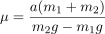
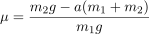
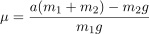
A. \displaystyle{\mu=\frac{a(m_1+m_2)}{m_1m_2g^2}}
B. \displaystyle{\mu=\frac{a(m_1+m_2)}{m_2g-m_1g}}
C. \displaystyle{\mu=\frac{m_2g-a(m_1+m_2)}{m_1g}}
D. \displaystyle{\mu=\frac{a(m_1+m_2)-m_2g}{m_1g}}

If the masses of both object 1 and object 2 were doubled, how would the acceleration of the two objects be affected?

A. The acceleration would stay the same.
B. The acceleration would be halved.
C. The acceleration would be doubled.
D. The acceleration would be quadrupled (multipled by a factor of 4).

Extracted from Phu Nielson. (2015). SAT Math Advanced Guide and Workbook.


Roughwork.

First, begin with free-body diagrams:

Next, carry on by Newton’s 2nd law:

\mathbf{F}_{\mathrm{net}}=m\mathbf{a}

jotting positive the motion directing to,

\begin{aligned} (T-\mu m_1g)\,\hat{\mathbf{i}} & = m_1a\,\hat{\mathbf{i}} \\ (m_2g-T)\,\hat{\mathbf{j}} & = m_2a\,\hat{\mathbf{j}} \\ \end{aligned}

then writing Euler-Lagrange (E-L) equation with Rayleigh dissipation function \mathcal{F}:

\displaystyle{\frac{\mathrm{d}}{\mathrm{d}t}\bigg(\frac{\partial\mathcal{L}}{\partial\dot{x}}\bigg) -\frac{\partial\mathcal{L}}{\partial x} = -\frac{\partial\mathcal{F}}{\partial\dot{x}}}

where

\begin{aligned} \mathcal{L} & = T-V \\ T & = \frac{1}{2}(m_1+m_2)\dot{x}^2 \\ V & = m_2gx \\ \mathcal{F} & = k\dot{x}^2 \enspace (\leqslant \mu m_1g) \\ \end{aligned}

or by noting the undissipated Hamiltonian \mathcal{H}(\mathbf{p},\mathbf{q})=T+V as in:

\begin{aligned} \frac{\mathrm{d}\mathbf{q}}{\mathrm{d}t} & = \frac{\partial\mathcal{H}}{\partial\mathbf{p}} \\ \frac{\mathrm{d}\mathbf{p}}{\mathrm{d}t} & = -\frac{\partial\mathcal{H}}{\partial\mathbf{q}} \\ \end{aligned}

where though it is not uncommon for some few to despise differentiating with respect to vectors whom I hereby ignore.

\displaystyle{\mathcal{H}=\frac{p_1^2}{2m_1}+\frac{p_2^2}{2m_2}+m_2gq-\mu m_1gq}.


This problem is not to be attempted.

202305171045 Problem 23.11

In the figure below, AC is a diameter of the circle.

If AC=1, which of the following gives the area of triangle ABC in terms of \theta?

A. \displaystyle{\frac{\theta}{2}}
B. \displaystyle{\frac{\tan\theta}{2}}
C. 2\sin\theta
D. \displaystyle{\frac{\sin\theta\cos\theta}{2}}

Extracted from Phu Nielson. (2015). SAT Math Advanced Guide and Workbook.


Remark.

The quantity angle \theta is dimensionless as it is the ratio of arc length to radius, i.e.,

\frac{[L]}{[L]}=[L]^0;

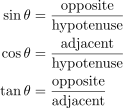
the sine, the cosine, and the tangent of which, as in a right-angled triangle, are

\begin{aligned} \sin\theta & = \frac{\textrm{opposite}}{\textrm{hypotenuse}} \\ \cos\theta & = \frac{\textrm{adjacent}}{\textrm{hypotenuse}} \\ \tan\theta & = \frac{\textrm{opposite}}{\textrm{adjacent}} \\ \end{aligned}

also dimensionless, i.e., [L]^0. Note that the quantity area is [L]^2 in dimension. Hence, choices A. to D. are being understood as:

A. \displaystyle{\frac{\theta}{2}}\enspace\textrm{(sq unit)}
B. \displaystyle{\frac{\tan\theta}{2}}\enspace\textrm{(sq unit)}
C. 2\sin\theta\enspace\textrm{(sq unit)}
D. \displaystyle{\frac{\sin\theta\cos\theta}{2}}\enspace\textrm{(sq unit)}


Warm-up.

Set-up.

where

\begin{aligned} \mathbf{OA} & = (-1/2,0) \\ \mathbf{OB} & = (x,y) \\ \mathbf{OC} & = (1/2,0) \\ \mathbf{AB} & = \mathbf{OB}-\mathbf{OA} \\ & = (x+1/2,y) \\ AB &= |\mathbf{AB}| \\ & = \sqrt{\bigg( x+\frac{1}{2}\bigg)^2+y^2} \\ \mathbf{BC} & = \mathbf{OC}-\mathbf{OB} \\ & = (1/2-x,-y) \\ BC &= |\mathbf{BC}| \\ & = \sqrt{\bigg(\frac{1}{2}-x\bigg)^2+(-y)^2} \\ \mathbf{AC} & = \mathbf{OC}-\mathbf{OA} \\ & = (1,0) \\ AC & = |\mathbf{AC}| \\ & = \sqrt{(1)^2+(0)^2} =1\\ \sin\theta & = \frac{y}{BC} \\ \cos\theta & = \frac{1/2-x}{BC} \\ \tan\theta & = \frac{y}{1/2-x} \\ \end{aligned}

Observe that

\displaystyle{\textrm{Area of }\triangle ABC=\frac{|\mathbf{AB}||\mathbf{BC}|}{2}}

proceed with

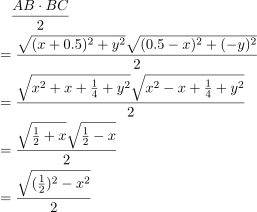
\begin{aligned} &\quad \frac{AB\cdot BC}{2} \\ & = \frac{\sqrt{(x+0.5)^2+y^2}\sqrt{(0.5-x)^2+(-y)^2}}{2} \\ & = \frac{\sqrt{x^2+x+\frac{1}{4}+y^2}\sqrt{x^2-x+\frac{1}{4}+y^2}}{2} \\ & = \frac{\sqrt{\frac{1}{2}+x}\sqrt{\frac{1}{2}-x}}{2} \\ & = \frac{\sqrt{(\frac{1}{2})^2-x^2}}{2}\\ \end{aligned}

by noting OB=|\mathbf{OB}| the radius being \frac{1}{2}:

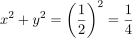
\displaystyle{x^2+y^2=\bigg(\frac{1}{2}\bigg)^2=\frac{1}{4}}.

The function

\displaystyle{f(x)=\sqrt{\frac{1}{16}-\frac{x^2}{4}}}

will output the area by inputting x under constraint on x, y:

g(x,y)=x^2+y^2-\frac{1}{4}=0.

(to be refreshed)


Now ready for problem-solving, write simply

\begin{aligned} \sin\theta & = \frac{AB}{AC}=AB\\ \cos\theta & = \frac{BC}{AC}=BC\\ \tan\theta & = \frac{AB}{BC}\\ \end{aligned}

and the answer is D.

202305151128 Exercise 1.1

Evaluate \textrm{\scriptsize{WITHOUT}} a calculator.

1. (-1)^4 2. (-1)^5 3. (-1)^{10} 4. (-1)^{15} 5. (-1)^8 6. -1^8 7. -(-1)^8 8. (-3)^3 9. -3^3 10. -(-3)^3 11. -(-6)^2 12. -(-4)^3 13. 2^3\times 3^2\times (-1)^5 14. (-1)^4\times 3^3\times 2^2 15. (-2)^3\times (-3)^4 16. 3^0 17. 6^{-1} 18. 4^{-1} 19. 5^0 20. 3^2 21. 3^{-2} 22. 5^3 23. 5^{-3} 24. 7^2 25. 7^{-2} 26. 10^3 27. 10^{-3}

Extracted from Phu Nielson. (2015). SAT Math Advanced Guide and Workbook.


Roughwork.

1.

Since (x^m)^n=x^{mn},

\begin{aligned} (-1)^4 & = ((-1)^2)^2 \\ & = (1)^2\\ & = 1 \\ \end{aligned}

2.

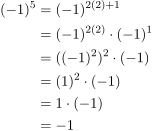
Since x^m\cdot x^n=x^{m+n},

\begin{aligned} (-1)^5 & = (-1)^{2(2)+1} \\ & = (-1)^{2(2)}\cdot (-1)^1 \\ & = ((-1)^{2})^2\cdot (-1)\\ & = (1)^2\cdot (-1) \\ & = 1\cdot (-1) \\ & = -1 \\ \end{aligned}

3.

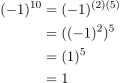
\begin{aligned} (-1)^{10} & = (-1)^{(2)(5)}\\ & = ((-1)^2)^5 \\ & = (1)^5 \\ & = 1\\ \end{aligned}

4.

\begin{aligned} (-1)^{15} & = (-1)^{2(7)+1} \\ & = (-1)^{2(7)}\cdot (-1)^1 \\ & = ((-1)^2)^7\cdot (-1) \\ & = (1)^7\cdot (-1) \\ & = 1\cdot (-1) \\ & = -1 \\ \end{aligned}

5.

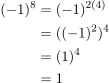
\begin{aligned} (-1)^8 & = (-1)^{2(4)} \\ & = ((-1)^2)^4 \\ & = (1)^4 \\ & = 1 \\ \end{aligned}

6.

\begin{aligned} -1^8 & = -(1^8) \\ & = -(1) \\ & = -1 \\ \end{aligned}

7.

\begin{aligned} -(-1)^8 & = -((-1)^8) \\ & = -((-1)^{2(4)}) \\ & = -(((-1)^2)^4) \\ & = -(1^4) \\ & = -(1) \\ & = -1 \\ \end{aligned}

8.

Since (xy)^m=x^my^m,

\begin{aligned} (-3)^3 & = ((-1)(3))^3 \\ & = (-1)^3(3)^3 \\ & = (-1)^{2+1}(3\cdot 3\cdot 3) \\ & = ((-1)^2\cdot (-1))(9\cdot 3) \\ & = (1\cdot (-1))(27) \\ & = (-1)(27) \\ & = -27 \\ \end{aligned}

9.

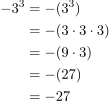
\begin{aligned} -3^3 & = -(3^3) \\ & = -(3\cdot 3\cdot 3) \\ & = -(9\cdot 3) \\ & = -(27) \\ & = -27 \\ \end{aligned}

10.

\begin{aligned} -(-3)^3 & = -((-3)^3) \\ & = -(((-1)(3))^3) \\ & = -((-1)^3(3)^3) \\ & = -((-1)^{2+1}(3\cdot 3\cdot 3)) \\ & = -((-1)^2(-1)(9\cdot 3)) \\ & = -((1)(-1)(27)) \\ & = -((-1)(27)) \\ & = -(-27) \\ & = 27 \\ \end{aligned}

Expressions 11. to 27. are not to be attempted.

202305111603 Exercise 3.1

Solve the following equations:

(a) 13x-4=3x+16.

(b) \displaystyle{\frac{3x-9}{18}+\frac{x}{27}-\frac{2x-5}{4}=\frac{4}{3}-x}.

(c) \displaystyle{\frac{3}{x-1}-\frac{2}{x+4}=\frac{4}{2-2x}}.

(d) \displaystyle{\frac{2x}{x-3}-\frac{4x+1}{2x-1}=\frac{21}{2x^2-7x+3}}.

(e) \displaystyle{\frac{1}{4}(3y-2)-\bigg[ y-\frac{1}{y}(7-3y)\bigg] =-\frac{1}{4}y-7}.

Extracted from K. L. Nielsen. (1958). College Mathematics.


Roughwork.

(a)

\begin{aligned} 13x-4 & = 3x+16 \\ 13x-3x & = 16+4 \\ 10x & = 20 \\ x & = 2 \\ \end{aligned}

(b)

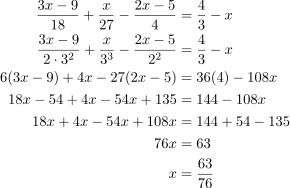
\begin{aligned} \frac{3x-9}{18} + \frac{x}{27} - \frac{2x-5}{4} & = \frac{4}{3}-x \\ \frac{3x-9}{2\cdot 3^2} + \frac{x}{3^3} - \frac{2x-5}{2^2} & = \frac{4}{3}-x \\ 6(3x-9) + 4x-27(2x-5) & =36(4)-108x \\ 18x-54+4x-54x+135 & =144-108x \\ 18x+4x-54x+108x & = 144+54-135 \\ 76x & = 63 \\ x & = \frac{63}{76} \\ \end{aligned}

(c)

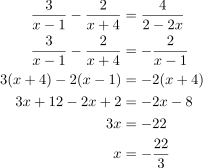
\begin{aligned} \frac{3}{x-1}-\frac{2}{x+4} & = \frac{4}{2-2x} \\ \frac{3}{x-1}-\frac{2}{x+4} & = -\frac{2}{x-1} \\ 3(x+4) - 2(x-1) & = -2(x+4) \\ 3x+12-2x+2 & = -2x-8 \\ 3x & = -22 \\ x & = -\frac{22}{3} \\ \end{aligned}

(d) Not to be attempted.

(e) Not to be attempted.

202305101606 Problem 3.16.1

Let G=\{ \mathbf{e},a,a^2,a^3\} be a cyclic group of order 4 and G' be the multiplicative group \{1,-1,\mathbf{i},-\mathbf{i}\} of 4 complex numbers.

i. Tabulate two isomorphisms from G to G'.
ii. Explain why there are no other isomorphisms from G to G'.

Extracted from A. P. Hillman. (1999). Abstract Algebra A First Undergraduate Course.


Background.

The group G is cyclic if and only if every element of G can be expressed as the power of one element of G:

\exists\, g\in G,\,\forall\, h\in G:\enspace h=g^n\textrm{ for some }n\in\mathbb{Z}.

if and only if it is generated by one element g\in G called a generator of G:

G=\langle g\rangle.

ProofWiki on Cyclic Group

Let (F,+,\times ) be a field and let F^*:=F\backslash\{ 0\} be the set F less its zero. The group (F^*,\times ) is known as the multiplicative group of F.

ProofWiki on Multiplicative Group

A bijective homomorphism is called an isomorphism; that is, a group isomorphism \theta from G to G' is a bijection \theta such that \theta (ab)=\theta (a)\theta (b) for all a and b in G.

Text on 3.2 Group Isomorphism, pg.141

Let \theta be a group isomorphism from G to G'. Then:

(a) \mathbf{e}\stackrel{\theta}{\mapsto}\mathbf{e}', where \mathbf{e} and \mathbf{e}' are the identities of G and G'.
(b) If a\stackrel{\theta}{\mapsto}a', then a^n\stackrel{\theta}{\mapsto}(a')^n for all integers n. In particular,

a^{-1}\stackrel{\theta}{\mapsto}(a')^{-1}.

(c) If a\stackrel{\theta}{\mapsto}a', then a and a' have equal orders.

Text on 3.2 Group Isomorphism, pg.143


Roughwork.

\begin{array}{c|cccc} (G,*) & \mathbf{e} & a & a^2 & a^3 \\\hline \mathbf{e} & \mathbf{e} & a & a^2 & a^3 \\ a & a & a^2 & a^3 & \mathbf{e} \\ a^2 & a^2 & a^3 & \mathbf{e} & a \\ a^3 & a^3 & \mathbf{e} & a & a^2 \\ \end{array}

\begin{array}{c|cccc} (G',\times ) & 1 & -1 & \mathbf{i} & -\mathbf{i} \\\hline 1 & 1 & -1 & \mathbf{i} & -\mathbf{i} \\ -1 & -1 & 1 & -\mathbf{i} & \mathbf{i} \\ \mathbf{i} & \mathbf{i} & -\mathbf{i} & -1 & 1 \\ -\mathbf{i} &-\mathbf{i} & \mathbf{i}} & 1 & -1 \\ \end{array}

Observe that

G=\langle a\rangle; G'=\langle \mathbf{i}\rangle=\langle -\mathbf{i}\rangle.


This problem is not to be attempted.