202302200931 Review Problem 6.5.7

Let z\in\mathbb{C}. Recall that z=x+iy for some x,y\in\mathbb{R}, and we can form the complex conjugate of z by taking \overline{z}=x-iy. The function c:\mathbb{R}^2\to\mathbb{R}^2 which sends (x,y)\mapsto (x,-y) agrees with complex conjugation.

(a) Show that c is a linear map over \mathbb{R} (i.e., scalars in \mathbb{R}).
(b) Show that \overline{z} is not linear over \mathbb{C}.

Extracted from D. Cherney, et al. (2013). Linear Algebra.


Roughwork.

A function L:V\to W is linear if V and W are vector spaces and

L(ru+sv)=rL(u)+sL(v)

for all u,v\in V and r,s\in\mathbb{R}.

(a)

\begin{aligned} c(az_1+bz_2) & = c(a(x_1+iy_1)+b(x_2+iy_2)) \\ & = c((ax_1+bx_2)+i(ay_1+by_2)) \\ & = (ax_1+bx_2)+i(-(ay_1+by_2)) \\ & = (ax_1+bx_2)-i(ay_1+by_2) \\ & = a(x_1-iy_1) + b(x_2-iy_2) \\ & = a(x_1+i(-y_1)) + b(x_2+i(-y_2)) \\ & = a(c(x_1+iy_1)) + b(c(x_2+iy_2)) \\ & = ac(z_1) + bc(z_2) \\ \end{aligned}

(b)

Not to be attempted.

202302140910 Exercises 2.1

What do the following equations represent geometrically? Give sketches.

i. |z+2|=6,
ii. |z-3\,\mathrm{i}|=|z+\mathrm{i}|,
iii. |\mathrm{i}z-1|=|\mathrm{i}z+1|,
iv. |z-\omega |=|z-1| (\omega=e^{2\pi\,\mathrm{i}/3}).

Extracted from H. A. Priestley. (2003). Introduction to Complex Analysis.


Roughwork.

i.

\begin{aligned} |z+2|&=6 \\ |(x+\mathrm{i}y)+2| & = 6 \\ |(x+2)+\mathrm{i}y| & = 6 \\ \sqrt{(x+2)^2+y^2} & = 6 \\ (x+2)^2 + y^2 & = 6^2 \\ \end{aligned}

i.e., a circle centred at (-2,0) with 6 units in radius.

ii.

\begin{aligned} |z-3\,\mathrm{i}| & = |z+\mathrm{i}| \\ |(x+\mathrm{i}y)-3\,\mathrm{i}| & = |(x+\mathrm{i}y)+\mathrm{i}| \\ |x+\mathrm{i}(y-3)| & = |x+\mathrm{i}(y+1)| \\ \sqrt{x^2+(y-3)^2} & = \sqrt{x^2+(y+1)^2} \\ x^2+(y-3)^2 & = x^2 + (y+1)^2 \\ y^2-6y+9 & = y^2+2y+1 \\ y & = 1 \\ \end{aligned}

i.e., a horizontal line with y-intercept 1 unit.

iii.

\begin{aligned} |\mathrm{i}z-1| & = |\mathrm{i}z+1| \\ |\mathrm{i}(x+\mathrm{i}y)-1| & = |\mathrm{i}(x+\mathrm{i}y)+1| \\ |(-y+\mathrm{i}x)-1| & = |(-y+\mathrm{i}x+1|\\ |(-y-1)+\mathrm{i}x| & = |(-y+1)+\mathrm{i}x| \\ \sqrt{(-y-1)^2+x^2} & = \sqrt{(-y+1)^2+x^2} \\ y^2+2y+1 & = y^2-2y+1 \\ y & = 0 \\ \end{aligned}

i.e., the x-axis.

iv.

\begin{aligned} |z-\omega | & = |z-1| \\ |(x+\mathrm{i}y)-\mathrm{cis}(2\pi/3)|& = |(x+\mathrm{i}y)-1| \\ \bigg|\bigg(x+\frac{1}{2}\bigg)+\mathrm{i}\bigg(y-\frac{\sqrt{3}}{2}\bigg)\bigg| & = |(x-1)+\mathrm{i}y| \\ \end{aligned}

Not to be completed.

202302101153 Exercise 26.2

If required take g=9.8\,\mathrm{m\,s^{-2}}.

1. Two trucks, masses 30\,\mathrm{kg} and 20\,\mathrm{kg}, travelling at 6\,\mathrm{m\,s^{-1}} and 2\,\mathrm{m\,s^{-1}} respectively in the same direction, collide and continue together. Find the loss of KE due to the collision, and the percentage loss of energy.
2. Two masses, of 3\,\mathrm{kg} and 2\,\mathrm{kg}, move towards each other at speeds 2\,\mathrm{m\,s^{-1}} and 1\,\mathrm{m\,s^{-1}} respectively. After colliding they move together. Find the percentage loss of energy in the collision.
3. A force of 2\,\mathrm{N} is applied for 5\,\mathrm{s} to a mass of 2\,\mathrm{kg} resting on a smooth horizontal surface. The mass now collides with a second mass of 3\,\mathrm{kg} at rest, and they continue together. Find the common velocity and the loss of KE in the impact.

Extracted from A. Godman & J. F. Talbert. (1975). Additional Mathematics Pure and Applied in SI Units.


Roughwork.

1.

\begin{aligned} m_1u_1+m_2u_2 & = (m_1+m_2)v \\ (30)(6) + (20)(2) & = (30+20)v \\ v& = 4.4\,\mathrm{m\,s^{-1}}\\ \end{aligned}

\begin{aligned} \textrm{KE}_\textrm{initial} & = \frac{1}{2}(30)(6)^2 + \frac{1}{2}(20)(2)^2 = 580\,\mathrm{J} \\ \textrm{KE}_\textrm{final} & = \frac{1}{2}(30+20)(4.4)^2 = 484\,\mathrm{J}\\ \Delta\textrm{KE} & =  -96\,\mathrm{J}\\ \end{aligned}

2. Not to be attempted.

3.

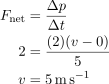
\begin{aligned} F_{\textrm{net}} & = \frac{\Delta p}{\Delta t} \\ 2 & = \frac{(2)(v-0)}{5} \\ v & = 5\,\mathrm{m\,s^{-1}} \\ \end{aligned}

\begin{aligned} m_1u_1+m_2u_2 & = (m_1+m_2)v \\ (2)(5)+(3)(0) & = (2+3)v \\ v & = 2\,\mathrm{m\,s^{-1}} \\ \end{aligned}

Not to be completed.

202302091224 Exercise 20.2

(All accelerations are to be taken as uniform and in a straight line.)

1. A particle starts with velocity 3\,\mathrm{m\,s^{-1}} and accelerates at 0.5\,\mathrm{m\,s^{-2}}. What is its velocity after i. 3\,\mathrm{s}, ii. 10\,\mathrm{s}, iii. t\,\mathrm{s}? How far has it travelled in these times?
2. A body, decelerating at 0.8\,\mathrm{m\,s^{-2}}, passes a certain point with a speed of 30\,\mathrm{m\,s^{-1}}. Find its velocity after 10\,\mathrm{s}, the distance covered in that time and how much further the body will go until it stops.
3. A particle travelling with acceleration of 0.75\,\mathrm{m\,s^{-2}} passes a point O with speed 5\,\mathrm{m\,s^{-1}}. How long will it take to cover a distance of 250\,\mathrm{m}? What will its speed be at that time?
4. If a particle passes a certain point with speed 5\,\mathrm{m/s} and is accelerating at 3\,\mathrm{m/s^{2}} how far will it travel in the next 2\,\mathrm{s}? How long will it take (from the start) to travel 44\,\mathrm{m}?
5. A body falls from rest with an acceleration of 10\,\mathrm{m\,s^{-2}}. What is its velocity 5\,\mathrm{s} afterwards? How far has it fallen by then?

Extracted from A. Godman & J. F. Talbert. (1975). Additional Mathematics Pure and Applied in SI Units.


Roughwork.

1.

\begin{aligned} v(t) & = u+at = 3 + 0.5t \\ v(3) & = 3+0.5(3) = 4.5\,\mathrm{m\,s^{-1}}\\ v(10) & = 3+0.5(10) = 8\,\mathrm{m\,s^{-1}} \\ \end{aligned}

\begin{aligned} s(t) & =ut+\frac{1}{2}at^2 = 3t+\frac{t^2}{4} \\ s(3) & = 3(3)+\frac{(3)^2}{4} = 11.25\,\mathrm{m}\\ s(10) & = 3(10)+\frac{(10)^2}{4} = 55\,\mathrm{m}\\ \end{aligned}

2.

Not to be attempted.

3.

\begin{aligned} s & = ut+\frac{1}{2}at^2 \\ (250) & = (5)t+\frac{1}{2}(0.75)t^2 \\ 0 & = 3t^2 + 40t - 2000 \\ 0 & = (3t+100)(t-20) \\ t & = 20\,\mathrm{s}\textrm{ \scriptsize{OR} }-\frac{100}{3}\,\mathrm{s}\textrm{ (rej.)} \\ \end{aligned}

\begin{aligned} v & = u+at \\ & = (5)+(0.75)(20) \\ & = 20\,\mathrm{m\,s^{-1}} \\ \end{aligned}

or,

\begin{aligned} v^2 & =u^2+2as \\ v & = \pm\sqrt{(5)^2+2(0.75)(250)} \\ & = 20\,\mathrm{m\,s^{-1}}\textrm{ \scriptsize{OR} }-20\,\mathrm{m\,s^{-1}}\textrm{ (rej.)} \\ \end{aligned}

4. Not to be attempted.

5. Not to be attempted.