202301200900 Problem 2.1

Suppose you flip four fair coins.

(a) Make a list of all the possible outcomes, as in Table 2.1.
(b) Make a list of all the different “macrostates” and their probabilities.
(c) Compute the multiplicity of each macrostate using the combinatorial formula 2.6, and check that these results agree with what you got by brute-force counting.

Extracted from D. V. Schroeder. (2000). An Introduction to Thermal Physics.


Background.

For a fair coin, the probabilities of heads-up (\textrm{H}) and tails-up (\textrm{T}) are 50:50 odds, i.e., P(\textrm{H})=P(\textrm{T})=\displaystyle{\frac{1}{2}} the same.

\begin{tabular}{cccc} Coin 1 & Coin 2 & Coin 3 & Coin 4 \\\hline H & H & H & H \\ H & H & H & T \\ H & H & T & H \\ H & H & T & T \\ H & T & H & H \\ H & T & H & T \\ H & T & T & H \\ H & T & T & T \\ T & H & H & H \\ T & H & H & T \\ T & H & T & H \\ T & H & T & T \\ T & T & H & H \\ T & T & H & T \\ T & T & T & H \\ T & T & T & T \\ \end{tabular}

Any one possibility of the

P_\textrm{w/ rplc}(2,4)=\text{}^2P_4=2^4=16

permutations is called a microstate, and all (sixteen) microstates compose ensemble the probability distribution of the

5=\mathrm{ord}(\{4\textrm{H}0\textrm{T},3\textrm{H}1\textrm{T},2\textrm{H}2\textrm{T},1\textrm{H}3\textrm{T},0\textrm{H}4\textrm{T}\})

combinations, called the (five) macrostates. The number of microstates corresponding to a given macrostate is called the multiplicity of that macrostate. With full knowledge of the microstates of a system are its macrostates fully known; the reverse is not true.

If there are N coins, the multiplicity of the macrostate with n heads is

\displaystyle{\Omega (N,n)=\frac{N!}{n!\cdot (N-n)!}=\begin{pmatrix}N\\n\end{pmatrix}}.

\begin{aligned} \Omega (4,0) & = 1\\ \Omega (4,1) & = 4\\ \Omega (4,2) & = 6\\ \Omega (4,3) & = 4\\ \Omega (4,4) & = 1\\ \end{aligned}

This problem is not to be attempted.

202301171158 Problem 1.45

As an illustration of why it matters which variables you hold fixed when taking partial derivatives, consider the following mathematical example. Let w=xy and x=yz.

(a) Write w purely in terms of x and z, and then purely in terms of y and z.
(b) Compute the partial derivatives

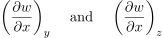
\displaystyle{\bigg(\frac{\partial w}{\partial x}\bigg)_y}\quad\textrm{ and }\quad\displaystyle{\bigg(\frac{\partial w}{\partial x}\bigg)_z},

and show that they are not equal. (Hint: To compute (\partial w/\partial x)_y, use a formula for w in terms of x and y, not z. Similarly, compute (\partial w/\partial x)_z from a formula for w in terms of only x and z.)
(c) Compute the other four partial derivatives of w (two each with respect to y and z), and show that it matters which variable is held fixed.

Extracted from D. V. Schroeder. (2000). An Introduction to Thermal Physics.


Roughwork.

(a) Write on one hand

\begin{aligned} w & = xy \\ & = x\bigg(\frac{x}{z}\bigg) \\ & = \frac{x^2}{z} \\ \end{aligned}

and the other

\begin{aligned} w & = xy \\ & = (yz)y \\ & = y^2z \\ \end{aligned}

(b)

\begin{aligned} \bigg(\frac{\partial w}{\partial x}\bigg)_y &=\frac{\partial}{\partial x}(w(x,y)) = \frac{\partial}{\partial x}(xy) = y \\ \bigg(\frac{\partial w}{\partial x}\bigg)_z & =\frac{\partial}{\partial x}(w(x,z)) = \frac{\partial}{\partial x}\bigg(\frac{x^2}{z}\bigg) = \frac{2x}{z} \\ \end{aligned}

(c) Not to be attempted.

202301170910 Exercise 3.2

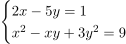
Solve these simultaneous equations:

1. \begin{cases} x+y=5 \\ xy=6 \\ \end{cases}

Roughwork. Read More

    Substituting x=5-y for x:

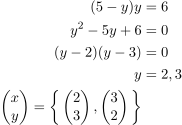
    \begin{aligned} (5-y)y & = 6 \\ y^2-5y+6 & = 0 \\ (y-2)(y-3) & = 0 \\ y & = 2,3 \\ \begin{pmatrix}x \\ y \end{pmatrix} = \bigg\{ \begin{pmatrix} 2 \\ 3 \end{pmatrix},\begin{pmatrix} 3 \\ 2 \end{pmatrix} \bigg\} & \\ \end{aligned}

    Substituting x=1+2y for x:

    \begin{aligned} (1+2y)^2 + y^2 & =29 \\ (1+4y+4y^2)+y^2 & = 29 \\ 5y^2 +4y -28 & = 0 \\ (5y+14)(y-2) & = 0 \\ y & = -\frac{14}{5},2 \\ \begin{pmatrix}x\\y\end{pmatrix} = \bigg\{ \begin{pmatrix}5\\2\end{pmatrix}, \begin{pmatrix}-23/5\\-14/5\end{pmatrix} \bigg\} & \\ \end{aligned}

    Substituting y=5-2x for y:

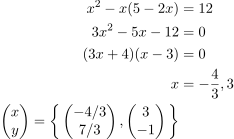
    \begin{aligned} x^2-x(5-2x) & = 12 \\ 3x^2 -5x -12 & = 0 \\ (3x+4)(x-3) & = 0 \\ x & = -\frac{4}{3},3 \\ \begin{pmatrix}x\\y\end{pmatrix} = \bigg\{ \begin{pmatrix}-4/3\\7/3\end{pmatrix},\begin{pmatrix}3\\-1\end{pmatrix}\bigg\} &\\ \end{aligned}

    Substituting y=3x-7 for y:

    \begin{aligned} x^2-x(3x-7)+(3x-7)^2 & = 7 \\ 7x^2 -35x +42 & = 0 \\ (7x+7)(x-6) & = 0 \\ x & = -1,6 \\ \begin{pmatrix}x\\y\end{pmatrix} = \bigg\{ \begin{pmatrix}-1\\-10\end{pmatrix} , \begin{pmatrix}6\\11\end{pmatrix}\bigg\} & \\ \end{aligned}

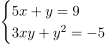
    Substituting y=9-5x for y:

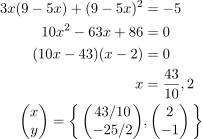
    \begin{aligned} 3x(9-5x)+(9-5x)^2 & = -5 \\ 10x^2-63x +86 & = 0 \\ (10x-43)(x-2) & = 0 \\ x & = \frac{43}{10},2 \\ \begin{pmatrix}x\\y\end{pmatrix} = \bigg\{ \begin{pmatrix}43/10\\-25/2\end{pmatrix} & , \begin{pmatrix}2\\-1\end{pmatrix}\bigg\}  \\ \end{aligned}

    Substituting \displaystyle{y = \frac{13-3x}{2}} for y:

    \begin{aligned} 3x^2 + \bigg(\frac{13-3x}{2}\bigg)^2 = 31 \\ 7x^2 - 26x+15 & = 0 \\ (7x-5)(x-3) & = 0 \\ x & = \frac{7}{5},3 \\ \begin{pmatrix}x\\y\end{pmatrix} = \bigg\{ \begin{pmatrix}7/5\\22/5\end{pmatrix},\begin{pmatrix}3\\-13\end{pmatrix} \bigg\} & \\ \end{aligned}

    Substituting \displaystyle{y=\frac{2x+11}{3}} for y:

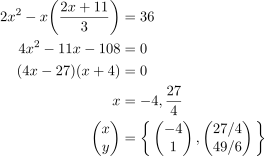
    \begin{aligned} 2x^2-x\bigg( \frac{2x+11}{3}\bigg) & =36 \\ 4x^2-11x-108 &= 0 \\ (4x-27)(x+4) & = 0 \\ x & = -4,\frac{27}{4} \\ \begin{pmatrix}x\\y\end{pmatrix} & = \bigg\{ \begin{pmatrix}-4\\1\end{pmatrix},\begin{pmatrix}27/4\\49/6\end{pmatrix}\bigg\} \\ \end{aligned}

    Substituting \displaystyle{y=\frac{2x-1}{5}} for y:

    \begin{aligned} x^2-x\bigg(\frac{2x-1}{5}\bigg)+3\bigg(\frac{2x-1}{5}\bigg)^2 & = 9 \\ 27x^2 -7x -222 & = 0 \\ (27x+74)(x-3) & = 0 \\ x & = -\frac{74}{27},3 \\ \begin{pmatrix}x\\y\end{pmatrix} = \bigg\{ \begin{pmatrix}-74/27\\-35/27\end{pmatrix} , \begin{pmatrix}3\\1\end{pmatrix} \bigg\} & \\ \end{aligned}

    Substituting \displaystyle{x=\frac{7-3y}{2}} for x:

    \begin{aligned} y^2 & = 26-\bigg(\frac{7-3y}{2}\bigg)^2 \\ 0 & = 13y^2 -42y -55 \\ 0 & = (13y-55)(y+1) \\ y & = -1,\frac{55}{13} \\ \begin{pmatrix}x\\y\end{pmatrix} & = \bigg\{ \begin{pmatrix}5\\-1\end{pmatrix} , \begin{pmatrix}74/26\\55/13\end{pmatrix}\bigg\} \\ \end{aligned}

    Substituting \displaystyle{x=\frac{-7-3y}{5}} for x:

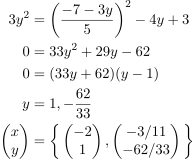
    \begin{aligned} 3y^2 & = \bigg(\frac{-7-3y}{5}\bigg)^2-4y+3 \\ 0 & = 33y^2+29y-62 \\ 0 & = (33y+62)(y-1) \\ y & = 1,-\frac{62}{33}\\ \begin{pmatrix}x\\y\end{pmatrix} & = \bigg\{\begin{pmatrix} -2 \\1\end{pmatrix},\begin{pmatrix} -3/11\\-62/33\end{pmatrix}\bigg\} \\ \end{aligned}

    Extracted from A. Godman & J. F. Talbert. (1975). Additional Mathematics Pure and Applied in SI Units.


    This problem is not to be attempted.

202301161044 Exercise 3.5.12

A stone is thrown upwards with a velocity of u\,\mathrm{m\,s^{-1}} at the same instant that a stone is let fall from the top of a cliff immediately above the first stone. They meet after t\,\mathrm{s}. What is the height of the cliff?

Extracted from L. H. Clarke & F. G. J. Norton. (1972). Additional Applied Mathematics.


Roughwork.

Let the height of the cliff be H\,\mathrm{m}. Take upward positive, and the ground s=0 the reference level.

For the stone let fall, parametrize its trajectory:

\mathbf{s}\Big(t\in \Big[0,\sqrt{\frac{2H}{g}}\Big]\Big)=\displaystyle{\bigg(H-\frac{1}{2}gt^2\bigg)\,\hat{\mathbf{j}}},

and for the stone thrown upward, also:

\mathbf{s}\big(t\in \big[ 0,\frac{2u}{g}\big]\big)=\displaystyle{\bigg(ut-\frac{1}{2}gt^2\bigg)\,\hat{\mathbf{j}}}.

As the two stones meet at time t=t':

\begin{aligned} H-\frac{1}{2}gt'^2 & = ut'-\frac{1}{2}gt'^2 \\ H & = ut' \end{aligned}

This problem is not to be attempted.

202301160933 Exercise 3.4.B (Q29)

A ball is thrown vertically upward from the ground. Its displacement at time t is given by 20t-5t^2. Find the maximum distance of the ball from the ground and the time this occurs.

Extracted from Y. F. So & M. S. Wong. (1988). New Way Additional Mathematics.


Roughwork.

By differentiation wrt time

\begin{aligned} s(t) & = 20t-5t^2 \\ v(t) & = 20 - 10t \\ a(t) & = -10 \\ \end{aligned}

Its velocity is zero at some time t', i.e.,

\begin{aligned} 0=v(t') & =20-10t' \\ t' & = 2\,\mathrm{s} \\ \end{aligned}

once it reaches the maximum height

\begin{aligned} s(t') & = 20(2)-5(2)^2 \\ & = 20\,\mathrm{m} \\ \end{aligned}

This problem is not to be attempted.

202301130941 Solution to 2014-IBHL-PHY-I-5

Two blocks of weight 5\,\mathrm{N} and 2\,\mathrm{N} are attached to two ropes, \textrm{X} and \textrm{Y}.

The blocks hang vertically. The mass of the ropes is negligible. What is the tension in \textrm{X} and the tension in \textrm{Y}?


Roughwork.

As always start with free-body diagrams. Take upward positive. First the lower block:

Then the higher block:

Or alternatively,

Ans. \begin{cases} T_\textrm{X}=7\,\mathrm{N} \\ T_\textrm{Y}=2\,\mathrm{N} \\ \end{cases}

This problem is not to be attempted.

202301130918 Solution to 2011-IBHL-PHY-I-3

A skydiver of mass 80\,\mathrm{kg} falls vertically with a constant speed of 50\,\mathrm{m\,s^{-1}}. The upward force acting on the skydiver is approximately

A. 0\,\mathrm{N}.
B. 80\,\mathrm{N}.
C. 800\,\mathrm{N}.
D. 4000\,\mathrm{N}.


Roughwork.

As always start with a free-body diagram.

Take upward positive. Write the equation of motion by Newton’s 2nd law:

\begin{aligned} \mathbf{F}_{\textrm{net}} & = m\mathbf{a} \\ f-mg & = m(0) \\ f & = mg \\ & \approx (80)(10) \\ & = 800 \\ \end{aligned}

And the answer is C.

This problem is not to be attempted.

202301120908 Solution to 2002-IBHL-PHY-I-9

A pendulum has a bob of mass m and swings in the arc shown below.

As the bob swings through the lowest point of its motion, the tension in the string will be

A. zero.
B. less than mg.
C. equal to mg.
D. greater than mg.


Roughwork.

Assumed the string is l long, taut and inextensible.

Derivation. Read More

    \begin{aligned} T & = \frac{1}{2}ml^2\dot{\theta}^2 \\ V & = mgl(1-\cos\theta ) \\ \mathcal{L} & = T-V \\ \frac{\partial \mathcal{L}}{\partial\theta} & = -mgl\sin\theta \\ \frac{\partial \mathcal{L}}{\partial\dot{\theta}} &  = ml^2\dot{\theta} \\ 0 & =\frac{\mathrm{d}}{\mathrm{d}t}\bigg(\frac{\partial\mathcal{L}}{\partial \dot{\theta}}\bigg) - \frac{\partial\mathcal{L}}{\partial \theta} \\ \end{aligned}

    A simple pendulum, under gravity, has

    \textrm{EoM: }\qquad\displaystyle{\ddot{\theta}+\frac{g}{l}\cdot\sin\theta =0}

    the equation of motion, independent of mass m, neglecting friction.

    Lemma. (not in use) Read More

    \begin{aligned} \begin{bmatrix} \hat{\mathbf{e}}_r \\ \hat{\mathbf{e}}_\theta \end{bmatrix} & = \begin{bmatrix} \displaystyle{\frac{\partial x}{\partial r}} & \displaystyle{\frac{\partial y}{\partial r}} \\[2mm]\displaystyle{\frac{1}{r}\frac{\partial x}{\partial\theta}} & \displaystyle{\frac{1}{r}\frac{\partial y}{\partial\theta}} \end{bmatrix}\begin{bmatrix} \hat{\mathbf{e}}_x \\ \hat{\mathbf{e}}_y \end{bmatrix} \\ \begin{bmatrix} \hat{\mathbf{e}}_x \\ \hat{\mathbf{e}}_y \end{bmatrix} & = \begin{bmatrix} \displaystyle{\frac{1}{r}\frac{\partial y}{\partial \theta}} & \displaystyle{-\frac{\partial y}{\partial r}} \\[2mm]\displaystyle{-\frac{1}{r}\frac{\partial x}{\partial\theta}} & \displaystyle{\frac{\partial x}{\partial r}} \end{bmatrix} \begin{bmatrix} \hat{\mathbf{e}}_r \\ \hat{\mathbf{e}}_\theta \end{bmatrix} \\ \end{aligned}

    The net force for this non-uniform circular motion, being centripetal force producing radial plus tangential accelerations,

    \mathbf{a} = -l(\dot{\theta}^2\cos\theta +\ddot{\theta}\sin\theta)\,\hat{\mathbf{i}} + l(\ddot{\theta}\cos\theta -\dot{\theta}^2\sin\theta )\,\hat{\mathbf{j}}

    is the resultant of tension

    \begin{aligned} T & = |\mathbf{T}| \\ \mathbf{T} & =T\sin\theta\,\hat{\mathbf{i}}+T\cos\theta\,\hat{\mathbf{j}}} \end{aligned}

    and weight \mathbf{W}=m\mathbf{g}=-mg\,\hat{\mathbf{j}}. Write, with a free-body diagram in mind,

    \begin{aligned} \because\enspace & \mathbf{F}_{\textrm{net}}  =\mathbf{T}+\mathbf{W}=m\mathbf{a} \\ \therefore\enspace & \begin{cases} T\sin\theta = -ml(\dot{\theta}^2\cos\theta+\ddot{\theta}\sin\theta ) \\ T\cos\theta - mg = ml(\ddot{\theta}\cos\theta-\dot{\theta}^2\sin\theta ) \\ \end{cases} \\ \end{aligned}

    When the bob is at the lowest point, i.e., \theta =0,

    \begin{aligned} T & = mg + ml\ddot{\theta} \\ & = mg - mg\sin\theta \qquad (\textrm{by EoM})\\ & \approx mg-mg\theta \qquad (\because\enspace \sin\theta\approx\theta\textrm{ for small }\theta)\\ & \lneq mg \\ \end{aligned}

    The official answer is D but mine B.  Could that be E: more or less mg? If I am wrong, I must have omitted some simple facts of noble truth.

    This problem is not to be attempted.

202301111028 Solution to 2003-IBHL-I-4

Two forces of magnitudes 7\,\mathrm{N} and 5\,\mathrm{N} act at a point. Which one of the following is not a possible value for the magnitude of the resultant force?

A. 1\,\mathrm{N}
B. 3\,\mathrm{N}
C. 5\,\mathrm{N}
D. 7\,\mathrm{N}


Roughwork.

Suppose

\begin{aligned} \mathbf{F}_1 & = 7\sin\alpha\,\hat{\mathbf{i}} + 7\cos\alpha\,\hat{\mathbf{j}} \\ \mathbf{F}_2 & = 5\sin\beta\,\hat{\mathbf{i}} + 5\cos\beta\,\hat{\mathbf{j}} \\ \end{aligned}

where \alpha ,\beta\in [0,2\pi ).

\begin{aligned} \mathbf{F}_3 & = \mathbf{F}_1+\mathbf{F}_2 \\ & = (7\sin\alpha + 5\sin\beta )\,\hat{\mathbf{i}} + (7\cos\alpha +5\cos\beta )\,\hat{\mathbf{j}} \\ F_3 & = |\mathbf{F}_3| \\ & = \sqrt{(7\sin\alpha + 5\sin\beta )^2 + (7\cos\alpha +5\cos\beta )^2}\\ & = \sqrt{74+70(\sin\alpha\sin\beta +\cos\alpha\cos\beta )}\\ & = \sqrt{74+70\cos (\alpha-\beta)} \\ \end{aligned}

\begin{aligned} \because \quad & \begin{cases} \max (F_3) = \sqrt{74+70(1)} = 12 \\ \min (F_3) = \sqrt{74+70(-1)} = 2 \\ \end{cases} \\ \therefore\quad & F_3 \in [2,12] \\ \end{aligned}

One can actually do without vector analysis for the sake of a mental exercise.

This problem is not to be attempted.

202301110923 Solution to 1980-AL-PHY-IA-26

A charged ball X is suspended by a string.

When a uniform electric field E is applied horizontally, the ball is displaced a horizontal distance a such that the string makes an angle \theta with the vertical.


Roughwork.

As always start with a free-body diagram. Hence, draw

Resolving components, write

\begin{cases} \textrm{Horizontal:}\quad & T\sin\theta = qE \\ \textrm{Vertical:}\quad & T\cos\theta = mg \\ \end{cases}

Squaring and summing, write

\begin{aligned} (T\sin\theta )^2+ (T\cos\theta)^2 &=  (qE)^2 + (mg)^2\\ T & = \sqrt{q^2E^2+m^2g^2} \\ \end{aligned}

By considering the electric field strength E as an independent variable, and the angle of elevation \theta the dependent variable, make differentiation

\displaystyle{\mathrm{d}E = \bigg(\frac{T\cos\theta}{q}\bigg)\,\mathrm{d}\theta}\qquad(\theta\in [0,90^\circ])

This problem is not to be attempted.