
A family of straight lines is given by the equation
 ,
,
where  is real.
(a) Find the equation of a line  in the family whose
  -intercept is
  .
.
(b) Find the equation of a line  in the family which is parallel to the -axis.
(c) Find the acute angle between and .
Roughwork.
(a)
Substituting  for the -intercept:

(b)
Differentiating on both hand sides,

(c)  .
.
This problem is not to be attempted.
 and
and  are real numbers such that
 .
. .
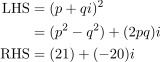
.


 .
. of length
  units slides with
  on the
  on the
  -axis.
  is the point on
  . Find the equation of the locus of
  and
and  where
where ![a,b\in [0,4]](https://physicspupil.com/wp-content/ql-cache/quicklatex.com-7cc3b41554991833802f5ebd52f2912e_l3.svg "Rendered by QuickLaTeX.com") and
and  . The locus of
  is
is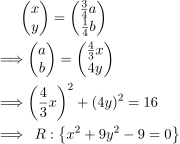
 to the parabola
  .
.
 and
and  be two points at which the two tangents touches the parabola. Then,


 .
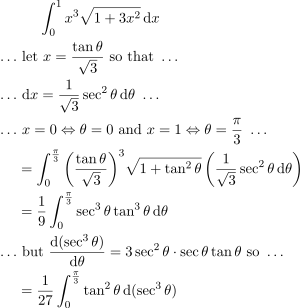
.
![\begin{aligned} & \quad\enspace \int_{0}^{1}x^3\sqrt{1+3x^2}\,\mathrm{d}x \\ \dots &\textrm{ let }u=1+3x^2\textrm{ then }\mathrm{d}x=\frac{\mathrm{d}u}{6x}\textrm{ }\dots \\ \dots &\textrm{ then }x=0\Leftrightarrow u=1\textrm{ and }x=1\Leftrightarrow u=4\textrm{ }\dots \\ & = \int_{1}^{4}x^3\sqrt{u}\,\bigg(\frac{\mathrm{d}u}{6x}\bigg) \\ & = \frac{1}{6}\int_{1}^{4}\bigg(\frac{u-1}{3}\bigg)\sqrt{u}\,\mathrm{d}u \\ & = \frac{1}{18}\int_{1}^{4}\big( u^{\frac{3}{2}}-u^{\frac{1}{2}}\big)\,\mathrm{d}u \\ & = \frac{1}{18}\bigg[ \frac{2u^{\frac{5}{2}}}{5}-\frac{2u^{\frac{3}{2}}}{3}\bigg]\bigg|_{1}^{4} \\ & = \cdots \\ \end{aligned}](https://physicspupil.com/wp-content/ql-cache/quicklatex.com-2de73630bc9aa34328c9f2a302349c59_l3.svg "Rendered by QuickLaTeX.com")
 is in the form of the parabola given by the equation

 . Find the coordinate of
 .
. .
.


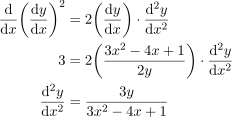

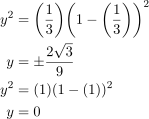


 for the author.
 if
if .
.
 ?
?
 of ice in a sealed container of volume
  and pressure at
  at
at  to steam at
  . (Neglect the heat absorbed by the air and the container. The specific heat of ice and steam is
  ). What is the pressure inside the container expressed in atmospheric pressure, when the
  as may well be applicable to solids and liquids as the ideal gas law
  to gases, lacking the enthalpies of fusion and vaporisation unknown?