202212121040 Solution to 1968-CE-AMATH-II-X

Find the maximum and minimum values of y on the curve

y^2=x(1-x)^2.

Sketch the curve.


Roughwork. (true-negative/false-positive example)

All computations in the enclosed section below involving higher-order derivatives than the first are wrong owing to the mistaken assumption

\times :\quad\displaystyle{\bigg(\frac{\mathrm{d}y}{\mathrm{d}x}\bigg)^2=\frac{(\mathrm{d}y)^2}{(\mathrm{d}x)^2}}

which was to be detested. Show

    \begin{aligned} y^2 & = x(1-x)^2 \\ & = x(1-2x+x^2) \\ y^2 & = x^3-2x^2+x \\ \end{aligned}

    \begin{aligned} 2y\,\mathrm{d}y & = 3x^2\,\mathrm{d}x-4x\,\mathrm{d}x+\mathrm{d}x \\ \frac{\mathrm{d}y}{\mathrm{d}x} & = \frac{3x^2-4x+1}{2y} \\ 2(\mathrm{d}y)^2 & = 6x(\mathrm{d}x)^2 - 4(\mathrm{d}x)^2 \\ \bigg(\frac{\mathrm{d}y}{\mathrm{d}x}\bigg)^2 & = 3x-2 \\ \end{aligned}

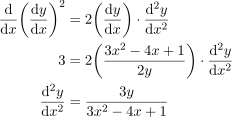
    \begin{aligned} \frac{\mathrm{d}}{\mathrm{d}x}\bigg(\frac{\mathrm{d}y}{\mathrm{d}x}\bigg)^2 & = 2\bigg(\frac{\mathrm{d}y}{\mathrm{d}x}\bigg)\cdot \frac{\mathrm{d}^2y}{\mathrm{d}x^2} \\ 3 & = 2\bigg(\frac{3x^2-4x+1}{2y}\bigg)\cdot \frac{\mathrm{d}^2y}{\mathrm{d}x^2} \\ \frac{\mathrm{d}^2y}{\mathrm{d}x^2} & = \frac{3y}{3x^2-4x+1} \\ \end{aligned}

    \begin{aligned} y'(x) & = 0 \\ 3x^2-4x+1 & = 0 \\ (3x-1)(x-1) & = 0 \\ x & = \frac{1}{3},1 \\ \end{aligned}

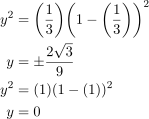
    \begin{aligned} y^2 & = \bigg(\frac{1}{3}\bigg)\bigg(1-\bigg(\frac{1}{3}\bigg)\bigg)^2 \\ y & =\pm\frac{2\sqrt{3}}{9}\\ y^2 & = (1)(1-(1))^2 \\ y & = 0 \\ \end{aligned}

    \begin{pmatrix}x\\y\end{pmatrix} = \Bigg\{ \begin{pmatrix}\frac{1}{3}\\ -\frac{2\sqrt{3}}{9} \end{pmatrix}, \begin{pmatrix}\frac{1}{3}\\ \frac{2\sqrt{3}}{9} \end{pmatrix}, \begin{pmatrix}1\\0\end{pmatrix}\Bigg\} are extrema.

    \begin{aligned} y''(x) & = 0 \\ 3y & = 0 \\ \pm\sqrt{x(1-x)^2} & = 0 \\ x(1-x)^2 & = 0 \\ x & = 0,1 \\ \end{aligned}

    \begin{pmatrix}x\\y\end{pmatrix} = \bigg\{ \begin{pmatrix}0\\ 0 \end{pmatrix}, \begin{pmatrix}1\\ 0\end{pmatrix}\bigg\} are inflexions.

    To answer whether

    \displaystyle{\frac{\mathrm{d}^2y}{\mathrm{d}x^2}}\bigg|_{\big( \frac{1}{3},\pm\frac{2\sqrt{3}}{9}\big)}

    is positive or negative is critical to yielding the maximum and the minimum values of the function.


    The correction is left a \textrm{\scriptsize{MUST}} for the author.