Referring to the figure below, the pulleys are assumed to be weightless and frictionless and the ropes massless and inextensible.

Prove that  if the system is in equilibrium. Find the equation of motion for each mass,
 i. if  ; and
; and ii. if  .
.
Roughwork.
In equilibrium,
 .
.
Thus

 .
.
Mass  will move down and
  up if , and the reverse if . When makes displacement of
  the vertical, makes
  .
.
Without gain of speciality, one may obtain the equations of motion by either (a) Newton’s second law, or (b) conservation of mechanical energy, or (c) Euler-Lagrange method.
Take downward positive. When , in one’s mind one can draw two free-body diagrams giving two equations:

Hence,

note that  . And so

Note the inequalities  . One can thus find tension in magnitude
  , yet this is left the reader.
The Lagrangian  of the system is
 ,
,
or,
 .
.
where  and
and  vary with time
  as are subjected to acceleration, and
  .
.
Euler-Lagrange equation reads
 .
.
Computing term by term,
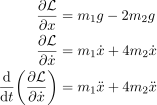
and the result follows.
(to be continued)

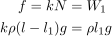
 ) with a length
  lies on a table. What is the maximum length
  of the part of the chain hanging over the table if the coefficient of friction between the chain and the table is
  ?
?
 .
.