
Use this fact, that the difference between a vacuum energy density  and
and  or
or  is that does not change as the universe expands (though it may change for other physical reasons), the basic Friedman equation Eq. (29.13):

with  , and the assumption of vacuum dominance (
 ) to show that Eq. (29.9):
 .
.
This form of the equation is valuable because it no longer refers to the present state of the universe.
Extracted from Thomas A. Moore. (2013). A General Relativity Workbook.
Roughwork.
This solution is not mine. It was found on the Internet some years ago, to whose author(s) I lost references.

 .
. and the coordinates of the point
  .
.
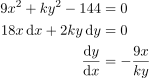
 and height
  is analytically
 .
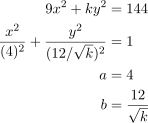
.
 ,
,![\displaystyle{\frac{\mathrm{d}}{\mathrm{d}x}\bigg[\frac{\sin (x^2+1)}{x}\bigg]}](https://physicspupil.com/wp-content/ql-cache/quicklatex.com-ef854e1978c620fe47e2201b5a025690_l3.svg "Rendered by QuickLaTeX.com") .
. and
and  s.t.
s.t.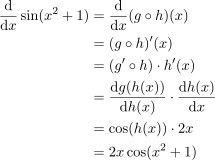
 s.t.
s.t.![\begin{aligned} \frac{\mathrm{d}}{\mathrm{d}x}\bigg[\frac{\sin (x^2+1)}{x}\bigg] & = \frac{\mathrm{d}}{\mathrm{d}x}\Big( g(h(x))\cdot f(x)\Big) \end{aligned}](https://physicspupil.com/wp-content/ql-cache/quicklatex.com-9859c9acef5989d3c51e89287e87e7e6_l3.svg "Rendered by QuickLaTeX.com")
 and
and  .
. in the form of
  .
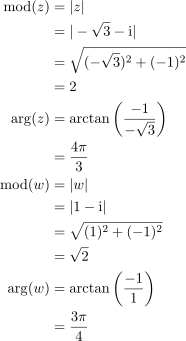
.

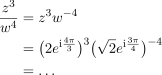
 .
. and its conjugate
  on the Argand diagram.
 , express
  in the form of
  are roots of the equation
  .
.
 .
.
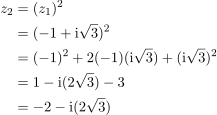
 the magnitude of the electrostatic force of attraction or repulsion between two point charges
  and
and  is directly proportional to
  the product of the magnitudes of charges and inversely proportional to
  the square of the distance between them:
 apart each of electric charge
  . The electrostatic force of repulsion between them is
 , or in degrees Fahrenheit,
 moves such that its distance from the point
  is equal to its distance from the line
  . Write down and simplify the equation of the locus of
  -parametrized as
  , and let the line
  be
be  -parametrized as
  .
. , its slope is:
 ,
, ,
, , whereas the slope of tangent at any point
  on the locus is
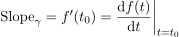 .
. .
.
 .
.
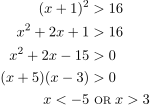
 satisfying the inequality
 .
.
 The range of
  .
. .
.

 .
.