
A small ball after projection moves under the effect of gravity only. Its velocity at a certain instant is shown below. What is the speed of the ball  before? Neglect air resistance. (
 )
)

This figure is not one original but a modified.
Roughwork.
Assume the angle of projection be  with speed
  at launch time
  such that the resolved
  -,
-,  – components

are combined to give the resultant speed at certain instant  :
:
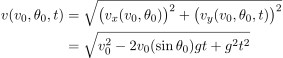
making with the level angle 

Now that for some instant  we are given

recall

Equating

Differentiating on  wrt time :
![\begin{aligned} \frac{\mathrm{d}\theta}{\mathrm{d}t} & = \frac{\mathrm{d}}{\mathrm{d}t}\bigg[\arctan \bigg(\frac{v_0\sin\theta_0-gt}{v_0\cos\theta_0}\bigg)\bigg] \\ & = \frac{1}{1+\Big(\frac{v_0\sin\theta_0-gt}{v_0\cos\theta_0}\Big)^2} \\ \theta'(t) & = \frac{v_0^2\cos^2\theta_0}{v_0^2-2v_0(\sin\theta_0)gt+g^2t^2} \\ \end{aligned}](https://physicspupil.com/wp-content/ql-cache/quicklatex.com-1065c30bad2d1f91f9d86b4646041e2a_l3.svg "Rendered by QuickLaTeX.com")
and also on  :
:

(to be continued)