
A sphere of radius  carries a polarization
 ,
,
where  is a constant and
  the vector from the centre.
(a) Calculate the bound charges  and
and  .
.
(b) Find the field inside and outside the sphere.
Extracted from David J. Griffiths. (1999). Introduction to Electrodynamics.
Roughwork.
The surface charge is defined by Eq. (4.11):

whereas the volume charge by Eq. (4.12):
 .
.
Text on pp. 167-168
On the surface  :
:

Under the surface  :
:

Notice  , so the sphere has zero net charge, i.e.,
  , and thus produces no electric field outside, i.e.,
  .
.
Eq. (4.13):

and the rest is left as an exercise to the reader.
 and
and  or
or  is that
 , and the assumption of vacuum dominance (
 ) to show that Eq. (29.9):
 .
.
 .
. .
.
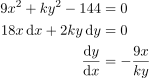
 and height
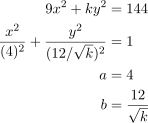
  is analytically
 .
.
 ,
,![\displaystyle{\frac{\mathrm{d}}{\mathrm{d}x}\bigg[\frac{\sin (x^2+1)}{x}\bigg]}](https://physicspupil.com/wp-content/ql-cache/quicklatex.com-ef854e1978c620fe47e2201b5a025690_l3.svg "Rendered by QuickLaTeX.com") .
. and
and  s.t.
s.t.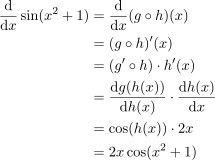
 s.t.
s.t.![\begin{aligned} \frac{\mathrm{d}}{\mathrm{d}x}\bigg[\frac{\sin (x^2+1)}{x}\bigg] & = \frac{\mathrm{d}}{\mathrm{d}x}\Big( g(h(x))\cdot f(x)\Big) \end{aligned}](https://physicspupil.com/wp-content/ql-cache/quicklatex.com-9859c9acef5989d3c51e89287e87e7e6_l3.svg "Rendered by QuickLaTeX.com")