
A point  moves such that its distance from the point
  is equal to its distance from the line
  . Write down and simplify the equation of the locus of .
Roughwork.
Let the locus of be  -parametrized as
  , and let the line
  be
be  -parametrized as
  .
.
For the shortest line joining any point on the locus to its perpendicular projection on  , its slope is:

with angle of inclination  , and for the line joining any point on the locus to point , its slope is
 ,
,
with angle of inclination  , whereas the slope of tangent at any point
  on the locus is
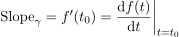 .
.
with angle of inclination  .
.
Have a picture in mind

Recall
 .
.
Hence,

The remaining are left the reader as an exercise.