
A point  moves such that its distance from the point
  is equal to its distance from the line
  . Write down and simplify the equation of the locus of .
Roughwork.
Let the locus of be  -parametrized as
  , and let the line
  be
be  -parametrized as
  .
.
For the shortest line joining any point on the locus to its perpendicular projection on  , its slope is:

with angle of inclination  , and for the line joining any point on the locus to point , its slope is
 ,
,
with angle of inclination  , whereas the slope of tangent at any point
  on the locus is
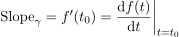 .
.
with angle of inclination  .
.
Have a picture in mind

Recall
 .
.
Hence,

The remaining are left the reader as an exercise.
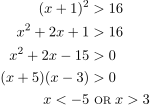
 satisfying the inequality
 .
.
 The range of
  .
. .
.

 .
.


 .
. .
. .]
.]![\begin{aligned} &\quad\, \int_{0}^{\frac{1}{2}}\frac{1}{\sqrt{1-x^2}}\,\mathrm{d}x \\ \dots\enspace & \textrm{let }x=\sin\theta\textrm{ s.t. }\mathrm{d}x=\cos\theta\,\mathrm{d}\theta \enspace\dots \\ & = \int_{x=0}^{x=\frac{1}{2}}\frac{\cos\theta}{\sqrt{1-(\sin\theta )^2}}\,\mathrm{d}\theta \\ & = \int_{x=0}^{x=\frac{1}{2}}\frac{\cos\theta}{\cos\theta}\,\mathrm{d}\theta \\ & = \int_{x=0}^{x=\frac{1}{2}}\mathrm{d}\theta \\ & = \big[\theta \big]\big|_{x=0}^{x=\frac{1}{2}} \\ & = \big[\sin^{-1}x\big]\big|_{0}^{\frac{1}{2}} \\ & = \frac{\pi}{6}\\ \end{aligned}](https://physicspupil.com/wp-content/ql-cache/quicklatex.com-11bfae113bc70418631a5fdbb5c2429e_l3.svg "Rendered by QuickLaTeX.com")
 .
.

 ,
,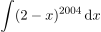 .
.

 of a curve
  is given by
 .
. , find the equation of
 for
for  :
:
 .
. .
.
![\displaystyle{\frac{\mathrm{d}}{\mathrm{d}x}[x(x+1)^n]=(x+1)^{n-1}[(n+1)x+1]}](https://physicspupil.com/wp-content/ql-cache/quicklatex.com-821b0bea59b0a1de26ef3a95c8138b98_l3.svg "Rendered by QuickLaTeX.com") ,
, is a rational number.
 .
. , find the equation of
 ![\begin{aligned} &\quad\, \int (x+1)^{n-1}[(n+1)x+1]\,\mathrm{d}x \\ & = \int (x+1)^{n-1}[(n+1)(x+1)-n]\,\mathrm{d}x \\ & = (n+1)\int (x+1)^n\,\mathrm{d}x - n\int (x+1)^{n-1}\,\mathrm{d}x \\ & = (n+1)\frac{(x+1)^{n+1}}{n+1} - n\frac{(x+1)^{(n-1)+1}}{(n-1)+1} + C \\ & = (x+1)^{n+1}-(x+1)^n + C \\ & = (x+1)^n(x+1) - (x+1)^n + C \\ & = x(x+1)^n + C \textrm{ for some constant}\\ \end{aligned}](https://physicspupil.com/wp-content/ql-cache/quicklatex.com-52e930bc6ae1f2cf95e2258b9ff13714_l3.svg "Rendered by QuickLaTeX.com")
![\begin{aligned} &\quad\,\frac{\mathrm{d}}{\mathrm{d}x}[x(x+1)^n] \\ & = x\cdot \frac{\mathrm{d}}{\mathrm{d}x}\big( (x+1)^n\big) + \frac{\mathrm{d}}{\mathrm{d}x} (x)\cdot (x+1)^n \\ & = x\cdot (n)(x+1)^{n-1}(1) + 1\cdot (x+1)^n \\ & = (nx)(x+1)^{n-1}+(x+1)(x+1)^{n-1} \\ & = (x+1)^{n-1}[(n+1)x+1] \\ \end{aligned}](https://physicspupil.com/wp-content/ql-cache/quicklatex.com-64714e3c2af3961b6a79b47edb10b830_l3.svg "Rendered by QuickLaTeX.com")
![\begin{aligned} y & = \int \frac{\mathrm{d}y}{\mathrm{d}x}\,\mathrm{d}x \\ & = \int (x+1)^{(2005)-1}[( (2005)+1)x+1] \\ y(x) & \stackrel{\textrm{(a)}}{=} x(x+1)^{2005}+C\textrm{ for some constant} \\ \end{aligned}](https://physicspupil.com/wp-content/ql-cache/quicklatex.com-d5bfde49002fa11006e941c592193a8f_l3.svg "Rendered by QuickLaTeX.com")
 for
for  ,
,
 .
.