
215. A cylindrical tube with a radius  is connected by means of spokes to two hoops with a radius
  . The mass of both the hoops is
  . The mass of the tube and the spokes in comparison with the mass can be neglected. A string passed over a weightless pulley is wound around the tube. A weight with a mass
  is attached to the end of the string.

Find the acceleration  of the weight, the tension
  of the string and the force of friction
  acting between the hoops and the surface. (Assume that the hoops do not slip.) Also determine
  the coefficient of friction at which the hoops will slip.
Extracted from B. Bukhovtsev et al. (1978). Problems In Elementary Physics.
Setup.
The kinetic energy  of the dumbbell is in two parts, translational (/linear) and rotational (/angular), i.e.,
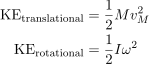
where the velocity of its centre of gravity (CG) is  , and its moment of inertia for discs
  . It has no potential energy
  of its position
  .
.
The kinetic energy of the weight is given by  , and its potential energy by
  .
.
The Lagrangian  of a system is obtained from
 ,
,
whereby the Euler–Lagrange equation is given as

Note the relationship between , , ,  , and
, and  , i.e.,

Also beware that forces  of any kinds, e.g., weight
  , tension
  , normal reaction
  , and friction
  , have not been taken into consideration.
(to be continued)