
A particle is projected vertically from the ground so that its velocity (in  ) in the first
  seconds is given by

and after the fourth second by

where  is the time (in seconds) after projection.
i. Show that  when
when  .
.
ii. Calculate the height of the particle when .
iii. Calculate the height of the particle when  .
.
iv. Find the value of when the acceleration of the particle is  .
.
Roughwork.
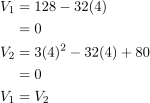
i.
When :
ii.
![\begin{aligned} h(t\in [0,4]) & = \int_{0}^{4}V_1\,\mathrm{d}t \\ & = \int_{0}^{4}(128-32t)\,\mathrm{d}t \\ & = \bigg[ 128\bigg(\frac{t^{(0)+1}}{(0)+1}\bigg) - 32\bigg(\frac{t^{(1)+1}}{(1)+1}\bigg)\bigg]\bigg|_{0}^{4} \\ & = [128(4)-16(4)^2]-[128(0)-16(0)^2] \\ & = 256\,\mathrm{ft} \\ \end{aligned}](https://physicspupil.com/wp-content/ql-cache/quicklatex.com-47438d258131c5fcff806f1b2e0e0c06_l3.svg "Rendered by QuickLaTeX.com")
iii.
![\begin{aligned} h(t\in [0,5]) & = h(t\in[0,4]) + h(t\in[4,5]) \\ & = 256\,\mathrm{ft} + \int_{4}^{5}V_2\,\mathrm{d}t \\ & = 256\,\mathrm{ft} + \int_{4}^{5}(3t^2-32t+80)\,\mathrm{d}t \\ & = 256\,\mathrm{ft} + \big[ t^3-16t^2+80t\big]\big|_{4}^{5} \\ & = 256\,\mathrm{ft} -3\,\mathrm{ft} \\ & = 253\,\mathrm{ft} \\ \end{aligned}](https://physicspupil.com/wp-content/ql-cache/quicklatex.com-6607eafb2c3081be313e8ef219694f94_l3.svg "Rendered by QuickLaTeX.com")
iv.
![\begin{aligned} a(t\in [0,4]) & = \frac{\mathrm{d}}{\mathrm{d}t}V_1=-32 \\ a(t\in [4,T]) & = \frac{\mathrm{d}}{\mathrm{d}t}V_2=6t-32 \\ \end{aligned}](https://physicspupil.com/wp-content/ql-cache/quicklatex.com-8e137310c8b4d81b920f65c2df64f3ff_l3.svg "Rendered by QuickLaTeX.com")

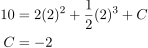
 and that
  when
when  . Find
  in terms of
  .
.
 .
. ,
,  ,
,  ,
,  , and
, and  are represented in the Argand diagram by the vertices of a regular pentagon with centre at the origin
  . If
. If  , write
  .
.
 in Cartesian form
  can also be expressed in the polar form
 is called the modulus
  , and
, and  the argument
  , of
, of  .
. .
. .
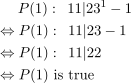
. is divisible by
  .
. be that
 .
.
 .
.
 true.
true. follows
  . By the principle of mathematical induction proven is that