202206081501 Exercise 4.1 (Q15)

In an electric circuit with a supplied voltage (emf) E, a resistor with resistance r_0, and an inductor with reactance x_0, suppose you want to add a second resistor. If r represents the resistance of this second resistor then the power P delivered to that resistor is given by
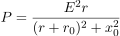
\displaystyle{P=\frac{E^2r}{(r+r_0)^2+x_0^2}}

with E, r_0, and x_0 treated as constants. For which value of r is the power P maximized?

extracted from Michael Corral. (2020). Elementary Calculus


Lemma. (quotient rule)

Let f(x)=\displaystyle{\frac{g(x)}{h(x)}}, where both g and h are differentiable and h(x)\neq 0. The quotient rule states that the derivative of f(x) is

f'(x)=\displaystyle{\frac{g'(x)h(x)-g(x)h'(x)}{h(x)^2}}

Wikipedia on Quotient Rule


Roughwork.

Defining
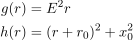
\begin{aligned} g(r) & = E^2r\\ h(r) & = (r+r_0)^2+x_0^2\\ \end{aligned}

and

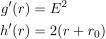
\begin{aligned} g'(r) & = E^2\\ h'(r) & = 2(r+r_0)\\ \end{aligned}

then

\displaystyle{\frac{\mathrm{d}P}{\mathrm{d}r}}=0\Longrightarrow g'(r)h(r)-g(r)h'(r)=0

Computing as follows

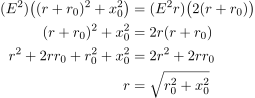
\begin{aligned} (E^2)\big( (r+r_0)^2+x_0^2 \big) & = (E^2r)\big( 2(r+r_0) \big) \\ (r+r_0)^2+x_0^2 & = 2r(r+r_0) \\ r^2+2rr_0+r_0^2 +x_0^2 & = 2r^2+2rr_0 \\ r & = \sqrt{r_0^2+x_0^2} \\ \end{aligned}

The mathematically formal way is to show that
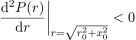
\displaystyle{\frac{\mathrm{d}^2P(r)}{\mathrm{d}r}\bigg|_{r=\sqrt{r^2_0+x_0^2}}}<0


But from a physical point of view, assume that the electric currents i passing through every components in series are the same, and the potential difference across each total up to the supplied voltage, namely,
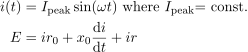
\begin{aligned} i(t) & = I_{\textrm{peak}}\sin (\omega t) \textrm{ where }I_{\textrm{peak}}\textrm{= const.} \\ E & = ir_0+x_0\frac{\mathrm{d}i}{\mathrm{d}t}+ir \\ \end{aligned}

The power P delivered to resistor r is given by the formula

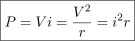
\boxed{P=Vi=\displaystyle{\frac{V^2}{r}}=i^2r}

and the only way to maximize P, is to maximize either or both i and V.

Solving for a first-order ordinary differential equation:

f(r,i,i')= ir_0+x_0i'+ir-E=0

deriving current i wrt \omega t, we have

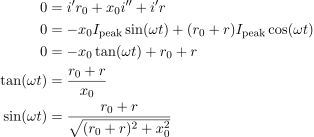
\begin{aligned} 0 & = i'r_0+x_0i''+i'r \\ 0 & = -x_0I_{\textrm{peak}}\sin (\omega t)+(r_0+r)I_{\textrm{peak}}\cos (\omega t) \\ 0 & = -x_0\tan (\omega t) + r_0+r \\ \tan (\omega t) & = \frac{r_0+r}{x_0} \\ \sin (\omega t)&=\frac{r_0+r}{\sqrt{(r_0+r)^2+x_0^2}} \\ \end{aligned}

Thus i(r)=\displaystyle{I_{\textrm{peak}}\frac{r_0+r}{\sqrt{(r_0+r)^2+x_0^2}}}

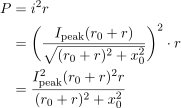
\begin{aligned} P & = i^2r \\ & = \bigg(\frac{I_{\textrm{peak}}(r_0+r)}{\sqrt{(r_0+r)^2+x_0^2}}\bigg)^2 \cdot r \\ & = \frac{I_{\textrm{peak}}^2(r_0+r)^2r}{(r_0+r)^2+x_0^2} \\ \end{aligned}

(to be continued)


Recall the relation between root mean square (rms) values and peak values:

\begin{aligned} V_{\textrm{rms}} & = \frac{V_\textrm{peak}}{\sqrt{2}} \\ I_{\textrm{rms}} & = \frac{I_\textrm{peak}}{\sqrt{2}} \\ \end{aligned}

Recall also that the resistance R_L of an ideal inductor is zero (=0), and that after the circuit has shortly reached steady state (i.e., constant current i anywhere/anytime), the potential difference (\textrm{p.d.}) or voltage drop (\Delta V) across the inductor will become zero (=0) before long.


Try again,

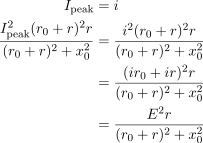
\begin{aligned} I_{\textrm{peak}} & = i \\ \frac{I_{\textrm{peak}}^2(r_0+r)^2r}{(r_0+r)^2+x_0^2} & = \frac{i^2(r_0+r)^2r}{(r_0+r)^2+x_0^2} \\ & = \frac{(ir_0+ir)^2r}{(r_0+r)^2+x_0^2} \\ & = \frac{E^2r}{(r_0+r)^2+x_0^2} \\ \end{aligned}

The derivative test seems inevitable. Maybe you could show that resistance r=\sqrt{r_0^2+x_0^2} maximizes power P, simply by drawing a phasor diagram?

(to be continued)

202206081349 Exercise 4.1 (Q12)

The phase velocity v of a capillary wave with surface tension T and water density p is

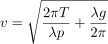
\displaystyle{v=\sqrt{\frac{2\pi T}{\lambda p}+\frac{\lambda g}{2\pi}}}

where \lambda is the wavelength. Find the value of \lambda that minimizes v.

extracted from Michael Corral. (2020). Elementary Calculus.


Setup.

Let v=v(u(\lambda )) s.t.

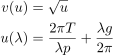
\begin{aligned} v(u) &=\sqrt{u} \\ u(\lambda ) & =\frac{2\pi T}{\lambda p}+\frac{\lambda g}{2\pi } \\ \end{aligned}

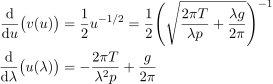
\begin{aligned} \frac{\mathrm{d}}{\mathrm{d}u}\big( v(u)\big) & = \frac{1}{2}u^{-1/2}=\frac{1}{2}\Bigg(\sqrt{\frac{2\pi T}{\lambda p}+\frac{\lambda g}{2\pi}}\Bigg)^{-1} \\ \frac{\mathrm{d}}{\mathrm{d}\lambda}\big( u(\lambda )\big) & = -\frac{2\pi T}{\lambda^2p}+\frac{g}{2\pi} \\ \end{aligned}

Hence,

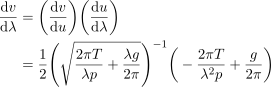
\begin{aligned} \frac{\mathrm{d}v}{\mathrm{d}\lambda} & = \bigg(\frac{\mathrm{d}v}{\mathrm{d}u}\bigg) \bigg(\frac{\mathrm{d}u}{\mathrm{d}\lambda}\bigg) \\ & = \frac{1}{2}\Bigg(\sqrt{\frac{2\pi T}{\lambda p}+\frac{\lambda g}{2\pi}}\Bigg)^{-1}\bigg(-\frac{2\pi T}{\lambda^2p}+\frac{g}{2\pi}\bigg) \\ \end{aligned}


Working.

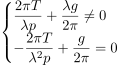
For \displaystyle{\frac{\mathrm{d}v}{\mathrm{d}\lambda}}=0 requires:

\begin{cases} \displaystyle{\frac{2\pi T}{\lambda p}+\frac{\lambda g}{2\pi}} \neq 0 \\ \displaystyle{-\frac{2\pi T}{\lambda^2p}+\frac{g}{2\pi}}= 0 \\ \end{cases}


Answer.

We have the satisfying stationary point:

\lambda_0 =\displaystyle{2\pi\sqrt{\frac{T}{pg}}}.

It remains to be verified that this is a global minimum indeed.

(to be continued)

202206011159 Problem 5E (Q25)

Test each of the following differentials to see whether they are exact, using two methods for each:

(a) -y\sin x\,\mathrm{d}x+\cos x\,\mathrm{d}y,

(b) y\,\mathrm{d}x+x\,\mathrm{d}y,
(c) yx^3e^x\,\mathrm{d}x+x^3e^x\,\mathrm{d}y,
(d) (1+x)ye^x\,\mathrm{d}x+xe^x\,\mathrm{d}y,
(e) 4x^3y^{-2}\,\mathrm{d}x-2x^4y^{-3}\,\mathrm{d}y.

K. S. Stowe. (2007). An Introduction to Thermodynamics and Statistical Mechanics


Revision. (exact differentials)

The differential of a function is given by Eq. (5.8):

\mathrm{d}F=\displaystyle{\frac{\partial F}{\partial x}\,\mathrm{d}x+\frac{\partial F}{\partial y}\,\mathrm{d}y}.

Therefore, one way to determine whether a differential given by Eq. (5.9):

\mathrm{d}\Phi =g(x,y)\,\mathrm{d}x+h(x,y)\,\mathrm{d}y

is exact is to see whether we can find some function F(x,y) such that

\displaystyle{\frac{\partial F}{\partial x}=g(x,y)}\qquad \textrm{and}\qquad\displaystyle{\frac{\partial F}{\partial y}=h(x,y)}.

If we can, the differential is exact, and if we can’t, it is inexact. Alternatively, we can use the identity

\displaystyle{\frac{\partial^2F}{\partial y\partial x}=\frac{\partial^2F}{\partial x\partial y}}.

Combining this with equations (5.8) and (5.9), we can see that for exact differentials, Eq. (5.10):

\displaystyle{\frac{\partial g}{\partial y}=\frac{\partial h}{\partial x}}.

Text on pg. 89, Sec. E, Ch. 5


Roughwork.

(a)

We can see that this is indeed an exact differential of the function

F=y\cos x+\textrm{constant},

because

\displaystyle{\frac{\partial F}{\partial x}=-y\sin x}\qquad\textrm{and}\qquad\displaystyle{\frac{\partial F}{\partial y}=\cos x}.

Or we can use Eq. (5.10). For this example g=-y\sin x and h=\cos x, so

\displaystyle{\frac{\partial g}{\partial y}=-\sin x}\qquad\textrm{and}\qquad\displaystyle{\frac{\partial h}{\partial x}=-\sin x}.

The two are the same, so the differential is exact.


Parts (b) to (e) are left to the reader as an exercise. Cf. analytic functions et Cauchy-Riemann equations.