
Exercises 1-8, show that the given function  is one-to-one over the given interval, then find the formulae for the inverse function
  and its derivative.
1. 
2. 
3. 
4. 
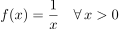
5. 
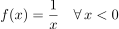
6. 
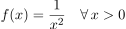
7. 
8. 
Extracted from Michael Corral. (2020). Elementary Calculus.
Background. (one-to-one; inverse; derivative of an inverse)
A one-to-one function (aka injection/injective function) is a function  that maps distinct elements to distinct elements; i.e.,
  , or equivalently in the contrapositive that
  . Not to be confused with one-to-one correspondence that refers to bijection.
Wikipedia on Injective function
The inverse function of a function (aka inverse of ) is a function that undoes the operation of . The inverse of exists if and only if is bijective, and if it exists, is denoted by . For a function  , its inverse
  admits an explicit description: it sends each element
  to the unique element
  such that
  .
.
Wikipedia on Inverse function
If is differentiable and has an inverse function  , then is differentiable and its derivative is
 .
.
Text on pg. 38, Sec. 2.1, Ch. 2
1.
:
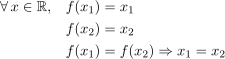

 is injective/one-to-one.
In order for an inverse  to exist, the original function
  must be bijective (et injective et surjective). It remains to check whether or not is surjective.
A function is said to be surjective if  . In other words, every element of the function’s codomain is the image of at least one element of its domain.
Wikipedia on Surjective function
Assume  is a real-valued function, i.e.,
  given by
  . Obviously is surjective. Thus it is bijective enough to have an inverse
  . And apparently is given by , such that
  . Its derivative is
  .
.
The remaining questions are left the reader.